Computer Architecture Fundamentals
Introduction to Computer Architecture
The Brains of the Machine
Think of a computer not as a single object, but as a team of specialists working together. Computer architecture is the blueprint that shows how these specialists are organized and how they communicate. It's the master plan that makes everything from your phone to a supercomputer work.
At the heart of this team are three main players: the processor, the memory, and the input/output devices. Each has a distinct job, but they are all constantly interacting.
At its core, a computer has a brain to think (CPU), a workspace to hold things (Memory), and ways to talk to the outside world (I/O).
The Central Processing Unit (CPU) is the brain. It's the component that performs calculations and executes commands. If you tell a computer to add 2 + 2, the CPU is what figures out the answer is 4. It's the tireless worker that carries out every instruction in a program, from opening an app to rendering a video.
The Memory, often called RAM (Random Access Memory), is the CPU's short-term workspace. It's like a desk where the CPU places the data and instructions it needs right now. Memory is incredibly fast, allowing the CPU to grab information instantly. However, it's also volatile, meaning it forgets everything when the power is turned off. This is different from storage (like a hard drive or SSD), which is more like a file cabinet for long-term safekeeping.
Finally, Input/Output (I/O) devices are the computer's senses and voice. Input devices let you give the computer information. Your keyboard, mouse, and microphone are all input devices. Output devices let the computer give you information back. The monitor, speakers, and printer are common output devices.
The Von Neumann Blueprint
How do these pieces fit together? Most modern computers follow a design called the von Neumann architecture. This elegant concept, developed by mathematician John von Neumann and others in the 1940s, solved a major problem for early computers.
The key idea is simple but revolutionary: the instructions a computer follows (the program) and the data it works with are stored together in the same memory. Think of it like a chef using a single countertop for both their recipe book (the instructions) and their ingredients (the data). The chef can easily grab an ingredient, then look at the next step in the recipe, all from the same workspace.
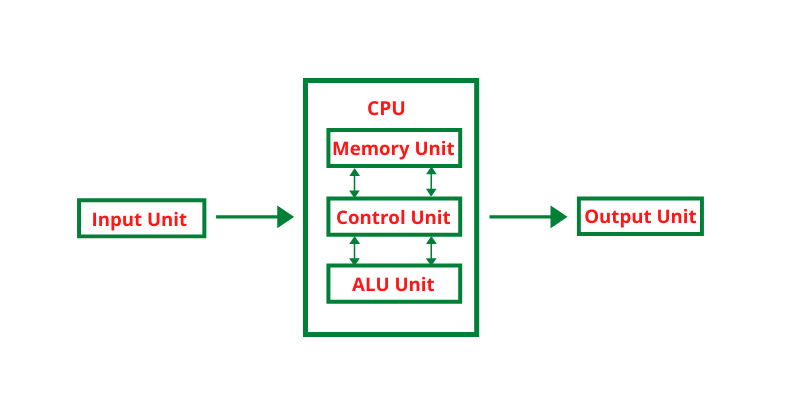
Before this, computers often had separate, dedicated storage systems for programs and data. This was inefficient and made it very difficult to change the computer's task. You practically had to rewire the machine to run a different program.
The von Neumann architecture created the idea of the "stored-program computer." By placing the program in memory, changing the computer's function became as simple as loading a different program. This flexibility is the foundation of modern computing, allowing a single device to be a word processor one moment and a gaming console the next.
This simple blueprint of a CPU connected to a single memory that holds both programs and data is the basis for nearly every computer you've ever used.