Computational Fluid Dynamics Fundamentals and Practice
CFD Mathematical Foundations
The Rules of Flow
Fluid motion can seem chaotic. Think of swirling smoke, a crashing wave, or the air rushing over a car. But underneath this complexity, fluids follow a strict set of rules. These aren't arbitrary regulations; they are fundamental physical laws that govern how all matter behaves. In the world of fluid dynamics, these rules are known as conservation laws.
Computational Fluid Dynamics (CFD) is essentially a way to solve the mathematical equations that represent these laws. To understand CFD, you first need to understand the three core principles it's built upon: the conservation of mass, momentum, and energy. Everything starts here.
The core idea is simple: you can't create or destroy mass, momentum, or energy out of thin air. You can only move them around or change their form.
Keeping Track of Mass
The law of mass conservation states that mass is never lost. If you pour water into a pipe, the amount of water coming out the other end must equal the amount you put in, unless some is stored inside. It can't just vanish.
In fluid dynamics, we apply this idea to an infinitesimally small volume of fluid. The rate at which mass enters this tiny volume, minus the rate at which it leaves, must equal the rate at which the mass inside the volume changes. This balance is expressed mathematically by the continuity equation.
Together, these terms must equal zero. If more fluid flows out of a region than flows in, the density inside that region must decrease to compensate, and vice versa. It’s a perfect accounting system for “stuff”.
Motion and Forces
Next, we consider momentum. You might remember Newton's Second Law from physics: Force equals mass times acceleration (). The law of momentum conservation is just Newton's Second Law applied to fluids. It states that the rate of change of a fluid's momentum is equal to the sum of the forces acting on it.
What forces act on a fluid? The main ones are:
- Pressure forces: A region of high pressure pushes fluid toward a region of low pressure.
- Viscous forces: This is essentially fluid friction. Honey has high viscosity; air has low viscosity.
- Body forces: These act on the entire volume of the fluid, like gravity.
Combining these forces with the principle of momentum conservation gives us the famous Navier-Stokes equations. They are the centerpiece of fluid mechanics.
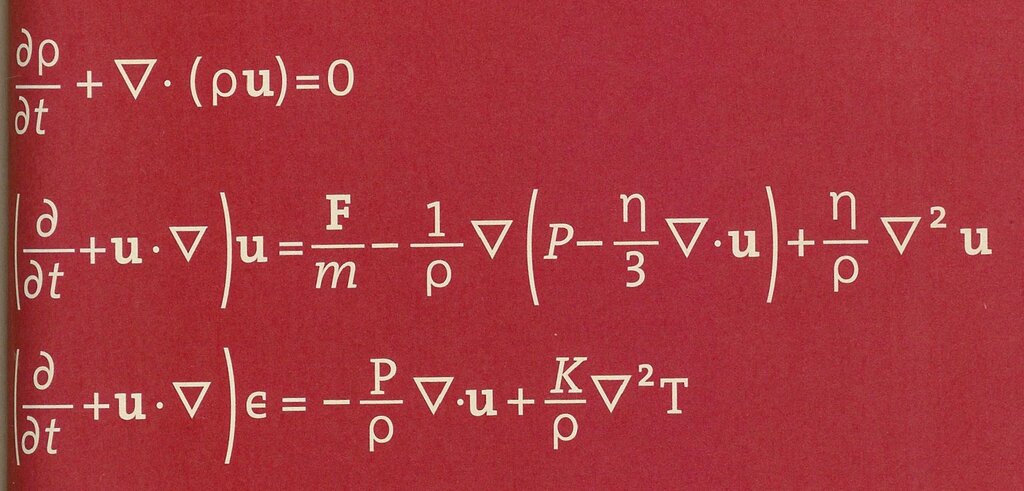
The full set of equations is quite complex, but let's look at the core momentum equation.
The Navier-Stokes equations, which include both the continuity and momentum equations, provide a complete description of a fluid's motion. Solving them tells you the fluid's velocity and pressure everywhere in your domain.
Making Problems Solvable
Solving the full Navier-Stokes equations is incredibly difficult, even for a supercomputer. For many practical problems, we don't need that level of detail. Instead, we can make simplifying assumptions that make the math much more manageable without sacrificing accuracy for the specific problem at hand.
The art of engineering is often knowing what you can safely ignore.
Two of the most common assumptions are incompressibility and steady-state flow.
Incompressible Flow
For many fluids, like water or air at low speeds, the density doesn't change much. We can assume the density is constant. This is the incompressibility assumption.
When we do this, the continuity equation simplifies dramatically. Since is constant, its change over time () is zero. The equation becomes:
Steady-State Flow
In many situations, the overall flow pattern doesn't change over time. Think of water flowing smoothly in a river or air moving over a wing in cruise flight. This is called steady-state flow.
Under this assumption, any term that represents a change with respect to time () becomes zero. In the momentum equation, the local acceleration term disappears, simplifying the left side of the equation. This turns a time-dependent problem into a static one, which is much easier to solve.
These assumptions, along with others related to energy and turbulence, are critical tools. They allow us to apply the power of the Navier-Stokes equations to real-world engineering challenges.
What are the three fundamental conservation laws that form the basis of Computational Fluid Dynamics (CFD)?
The law of momentum conservation is essentially an application of which fundamental law of physics to fluids?
Understanding these foundational laws is the first step toward mastering CFD. Next, we'll see how these continuous equations are adapted for a computer.