CompTIA Network Plus OSI Model
Network Communication Fundamentals
The Digital Postal Service
Getting a message from your computer to another across the world is a lot like sending a letter. The global postal system works because every country agrees on a set of rules. Your letter goes into an envelope with an address, gets picked up, sorted at a post office, travels by truck or plane, and is finally delivered. The system relies on everyone following the same procedure.
Computer networks operate on a similar principle. Your computer is like a house, and another computer is the destination. The connections between them, whether physical cables or wireless signals, are the roads and flight paths. Each device in the network, like a router or switch, acts as a post office, directing traffic. These devices are called nodes in networking.
Protocol
noun
A set of rules or procedures for transmitting data between electronic devices, such as computers.
For this digital postal service to work, every device needs to speak the same language and follow the same rules. These rules are called protocols. Without them, a message sent from an Apple computer might be complete gibberish to a Windows PC. To solve this, experts created a universal framework.
A Universal Rulebook
The framework that ensures different devices can communicate is called the . Think of it as a seven-step instruction manual for networking. It breaks down the complex process of sending data into seven distinct layers. Each layer has a specific job, and they all work together in order.
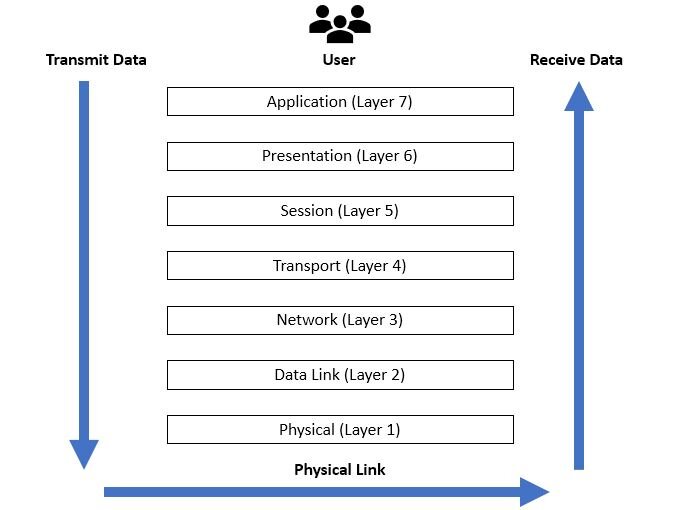
This layered approach makes it easier to design and troubleshoot networks. If there's a problem, you can pinpoint which layer is causing the issue. For example, if a cable is unplugged, the problem is at Layer 1, the Physical Layer. If your web browser can't load a page but you can still receive emails, the issue might be at Layer 7, the Application Layer.
Wrapping the Data
When you send data, it doesn't just go out as one big chunk. It gets packaged for its journey. This process is called encapsulation. Imagine you're sending a small gift. You first put the gift in a box. Then, you wrap that box and add a shipping label. Finally, that package might be placed in a larger container on a delivery truck.
Encapsulation works the same way. Your data (the gift) starts at the top of the OSI model (Layer 7) and moves down. At each layer, a piece of information called a header is added. This header contains instructions specific to that layer, much like a shipping label or handling instructions.