Comprehensive Youth Swimming Progression
Streamline and Breathing
The Perfect Streamline
Think of the fastest things in the water: a torpedo, a dolphin, a competitive swimmer pushing off a wall. They all have one thing in common. They are perfectly streamlined. A good streamline is the foundation of efficient swimming. It's not just about getting into a tight position; it's about actively minimizing the water you have to push out of the way. This resistance is called hydrodynamic drag and it's your biggest enemy in the pool. The less drag you create, the faster and farther you'll go with every single kick and pull.
Achieving a perfect streamline is an active process. Start by locking your hands, one over the other, with your thumb wrapped around to keep them secure. Squeeze your biceps tightly against your ears to create a pointed 'nose cone' with your arms. Your core should be braced, your back flat, and your toes pointed to create one long, taut line. It’s a feeling of being stretched and tight from your fingertips to your toes.
If you’re not streamlined and balanced in the water, you’ll create more drag and resistance, which will slow you down and tire you out.
Breathing Without Sinking
All that hard work creating a perfect streamline can be undone in an instant with a bad breath. The most common mistake swimmers make is lifting their head to breathe. Remember basic physics: when one end goes up, the other end goes down. Lifting your head, even slightly, will cause your hips to sink like a stone, destroying your horizontal body position and creating massive drag.
The key is to maintain a neutral head alignment. Imagine you have a stick running down your spine and through the back of your head. Your head should rotate along that axis, not lift off of it. You turn your head just enough for your mouth to clear the water, take a quick breath, and turn it right back down.
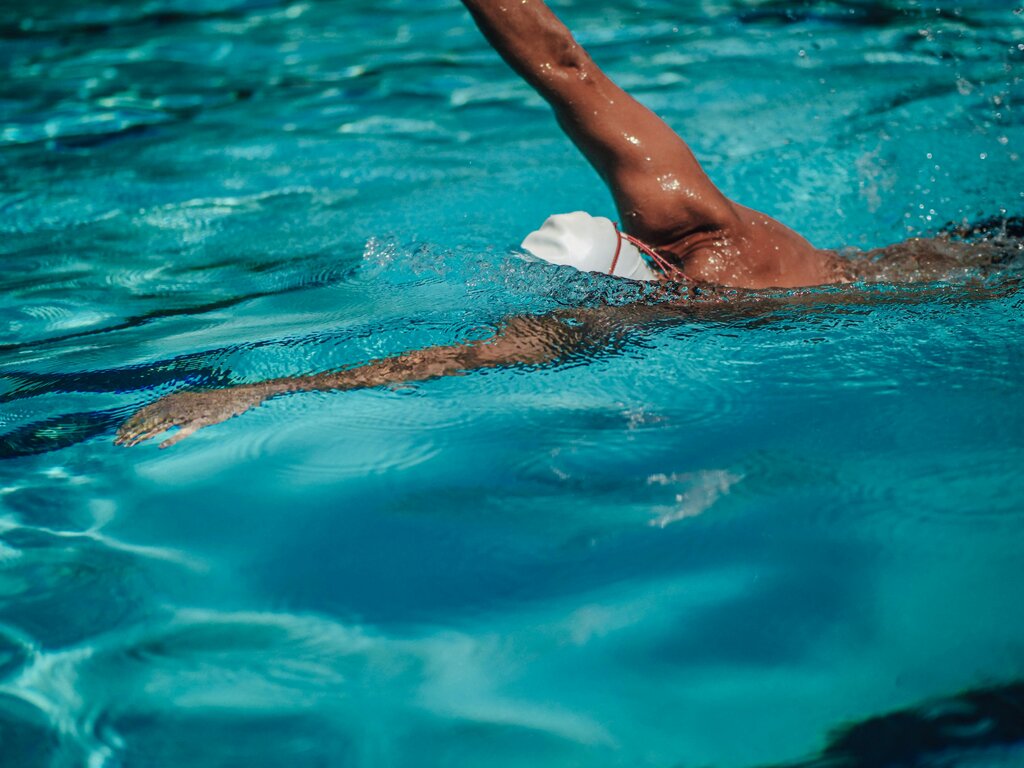
To support this balance, competitive swimmers practice bilateral breathing—breathing to both the left and right sides. A common pattern is to breathe every three strokes, which alternates your breathing side automatically. This builds a symmetrical stroke, prevents muscle imbalances in your neck and shoulders, and improves your awareness of what’s happening on both sides of you in a race.
The golden rule for breathing: keep one goggle in the water, and one goggle out. This ensures your head stays low and aligned.
Master Your Exhale
What goes in must come out. Just as important as how you inhale is how you exhale. Holding your breath creates tension and buoyancy problems in your chest, making your body ride unnaturally high. A continuous exchange of air is crucial for relaxed, rhythmic swimming. There are two main methods for exhaling.
| Technique | Description | Best For |
|---|---|---|
| Trickle Breathing | A slow, steady stream of bubbles exhaled continuously while your face is in the water. | Distance swimming, maintaining a relaxed rhythm. |
| Explosive Breathing | Holding your air, then forcefully exhaling everything just before turning your head to inhale. | Sprinting, getting a full air exchange quickly. |
For most swimming, especially for developing good habits, trickle breathing is preferred. It keeps your body relaxed and ensures you’re ready to inhale the moment your mouth clears the water. You should be humming or making a steady stream of bubbles the entire time your face is submerged. Explosive breathing is a more advanced technique used for all-out sprints where every fraction of a second counts.
What is the primary force that a good streamline is designed to minimize?
According to physics, what is the immediate consequence of a swimmer lifting their head to breathe?
Mastering your streamline and breathing is a constant process. By focusing on a taut body line and a rhythmic, relaxed breath, you build the essential foundation for fast and efficient swimming in any stroke.