Comprehensive Yoga Asana Progression
Alignment and Bio-mechanics
The Architecture of Asana
Proper alignment is more than just looking good in a pose. It’s about building a stable, efficient structure with your body. Think of it like architecture. To build a strong tower, you stack the blocks directly on top of one another. Your body works the same way. The principle is called joint stacking.
When you align your skeleton effectively, your bones bear the load, allowing your muscles to work efficiently rather than strain to hold you up.
In standing poses, this creates a vertical line of energy. Imagine a plumb line dropping from your earlobe straight down through your shoulder, hip, knee, and ankle. This is your body's central axis. When these points are stacked, you find a sense of lightness and stability. Your center of gravity is balanced over your base of support, requiring minimal muscular effort to stay upright.
This perfect line is an ideal, not a rigid rule. Our bodies aren't made of perfectly uniform blocks. The goal is to develop an awareness of this line and make constant, subtle 'micro-adjustments' to navigate toward it. This internal listening process is what protects your joints from strain, especially under load.
The Body's Chain Reaction
Your body isn't a collection of separate parts; it's an integrated system. In biomechanics, this is understood through an idea that movement in one joint impacts others up and down the line. Poses are a full-body experience. What you do with your feet has a direct effect on your hips and spine.
Consider a weight-bearing pose like Warrior II. You press down through the outer edge of your back foot (grounding), which creates a chain reaction of stability. This action engages the muscles of the leg, firms the thigh, helps square the hips to the side, and ultimately provides a solid foundation for the torso to lift and the arms to extend. A lazy back foot leads to a collapsed pose.
Function Over Form
It's easy to get caught up in making a pose look like a picture in a book. But everyone's skeleton is different. Your hip sockets might be deep or shallow, angled forward or to the side. Your femur bones might have a different rotation. These variations mean your Warrior II will never look exactly like someone else's, and it shouldn't.
Prioritize Proper Alignment Poor alignment is a major culprit behind yoga-related injuries.
Some styles, like Iyengar yoga, use rigid alignment and props to teach the precise actions of a pose. This builds incredible body awareness. Other approaches prioritize functional mobility, allowing for more variation to suit individual anatomy. The key is to find what works for your body. The goal isn't aesthetic perfection; it's structural integrity. Are your joints safe? Is the pose sustainable? Are you building strength in a balanced way?
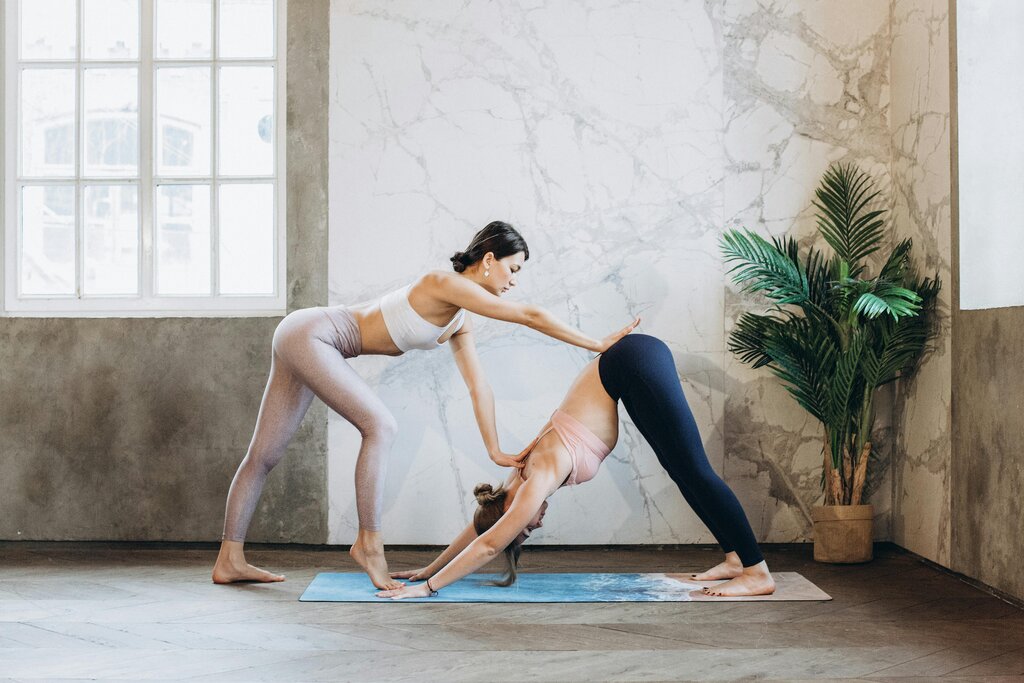
A crucial element in finding this integrity is understanding your pelvis. The concept of a is central. In a standing position, this means your anterior superior iliac spine (the two bony points at the front of your hips) and your pubic bone are in the same vertical plane. This allows for the natural curves of your spine to be maintained.
From this neutral base, you can work on spinal extension, or creating length in the spine. This isn't about forcing an arch but about creating space between each vertebra. In a forward fold, you'd hinge from the hips while maintaining this length, rather than rounding from the lower back. This protects your intervertebral discs and teaches your body to move from its powerful center.
Let's review the key terms we've covered.
Now, let's test your knowledge.
What is the primary purpose of 'joint stacking' in yoga poses?
The idea that pressing down through the outer edge of your back foot in Warrior II can help stabilize your hips and torso is an example of what biomechanical principle?
Understanding these principles of biomechanics shifts your practice from imitation to integration. You learn to build poses from the inside out, creating a practice that is safer, stronger, and uniquely your own.