Comprehensive School Mathematics Mastery
Basic Arithmetic
The Four Basic Operations
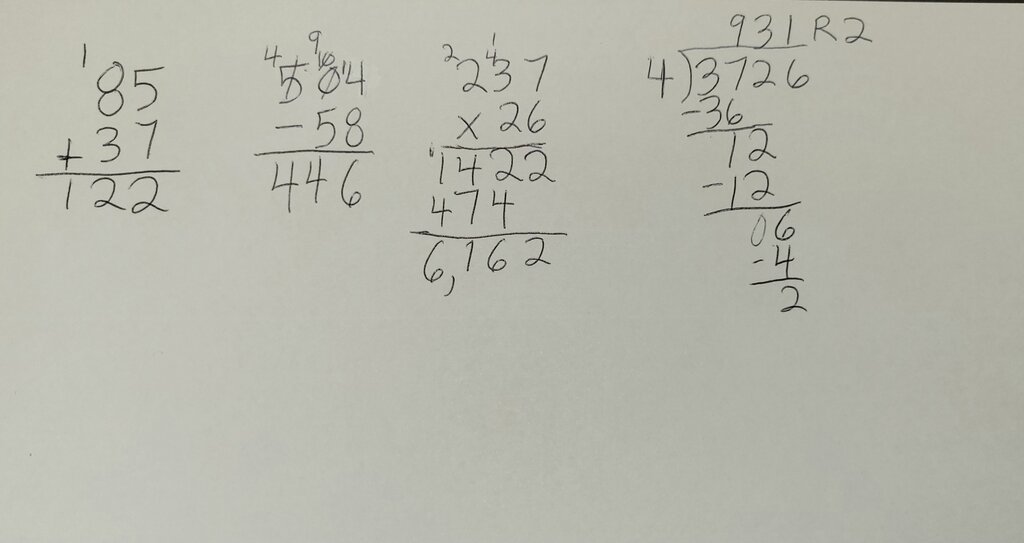
At the heart of math are four simple ideas: adding, subtracting, multiplying, and dividing. Everything else builds on these.
Addition is just combining things. If you have 3 apples and you get 2 more, you add them together to find the total. $3 + 2 = 5$. Subtraction is the opposite; it's about taking things away. If you start with 5 apples and eat 2, you have 3 left. $5 - 2 = 3$.
Notice how addition and subtraction are linked? They undo each other. This makes them inverse operations.
Multiplication is a shortcut for repeated addition. Instead of writing , you can just write . The answer is 12. It’s a faster way to handle equal-sized groups.
Division is the inverse of multiplication. It's about splitting a total into equal groups. If you have 12 apples and want to share them among 3 friends, each friend gets 4 apples. This is written as .
Just like subtraction undoes addition, division undoes multiplication. If you know that , you also know that .
Numbers Beyond Whole
Whole numbers work well for counting whole things, but what about parts of things? That's where fractions and decimals come in.
A fraction represents a part of a whole. If you slice a pizza into 8 equal pieces and take 1, you have of the pizza. The bottom number (denominator) tells you how many equal parts the whole is divided into, and the top number (numerator) tells you how many of those parts you have.
Decimals are another way to write fractions, specifically fractions based on powers of ten (like 10, 100, 1000). The decimal point separates the whole number part from the fractional part. For example, the decimal 0.5 is the same as the fraction , and 0.75 is the same as .
The Rules of the Road
Arithmetic operations follow a few simple, consistent rules. Knowing them makes calculations easier and more predictable.
The Commutative Property says you can swap the order of numbers in addition and multiplication without changing the result. Think of it like grocery shopping: it doesn't matter if you put the apples or the bananas in your cart first, you end up with the same groceries.
The Associative Property is about grouping. For addition and multiplication, you can change how numbers are grouped without affecting the outcome. If you're adding three numbers, you can add the first two and then the third, or you can add the second two and then the first. The total will be the same.
Finally, the Distributive Property connects multiplication and addition. It says that multiplying a number by a group of numbers added together is the same as doing each multiplication separately.
This property is incredibly useful. For instance, to calculate , you could think of it as . This becomes , which is , or 612. It's a great trick for mental math.
Time to check your understanding.
Which operation is the inverse of multiplication?
The calculation is an example of which property?
These four operations and their properties are the building blocks for all of mathematics. Mastering them is the first step toward tackling more complex problems.