Comprehensive Digital Marketing Mastery
Introduction to Digital Marketing
What Is Digital Marketing?
At its core, digital marketing is simply marketing done on a digital device. It’s the process of promoting a product, service, or brand to potential customers through the internet and other forms of digital communication. Think of it as the evolution of the conversations businesses have always had with their customers.
Traditional marketing often felt like a one-way street. A company would run a TV commercial or place an ad in a magazine, shouting its message to a broad audience. There was no easy way for the audience to talk back.
Digital marketing changed that. It’s a two-way conversation. When a brand posts on social media, customers can comment, ask questions, and share their opinions instantly. This direct interaction is what makes it so powerful. Businesses are no longer just talking at people; they're talking with them in the places they already spend their time, like social media feeds, email inboxes, and search engines.
The key benefit of digital marketing is the ability to reach the right audience, with the right message, at the right time, on the right device.
The Digital Marketing Toolkit
A successful digital marketing strategy doesn't rely on just one method. Instead, it combines several different channels, each with its own strengths. Think of it like a toolkit, where each tool has a specific job. Here are some of the most important tools in the kit.
Search Engine Optimization
noun
The practice of increasing the quantity and quality of traffic to your website through organic search engine results.
Often called SEO, this is all about making your website more visible on search engines like Google. When you search for "best running shoes," the sites that appear at the top didn't get there by accident. They were optimized so the search engine recognizes them as a relevant and trustworthy answer to your question. Good SEO is like having your store on the busiest street in town.
Content Marketing
noun
A marketing strategy focused on creating and distributing valuable, relevant, and consistent content to attract and retain a clearly defined audience.
Instead of directly pitching your products, you provide genuinely useful content that helps your audience solve their problems. A cookware company might create video recipes. A software firm could publish guides on improving productivity. The goal is to build trust and establish your brand as a helpful expert. When the time comes to buy, customers will remember the brand that helped them.
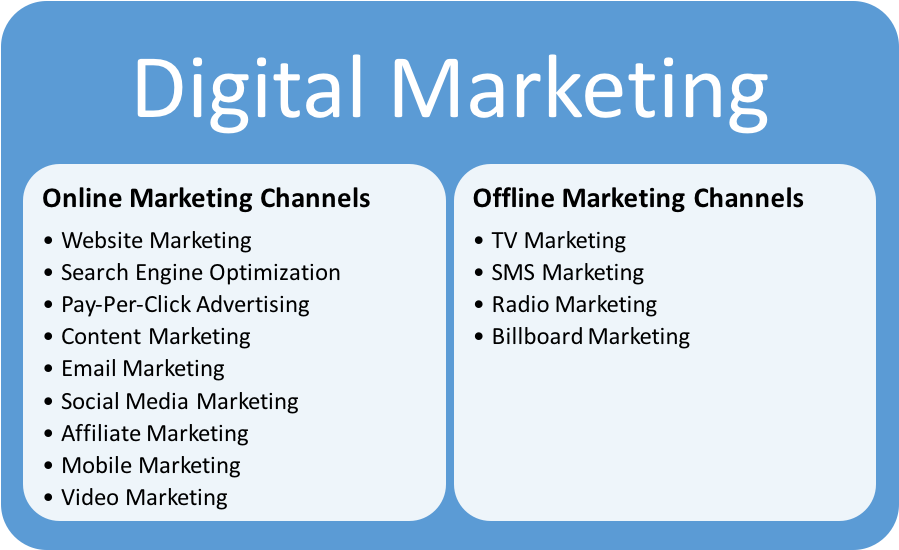
Social Media Marketing involves using platforms like Instagram, TikTok, Facebook, and LinkedIn to build a community, interact with customers, and share content. Each platform has its own audience and style, so the key is to be authentic and engaging.
Email Marketing is a way to communicate with your audience directly in their inbox. It's used for everything from sending newsletters and promotional offers to confirming orders. Because people have to opt-in to receive emails, it's a highly personal and effective channel for building loyalty.
Pay-Per-Click (PPC) Advertising is when you pay for your ads to appear on search engines or other websites. The most common type is a search ad, which appears at the top of Google results. You only pay when someone actually clicks on your ad, making it a targeted way to drive traffic to your site.
Marketing Automation uses software to handle repetitive marketing tasks. For example, it can automatically send a welcome email to a new subscriber or post to social media at a scheduled time. This frees up marketers to focus on strategy and creative work.
Putting It All Together
These components aren't meant to work in isolation. A truly effective strategy integrates them into a cohesive whole, where each channel supports the others.
For example, you could create a helpful blog post (content marketing) and then promote it on social media (social media marketing). To get access to a more detailed guide, visitors might provide their email address, allowing you to follow up with a newsletter (email marketing).
The biggest advantage of this integrated approach, and digital marketing in general, is measurability. With traditional advertising, it was hard to know exactly how many people saw your billboard and then visited your store. With digital tools, you can track almost everything. You can see how many people opened your email, clicked on your ad, or visited your website. This data allows you to see what’s working and what isn’t, so you can adjust your strategy in real-time.
| Feature | Traditional Marketing | Digital Marketing |
|---|---|---|
| Reach | Broad, often untargeted (e.g., TV) | Highly targeted (e.g., ads by interest) |
| Interaction | One-way communication | Two-way conversation |
| Measurement | Difficult to track direct results | Highly measurable and data-driven |
| Cost | Often high initial investment | Scalable, can start with a small budget |
| Speed | Slow to change or update | Campaigns can be adjusted instantly |
This ability to measure performance and engage directly with customers makes digital marketing an essential part of any modern business. It levels the playing field, allowing even small businesses to compete with large corporations for their audience's attention.
What is the key characteristic that distinguishes digital marketing from traditional marketing?
Which digital marketing strategy focuses on making a website more visible in non-paid search engine results?