Comprehensive Class 11 Hydrocarbons Mastery
Alkane Properties and Nomenclature
Saturated Hydrocarbons
Alkanes are the simplest family of organic molecules, consisting only of carbon and hydrogen atoms connected by single bonds. This makes them “saturated” — each carbon atom is bonded to the maximum possible number of other atoms. This bonding arrangement comes from a process called sp3 hybridization, where one s orbital and three p orbitals in the carbon atom mix to form four identical hybrid orbitals.
These sp3 orbitals arrange themselves in a tetrahedral geometry, with bond angles of 109.5°, to minimize repulsion. This shape is fundamental to all alkanes, from the simplest methane () to complex, branching chains. The single C-C bonds (called sigma bonds) are stable and allow for free rotation, which gives alkane molecules their flexibility.
Naming the Branches
As alkanes get larger, they can form isomers: molecules with the same chemical formula but different structural arrangements. For example, can be either a straight chain (butane) or a branched chain (isobutane). To tell them apart, we need a consistent naming system.
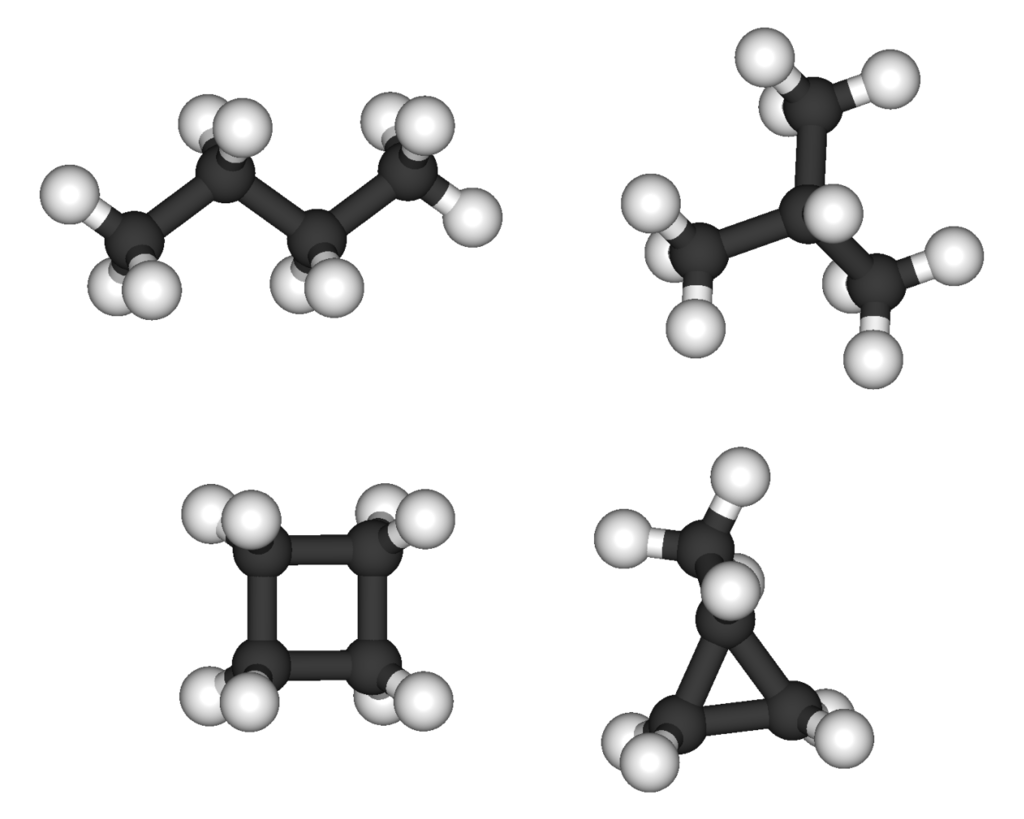
The IUPAC nomenclature system provides a set of rules for naming organic compounds unambiguously. For branched alkanes, the process involves a few key steps.
- Find the parent chain: Identify the longest continuous chain of carbon atoms.
- Number the chain: Start numbering from the end that gives the substituent groups the lowest possible numbers.
- Name the substituents: Name each branch (alkyl group) attached to the parent chain.
- Assemble the name: List substituents alphabetically, using prefixes (di-, tri-, tetra-) for multiples of the same group. Place numbers before each substituent to indicate its position.
Let's name an example molecule.
The longest chain has six carbons, so the parent name is hexane. We number from the right to give the substituents the lowest numbers (2, 3, and 4). There are two methyl groups and one ethyl group. Alphabetically, ethyl comes before methyl.
The final name is 3-ethyl-2,4-dimethylhexane.
Physical Properties
Alkanes are nonpolar molecules because the electronegativity difference between carbon and hydrogen is very small. This has a major impact on their physical properties, like boiling point and solubility. Since they lack charged regions, alkanes don't dissolve well in polar solvents like water. The rule of thumb is "like dissolves like"; nonpolar alkanes dissolve in other nonpolar solvents.
The main force of attraction between alkane molecules is a type of intermolecular force called (specifically, London dispersion forces). These are temporary, weak attractions caused by fleeting shifts in electron density around the molecules.
The strength of these forces depends on two main factors: surface area and molecular shape.
Larger molecules have higher boiling points. More surface area means more points of contact for Van der Waals forces to act, requiring more energy (a higher temperature) to pull the molecules apart into a gas.
Branched molecules have lower boiling points than their straight-chain isomers. Branching makes a molecule more compact and spherical, reducing its surface area. This weakens the Van der Waals forces between molecules.
| Alkane | Formula | Boiling Point (°C) |
|---|---|---|
| Methane | -161.5 | |
| Ethane | -88.6 | |
| Propane | -42.1 | |
| Butane | -0.5 | |
| Isobutane | -11.7 |
Understanding these trends is crucial. They explain why methane is a gas at room temperature, while octane (), a component of gasoline, is a liquid, and paraffin wax (with 20 or more carbons) is a solid.
Let's check your understanding of these core concepts.
What type of orbital hybridization is characteristic of carbon atoms in alkanes?
Why do alkanes have relatively low boiling points and are insoluble in water?
These principles of structure, naming, and physical properties form the foundation for understanding all other families of organic compounds.