Complexity of the Medieval World
Post-Roman Power Shifts
A New Order Forms
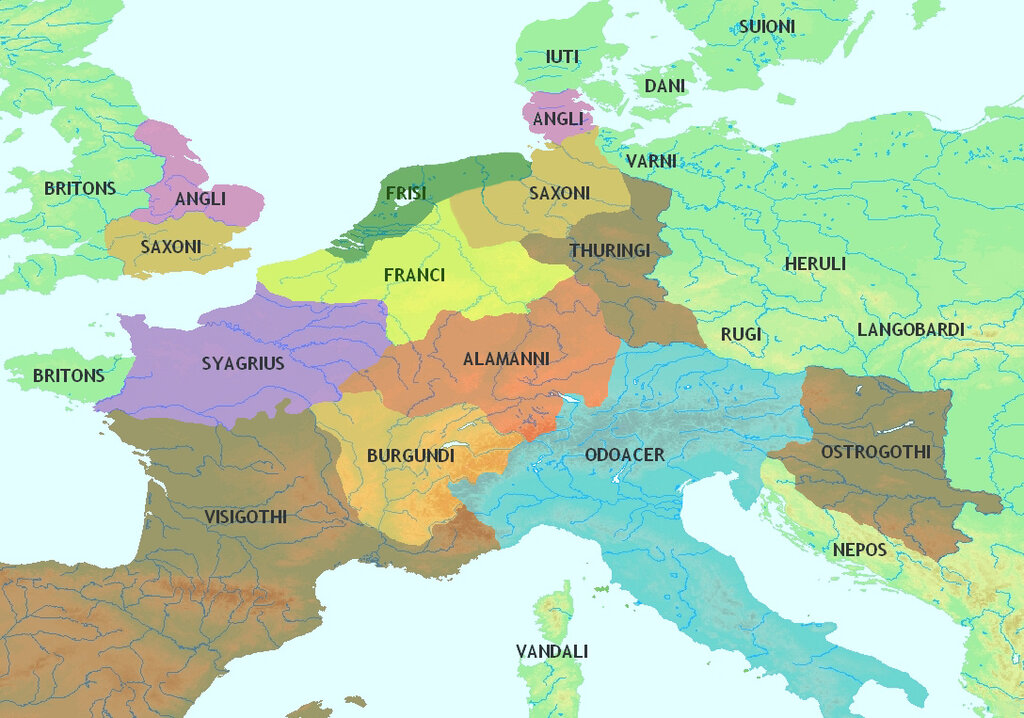
The end of Roman central authority in the West wasn't a sudden collapse but a slow, messy transformation. Power didn't disappear; it simply changed hands and splintered. Local Roman aristocrats and newly arrived Germanic kings stepped into the vacuum, creating a patchwork of successor kingdoms. These new rulers were often admirers of Roman culture. They didn't seek to erase the old world but to claim its prestige and repurpose its systems for their own use. The result was a fusion of two very different worlds: the sophisticated, bureaucratic legacy of Rome and the personal, loyalty-based traditions of Germanic tribes.
Law of the Land
One of the clearest examples of this blend was in law. Roman law was written, universal, and applied to citizens based on territory. It dealt with abstract concepts of state and property. Germanic law, on the other hand, was customary and personal. It was an unwritten set of traditions carried in the memory of the community. Justice was often a private affair between families, resolved through blood feuds or payments. A key concept was wergild, a sum of money paid to a victim's family to stop a cycle of revenge. Your wergild depended on your social rank. A noble's life was worth more than a peasant's.
Instead of a single, imperial legal code, people were often judged by the law of their own people, a principle known as personal law. A Frank would live under Frankish law, while his Gallo-Roman neighbor lived under a simplified version of Roman law, even within the same kingdom.
As Germanic kings like Clovis established their rule, they began to write down their laws, often in Latin, the language of Roman administration. The content, however, remained deeply Germanic. For instance, the of the Franks was a detailed list of fines for specific offenses, from stealing a pig to murder. It was Roman in form, a written code, but Germanic in spirit, focused on compensation rather than abstract justice.
From Villa to Manor
The economy changed just as dramatically. The vast, interconnected trade network of the Roman Empire crumbled, making long-distance commerce risky and expensive. Life became intensely local. The Roman system, large agricultural estates owned by wealthy aristocrats, adapted to this new reality.
With cities shrinking and central authority gone, these estates became the primary centers of power, production, and protection. Local landowners, both Roman holdovers and Germanic newcomers, offered peasants security in exchange for their labor. The peasants, who were once small independent farmers or tenants, gradually became tied to the land. This wasn't the fully-formed manorial system of the High Middle Ages, but the seeds were planted. The focus shifted from producing cash crops for a wide market to self-sufficiency.
Kings and Warlords
The nature of political power also transformed. A Roman emperor's authority was impersonal and bureaucratic, tied to the institution of the state. A Germanic king's power was intensely personal. It was based on his ability to win battles, reward his followers, and command their loyalty. This relationship between a leader and his elite warriors is captured by the concept of the , a Latin term for the Germanic warband.
In the comitatus, warriors swore personal loyalty to a chieftain, fighting for him in exchange for protection, weapons, and a share of the spoils. This was not a contract or a salary, but a deep, personal bond. The Merovingian kings of the Franks, for example, ruled as the most powerful chieftains. Their kingdom was treated as personal property, to be divided among their sons upon their death. This constant division of territory led to instability and civil war, a stark contrast to the Roman ideal of an indivisible Republic or Empire.
Germanic invasions helped to break up the Roman Empire and set the stage for the development of feudal and manorial systems.
This system of personal loyalty, where land and wealth were granted in exchange for military service, laid the essential groundwork for what would later evolve into feudalism. The centralized, tax-based state of Rome gave way to a decentralized world where power was held by those who could command the loyalty of armed men and control the land they lived on.