Complexity and the Dynamics of Attention
Attention as Emergence
From Resource to Phenomenon
We often talk about attention as a resource, something to be spent or saved. But what if it's less like a currency and more like a weather pattern? Attention isn't a single thing located in one part of the brain. It's a macroscopic property that emerges from the dizzying interaction of countless smaller parts.
Think of the wetness of water. A single H₂O molecule isn't wet. Wetness is a property that only appears when you have billions of them interacting. Attention is the 'wetness' of cognition.
This perspective treats attention as an emergent phenomenon of a complex adaptive system—in this case, your brain interacting with its environment. The focused state you experience isn't something a single neuron can possess. It arises from the self-organizing dance of neural circuits, sensory inputs, and internal goals. This collective activity creates a global pattern of focus that couldn't be predicted by examining any single component in isolation.
Two Flavors of Emergence
In cognition, emergence isn't a one-size-fits-all concept. It happens in at least two distinct ways: synchronically and diachronically.
is the magic of the now. It's how simultaneous interactions between many components create a higher-level pattern at a single point in time. A flash of insight, the recognition of a face in a crowd, or the feeling of being engrossed in a task are all synchronic. They are system-level states that exist because of the concurrent firing of millions of neurons, not before or after.
Diachronic emergence, on the other hand, unfolds over time. It's a pattern that results from a historical process. The development of a skill, like learning to ride a bike, is a diachronic process. Each moment of practice changes the system, making future states (like effortless balance) more likely. Your long-term attentional habits are a product of diachronic emergence, shaped by years of reinforcement and adaptation.
The Brain's Self-Portrait
So if attention is an emergent process, why does it feel like a spotlight we control? According to the Attention Schema Theory (AST), this feeling is itself a construct. The brain doesn't just have attention; it builds a simplified, useful model of its own attentional state. This "attention schema" is a constantly updated representation of what the brain is currently processing most deeply.
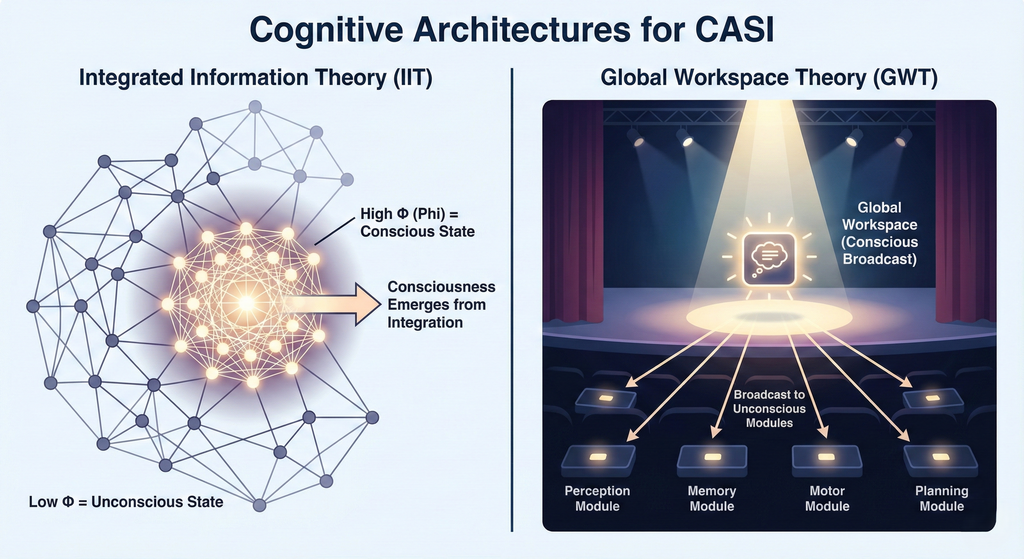
This schema is what gives us the subjective experience of focusing. It's a self-organizing representation that helps us predict and control our own cognitive state. This model isn't just about what's happening inside the skull. It integrates our body's orientation, our sensory inputs, and the environmental cues we're responding to. This connects directly to the principles of —the idea that the mind is Embodied, Embedded, Enacted, and Extended. Our attention is not a purely internal faculty; it's a property of the whole agent-environment system.
Let's review these new concepts before testing your understanding.
Now, let's see how well you've grasped these ideas.
According to the text, viewing attention as a 'weather pattern' rather than a 'currency' emphasizes that attention is:
A musician having a sudden 'flash of insight' about a difficult musical passage is an example of synchronic emergence.
Viewing attention as an emergent property changes how we approach focus and distraction. It suggests that managing our attention isn't just an act of willpower, but an act of designing our environment and interactions to foster the cognitive patterns we want.