Complex Web Application Architecture
Core Architectural Patterns
Beyond the Code: Choosing Your Architecture
Building an application is like building a city. You don't just start laying bricks. First, you need a city plan. In software, this plan is called architecture. It dictates how different parts of your application fit together, how they communicate, and how the system grows over time. Your choice of architecture has a massive impact on your application's scalability, maintainability, and cost.
The most traditional approach is the monolith. Imagine a single, large building that houses everything: the residential apartments, the offices, the shops, and the power plant. All components of the application—user interface, business logic, data access—are bundled into a single, unified codebase and deployed as one unit. For a small town, this is simple and efficient. Everyone knows where everything is, and communication is instantaneous because it all happens under one roof.
A monolithic architecture is a single, self-contained unit. All its components are tightly coupled and run as a single service.
Early on, this is a huge advantage. Development is straightforward. You can make changes, test the entire system, and deploy it in one go. There’s no network to worry about between components, because they are all part of the same process. This simplicity is why many projects start with a strategy called 'Monolith First'.
For many startups or applications with predictable, uniform growth, a well-architected modular monolith can offer ample scalability with far less operational burden.
When the City Grows
But what happens when the town becomes a bustling metropolis? The single mega-building becomes crowded and difficult to manage. A change to the plumbing in the residential section might require shutting down the entire building, including the offices and shops. This is the challenge of a large-scale monolith. A small bug fix requires re-deploying the entire application, which is risky and slow. Scaling becomes inefficient; if only the shopping section is busy, you still have to scale the entire building—apartments, offices, and all.
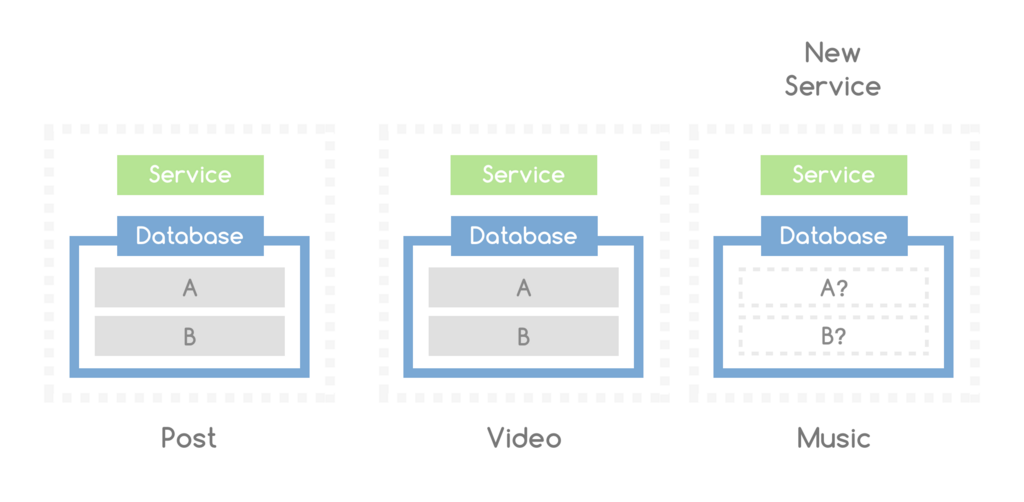
This is where microservices come in. Instead of one giant building, you have a city composed of many smaller, specialized buildings. One building handles user accounts, another handles product inventory, and a third processes payments. Each building is a 'service' with its own dedicated function, its own team, and its own database. They communicate with each other over a network, typically using APIs.
The benefits are clear: teams can work independently, deploy their services on their own schedule, and scale just the parts of the system that need it. If the payment service gets a surge of traffic, you only need to scale that service. However, this introduces new complexity. Network latency and partial failures become real concerns. What happens if the product service is down? The rest of the city must be able to handle its absence gracefully. This operational overhead is significant, which is why deciding how to split a monolith into services is a critical task. It requires identifying clear 'bounded contexts'.
The Serverless Revolution
There's a third model that takes the microservices idea even further: serverless. Imagine not owning any buildings at all. Instead, you rent space on-demand whenever a task needs to be done. A customer wants to upload a photo? You instantly rent a small function space that handles the upload and then disappears. You don't manage the building, the power, or the security—you just use the service. This is the core of serverless architecture, often implemented as Functions as a Service (FaaS).
With serverless, you write small, stateless functions that are triggered by events, like an API request or a new file being uploaded. The cloud provider (like AWS, Google, or Azure) handles all the underlying infrastructure. You pay only for the exact compute time you use, which can be incredibly cost-effective. The operational burden is dramatically reduced. However, there are trade-offs. 'Cold starts' can introduce latency, as a function that hasn't been used recently may take a moment to initialize. You also risk vendor lock-in, as your functions are often tied to a specific provider's ecosystem.
So, which is right for you? It depends. A small team building a new product will likely move fastest with a monolith. A large organization with multiple teams and a complex domain might benefit from microservices. A project with unpredictable, spiky traffic and a desire to minimize operational cost could be a perfect fit for serverless. The key is to understand the trade-offs in terms of development speed, operational complexity, and total cost of ownership, not just follow the latest trend.
What is a primary advantage of starting a new project with a monolithic architecture?
Which of the following is a major challenge introduced by a microservices architecture that is not present in a monolith?