Complex Numbers Unveiled
Introduction to Complex Numbers
Beyond the Number Line
For a long time, the number line seemed to cover all our needs. It has positive numbers, negative numbers, and zero. It has whole numbers, fractions, and even irrational numbers like . But what happens when you try to solve an equation like ?
If you square any real number, the result is always positive or zero. A positive times a positive is positive. A negative times a negative is also positive. There is no number on the regular number line that, when multiplied by itself, gives you a negative result. To solve this problem, mathematicians invented a new number.
i
noun
The imaginary unit, defined as the principal square root of -1.
This new number, called the imaginary unit, is denoted by the letter . Its defining property is simple but powerful.
It’s called “imaginary,” but it's just as valid a number as any other. It simply expands our number system to solve a new class of problems.
Building Complex Numbers
Once we have , we can combine it with the real numbers we already know. This combination creates a new set of numbers called complex numbers. A complex number has a standard form that consists of two parts: a real part and an imaginary part.
The standard form of a complex number is , where is the real part and is the imaginary part. Both and are real numbers.
The real part () is a number you'd find on the traditional number line. The imaginary part () is the coefficient of . Every real number is actually a complex number where the imaginary part is zero (e.g., ). Similarly, a number like is a pure imaginary number, which can be written as .
| Complex Number | Real Part (a) | Imaginary Part (b) |
|---|---|---|
| 3 | 2 | |
| 5 | -4 | |
| 0 | -7 | |
| 9 | 0 |
Visualizing Complex Numbers
Real numbers can be plotted on a one-dimensional number line. But a complex number has two components, a real part and an imaginary part. To visualize it, we need two dimensions. This two-dimensional grid is called the complex plane or Argand plane.
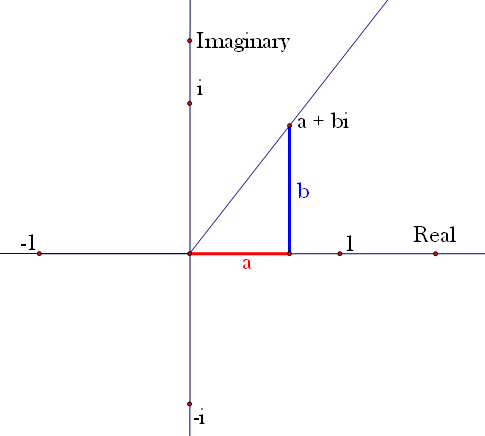
The complex plane looks a lot like a standard Cartesian coordinate system. The horizontal axis is the real axis, where we plot the real part (). The vertical axis is the imaginary axis, where we plot the imaginary part (). So, the complex number corresponds to the point on the plane.
This graphical representation is a powerful tool. It allows us to think about complex numbers not just as algebraic expressions, but as points in a plane, giving them a geometric meaning.
Now, let's test your understanding of these new concepts.
What is the defining property of the imaginary unit, denoted by ?
In the standard form of a complex number, , what does the 'a' represent?
By adding the imaginary unit to our toolbox, we've opened up a whole new world in mathematics. The complex plane gives us a way to see these numbers, making abstract concepts feel more concrete.