Compiler Construction Essentials
Introduction to Compilers
From Human to Machine
Computers are powerful, but at their core, they're also very simple. They only understand one language: machine code. It's a stream of ones and zeros that tells the processor exactly what to do. Writing a program directly in machine code is incredibly tedious and difficult, like trying to build a car by arranging individual atoms.
To make things easier, we use high-level programming languages like C++, Java, or Python. These languages use words and symbols that are much closer to human language. But this creates a problem: how does the computer understand our human-friendly code? We need a translator. That's where a compiler comes in.
A compiler is a special program that translates the entire source code of a program, written in a high-level language, into machine code all at once.
Think of it like translating a book from French to English. The compiler reads the whole book (your source code), translates it, and then produces a brand new, fully translated English version (the executable program). Once this translated version exists, you can read it anytime without needing the translator again. Similarly, once your code is compiled, you can run the resulting program over and over without recompiling it.
Compilers vs Interpreters
A compiler isn't the only type of translator. There's also another kind called an interpreter. The main difference is how they translate.
A compiler translates the entire program before it runs, creating a separate executable file. An interpreter, on the other hand, translates and executes the code line by line, on the fly.
Let's go back to our translator analogy. A compiler is the book translator who gives you the finished English version. An interpreter is like a live conversational translator at the UN. They listen to one sentence, translate it, and say it aloud immediately, then wait for the next sentence. They don't produce a separate translated document; the translation happens in real-time. Languages like C, C++, and Rust are typically compiled. Languages like Python and JavaScript are often interpreted.
| Feature | Compiler | Interpreter |
|---|---|---|
| Translation | Translates the entire program at once. | Translates and executes line by line. |
| Output | Creates a standalone executable file. | Does not create a separate file. |
| Speed | Faster execution, since translation is done beforehand. | Slower, as translation happens during execution. |
| Error Reporting | Reports all errors after scanning the whole program. | Reports errors as soon as one is found. |
A Quick Look Inside
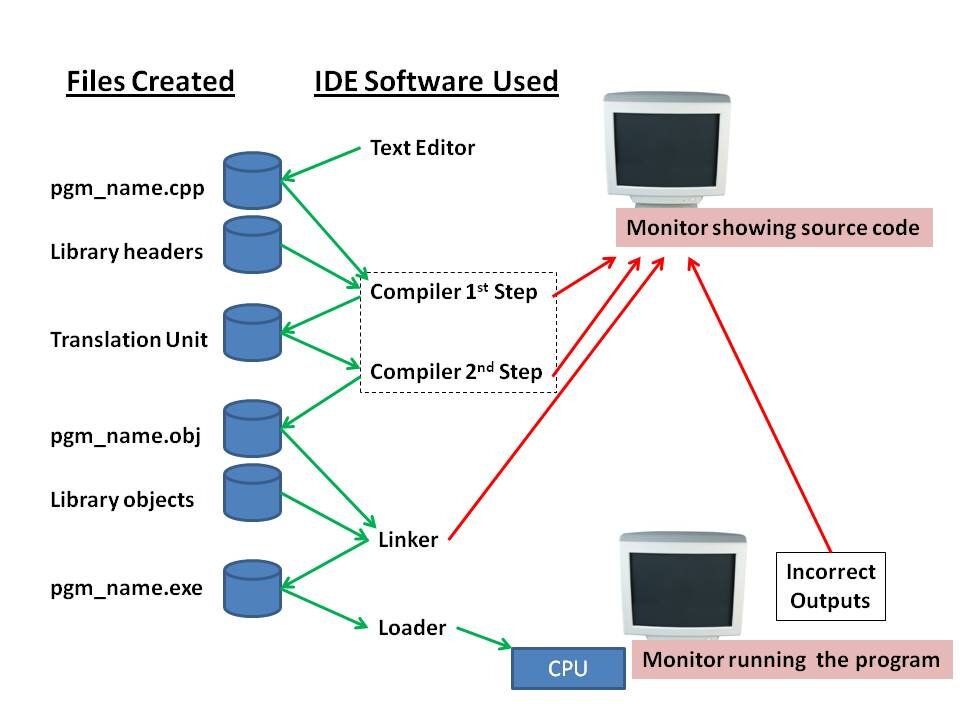
The compilation process isn't a single step. It's more like an assembly line with several distinct phases. While the details can get very complex, the basic idea is straightforward. Think of it like editing an essay.
First, the compiler breaks your code down into individual words and symbols, like identifying all the nouns, verbs, and punctuation in a sentence. This is lexical analysis.
Next, it checks if your code follows the language's grammar rules, just as you'd check for proper sentence structure. This is syntax analysis.
Then, it makes sure the code actually makes sense. You can have a grammatically correct sentence like "The rock is sleeping," but it's semantically meaningless. The compiler does a similar check, which is called semantic analysis.
After these checks, the compiler creates a simplified, generic version of the program, known as intermediate code. It then works to optimize this code, making it run faster and more efficiently, like a good editor trimming unnecessary words from your essay.
Finally, the optimized intermediate code is translated into the final machine code for the target processor. This last step is code generation. The result is the executable program that the computer can finally understand and run.
Understanding this process helps demystify how a few lines of code written by a human can become a powerful application running on a computer.