Competitive Math Mastery
Number System
The Building Blocks
Let's start with the basics. The first numbers you ever learned were likely the natural numbers. These are the counting numbers: 1, 2, 3, 4, and so on, stretching out to infinity. They're what you use to count apples, books, or anything else.
If you add just one more number to that set, you get the whole numbers. The only difference is the inclusion of zero. So, the whole numbers are 0, 1, 2, 3, and so on. It’s a small change, but an important one for many mathematical concepts.
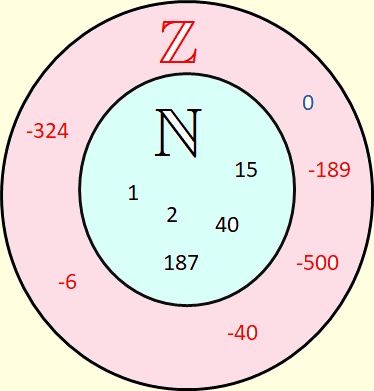
But what about negative values, like a temperature below freezing or a debt? For that, we need integers. This set includes all the whole numbers, their negative counterparts, and zero. Think of it as a symmetrical line stretching out in both positive and negative directions from zero: ..., -3, -2, -1, 0, 1, 2, 3, ....
This number line gives a simple visual of how these fundamental sets relate to each other. Natural numbers are a subset of whole numbers, and whole numbers are a subset of integers.
Beyond Whole Numbers
Of course, numbers aren't just whole units. We often deal with parts of a whole, like half a pizza or a quarter of a dollar. These are rational numbers. A number is rational if it can be written as a fraction , where and are integers and is not zero. This includes all integers (since any integer can be written as ), terminating decimals (like 0.5, which is 1/2), and repeating decimals (like 0.333..., which is 1/3).
Then there are the numbers that cannot be expressed as a simple fraction. These are the irrational numbers. Their decimal representations go on forever without repeating. Famous examples include (approximately 3.14159...) and the square root of 2 (, approximately 1.41421...).
When you combine all the rational and irrational numbers, you get the set of real numbers. This encompasses every point on the number line.
There's one more major category: complex numbers. These numbers extend the real number line into a two-dimensional plane by including the imaginary unit, , where . A complex number has the form , where and are real numbers. While less common in everyday arithmetic, they are fundamental in fields like engineering and physics.
Properties and Relationships
Beyond classifying numbers into sets, we can also describe them by their properties. A key distinction is between prime and composite numbers.
A prime number is a natural number greater than 1 that has no positive divisors other than 1 and itself. Think of numbers like 2, 3, 5, 7, 11, and 13. They are the basic building blocks of all other natural numbers.
A composite number is a natural number greater than 1 that is not prime. In other words, it can be formed by multiplying two smaller natural numbers. For example, 6 is composite because it's the product of 2 and 3.
The number 1 is unique. It is neither prime nor composite.
Understanding numbers also means understanding their relationships. A factor of a number is an integer that divides it evenly, with no remainder. The factors of 12 are 1, 2, 3, 4, 6, and 12.
A multiple of a number is the result of multiplying that number by an integer. Multiples of 3 include 3, 6, 9, 12, and so on.
Knowing the factors of a number can be made much easier by using divisibility rules, which are simple shortcuts to check if one number is divisible by another.
| Divisible by... | The Rule |
|---|---|
| 2 | The last digit is an even number (0, 2, 4, 6, 8). |
| 3 | The sum of the digits is divisible by 3. |
| 4 | The last two digits form a number divisible by 4. |
| 5 | The last digit is 0 or 5. |
| 6 | The number is divisible by both 2 and 3. |
| 9 | The sum of the digits is divisible by 9. |
| 10 | The number ends in 0. |
Finally, we often need to find the Highest Common Factor (HCF) and the Least Common Multiple (LCM) of two or more numbers.
The HCF (also known as the Greatest Common Divisor or GCD) is the largest positive integer that divides each of the numbers. For 12 and 18, the factors of 12 are {1, 2, 3, 4, 6, 12} and the factors of 18 are {1, 2, 3, 6, 9, 18}. The largest factor they share is 6, so the HCF is 6.
The LCM is the smallest positive integer that is a multiple of all the numbers. For 12 and 18, the multiples of 12 are {12, 24, 36, 48, ...} and the multiples of 18 are {18, 36, 54, ...}. The smallest multiple they share is 36, so the LCM is 36.
Ready to test your knowledge?
Which of the following sets is the most specific classification for the number -7?
Which of these numbers is irrational?
Understanding these categories and properties forms the foundation for all further study in mathematics. It gives you the vocabulary and tools to analyze and solve a huge variety of problems.