Competitive Markets Explained
Introduction to Market Fundamentals
The Heartbeat of the Market
Every time you buy a coffee, stream a movie, or fill up your car, you're participating in a market. A market isn't necessarily a physical place; it's any interaction between buyers and sellers. Two powerful forces are at work in every market: supply and demand. They are the foundation of economics, determining what gets made, how much it costs, and who gets it.
Supply and demand is perhaps one of the most fundamental concepts of economics and it is the backbone of a market economy.
Understanding these two concepts is the first step to seeing the world like an economist. Let's start with the buyers.
The Buyer's Side: Demand
Demand isn't just about wanting something. In economics, it means you want something and have the ability to pay for it. The quantity demanded is the amount of a good that buyers are willing and able to purchase at a specific price.
Demand
noun
The relationship between the price of a good and the quantity consumers are willing and able to buy.
There's a simple relationship between price and the quantity people want to buy. Think about your favorite snack. If it's on sale, you might buy extra. If the price suddenly doubles, you'll probably buy less, or none at all. This is the Law of Demand.
The Law of Demand states that, all else being equal, as the price of a good increases, the quantity demanded decreases. Conversely, as the price decreases, the quantity demanded increases.
We can visualize this relationship with a demand curve. It slopes downward, showing that as the price on the vertical axis falls, the quantity demanded on the horizontal axis rises.
Price is a huge factor, but it's not the only one. Other things can make you want to buy more or less of a product, even if the price stays the same. These are called determinants of demand.
- Income: If you get a raise, you might buy more of certain goods. If your income falls, you'll likely cut back.
- Tastes and Preferences: Trends change. A new health study might increase demand for kale, while a celebrity scandal could decrease demand for a particular brand.
- Price of Related Goods: This comes in two flavors. Substitutes are goods you can use in place of each other, like coffee and tea. If the price of coffee goes up, the demand for tea might increase. Complements are goods used together, like hot dogs and hot dog buns. If the price of hot dogs falls, the demand for buns will likely rise.
- Expectations: If you hear a new smartphone is coming out next month, your demand for the current model might drop today. If you expect a gas shortage, demand for gas might spike right now.
- Number of Buyers: If the population of a town grows, the demand for groceries, housing, and other goods will increase.
When one of these factors changes, the entire demand curve shifts to the left (a decrease in demand) or to the right (an increase in demand).
The Seller's Side: Supply
Now let's flip to the other side of the transaction. Supply refers to the amount of a good or service that producers are willing and able to sell at different prices.
Supply
noun
The relationship between the price of a good and the quantity producers are willing and able to sell.
For sellers, the logic is the opposite of buyers. If you're a baker, you'd be much more motivated to bake cakes if you can sell them for $50 each than if you can only sell them for $10. This simple idea is the Law of Supply.
The Law of Supply states that, all else being equal, as the price of a good increases, the quantity supplied increases. As the price decreases, the quantity supplied decreases.
The supply curve illustrates this. It slopes upward, showing that a higher price coaxes sellers to put more of their product on the market.
Just like demand, supply is affected by more than just price. These determinants of supply can shift the entire curve.
- Input Prices: The costs to produce a good matter. If the price of flour (an input for bread) goes up, bakeries will supply less bread at any given price.
- Technology: Improvements in technology make production more efficient and cheaper. A new, faster oven allows a bakery to supply more bread.
- Expectations: If a farmer expects corn prices to be higher next year, they might hold back some of their current crop from the market, reducing the supply today.
- Number of Sellers: If more companies start making electric cars, the overall supply of electric cars will increase.
Finding the Balance
So we have buyers who want low prices and sellers who want high prices. How does a market decide on a price? They meet in the middle. The point where the supply and demand curves intersect is called market equilibrium.
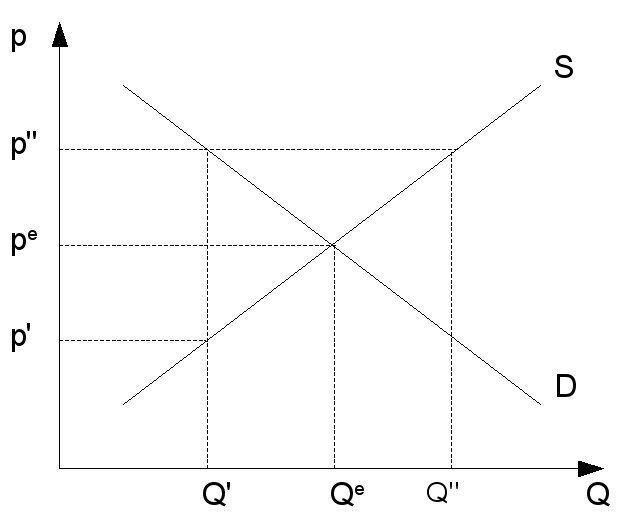
At the equilibrium price, the quantity of the good that buyers are willing to buy is exactly equal to the quantity that sellers are willing to sell. There's no leftover product and no one going home empty-handed. The market is 'clear.'
What happens if the price isn't at equilibrium? If the price is too high, sellers will offer a lot of a product, but buyers won't be interested. This creates a surplus. To get rid of the extra inventory, sellers will have to lower their prices, moving back toward equilibrium.
If the price is too low, buyers will want to buy a lot, but sellers won't be motivated to produce much. This creates a shortage. With too many buyers chasing too few goods, sellers can raise their prices, again moving the market back toward equilibrium.
| Situation | Price is... | Quantity Supplied vs. Demanded | Result |
|---|---|---|---|
| Surplus | Above Equilibrium | Qs > Qd | Downward pressure on price |
| Shortage | Below Equilibrium | Qd > Qs | Upward pressure on price |
| Equilibrium | At Equilibrium | Qs = Qd | Price is stable |
This balancing act is constantly happening in markets all around us, from the local farmer's market to the global stock exchange. It's the invisible hand that guides prices and production.
What does the "Law of Demand" state?
Coffee and tea are considered substitutes. If the price of coffee suddenly increases significantly, what is the most likely impact on the market for tea?