Comparative Song Analysis Mastery
Deconstructing Rhythmic Layers
Beyond the Beat
You already know how to find the pulse in a piece of music. But the real magic, the energy that makes you want to move, happens between those beats. This is the world of syncopation and rhythmic displacement—the art of playing with expectation.
Syncopation is the act of accenting the off-beats, the spaces where you don't expect a strong pulse. Think of it as a rhythmic surprise. Rhythmic displacement is a more specific technique where a musical phrase is moved from its expected place in the bar, creating a feeling of being pushed or pulled against the main groove. Instead of just accenting an off-beat, an entire melodic or rhythmic idea is shifted.
Imagine a familiar melody. Now, start singing it a fraction of a second later than you normally would, while the beat stays the same. That feeling of tension and eventual release is the power of displacement.
Finding the Pocket
Why does a drum machine playing a perfectly quantised beat feel sterile, while a live drummer playing the same pattern feels alive? The answer is micro-timing. These are the tiny, almost imperceptible deviations from the metronomic grid that humans naturally introduce. A drummer might play the snare hit consistently a few milliseconds behind the beat, or the hi-hats slightly ahead.
When the rhythm section locks into a shared sense of micro-timing, they create 'the pocket'. It's not a place you can find on sheet music; it's a feeling. It's that undeniable groove where every instrument sits perfectly in its own rhythmic space, creating a feel that is relaxed yet driving. Some players sit 'on top' of the beat (slightly ahead), while others play 'laid-back' (slightly behind). The pocket is their collective agreement on where that groove lives.
Weaving Rhythmic Textures
Rhythm can be presented in two main ways: linearly or polyphonically.
Linear rhythm is when you have a single rhythmic line. A solo drummer playing a pattern is a good example. All the rhythmic information is coming from one voice, even if it's spread across different drums.
Polyphonic rhythm, or polyrhythm, is the layering of two or more independent rhythms simultaneously. This is where rhythmic analysis gets exciting. The most common example is a '3 against 2' polyrhythm, where one instrument plays three evenly spaced notes in the same amount of time that another plays two.
This creates a pleasant rhythmic tension. Polyrhythms are a hallmark of West African, Afro-Cuban, and Indian classical music, and they've deeply influenced jazz, progressive rock, and electronic music.
Analysing the Groove
To compare the rhythmic feel of different songs or genres, we must analyse the groove. A groove is primarily defined by the interaction between the low-frequency instruments, typically the kick drum and the bassline. Their relationship establishes the track's 'drive' and stylistic signature. By examining the subdivisions they play and where they place their accents, we can deconstruct what makes a genre feel the way it does.
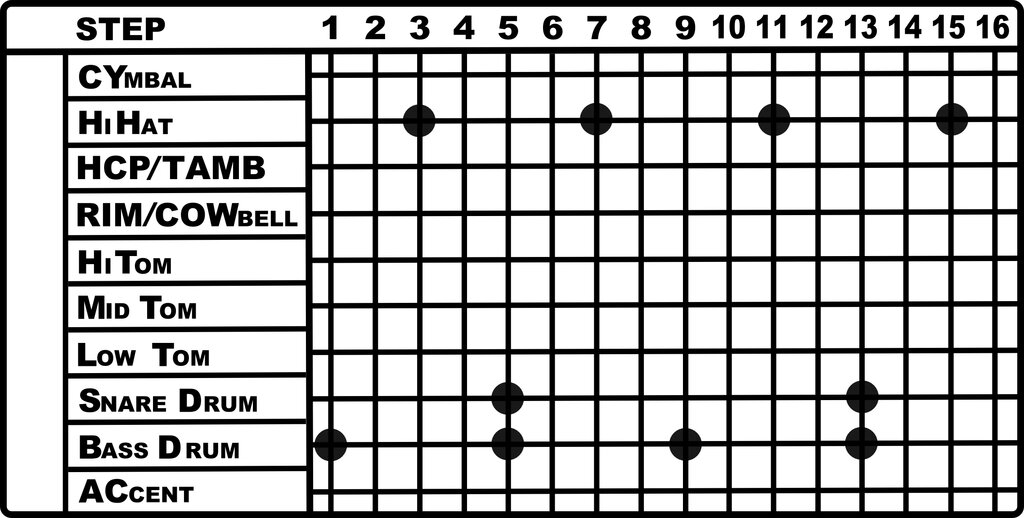
Another crucial element is the backbeat, the strong accent on beats two and four in 4/4 time, usually played by the snare drum. While fundamental to rock, pop, and funk, its treatment varies wildly across genres. Some styles displace it, others omit it entirely, completely changing the rhythmic centre of gravity.
| Genre | Kick Drum Pattern | Bassline Pattern | Backbeat Feel |
|---|---|---|---|
| Funk | Busy, syncopated 16th notes | Interlocks with kick, melodic | Strong and sharp on 2 & 4 |
| Reggae (One Drop) | Silent on beat 1, plays on 3 | Simple, heavy, often on beat 3 | Snare and kick hit together on 3 |
| House | Solid on every quarter note (4-on-the-floor) | Pulsing, often on the off-beats | Present, but often less forceful than the kick |
| Bo Diddley Beat | Syncopated 3-2 clave pattern | Follows the kick pattern | The whole groove is the accent pattern |
By listening specifically to how these elements interact—the kick, the bass, and the backbeat—you can develop a framework for comparing any two pieces of music on a rhythmic level, moving beyond simple tempo or time signature.
Time to test your understanding of these rhythmic layers.
What is the primary definition of syncopation?
The 'human' feel of a live drummer, as opposed to a perfectly quantised drum machine, is primarily due to...
Understanding these concepts gives you a vocabulary to describe the energy and flow of music. It’s the difference between saying a song is 'danceable' and explaining why it makes you want to dance.