Comparative Martial Arts Systems
Striking Biomechanics
The Anatomy of a Strike
A powerful strike doesn't start with the fist or foot. It begins from the ground up. This sequence of movement, from feet to hips to shoulder and finally to the limb, is known as the kinetic chain—a fundamental concept in biomechanics. Think of it like cracking a whip. The energy starts at the handle (your feet pushing off the ground) and accelerates as it moves up through progressively smaller, faster segments, culminating in a sharp, powerful snap at the tip (your fist or shin).
In boxing, a right cross perfectly illustrates this. The motion starts with the back foot pushing off the canvas. This energy travels up the leg, causing the hip to rotate forward powerfully. The torso follows, and finally, the arm and fist are delivered to the target. Each link in the chain adds momentum, so a failure at any point—like lifting the back foot too early or not rotating the hips—bleeds power from the final strike.
Rotational vs. Linear Power
Not all strikes use the kinetic chain in the same way. The key difference often lies in how force is generated: through rotation or linear drive. Compare a Muay Thai roundhouse kick with a Karate front kick.
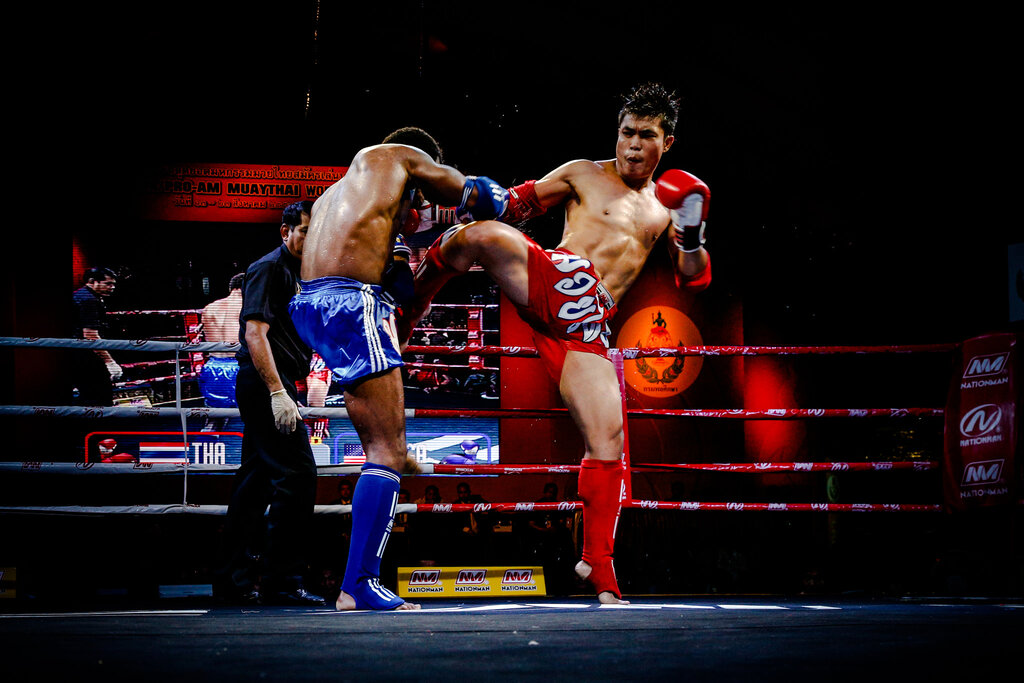
The Muay Thai roundhouse is a masterpiece of rotational torque. The fighter pivots on their standing foot, swings the kicking leg like a baseball bat, and turns their hips over completely at the moment of impact. The goal is to drive the shin through the target. This generates incredible power, leveraging the body's entire mass. The force is a product of mass, acceleration, and the torque () generated by the hip rotation. The trade-off is that it's a longer, more telegraphed motion.
A traditional Karate front kick (mae geri), on the other hand, is primarily a linear strike. The knee is 'chambered'—brought up high and tight to the chest—and then the lower leg snaps out directly towards the target. Power comes from the explosive extension of the quadriceps and the forward thrust of the hips, but without the full rotation seen in Muay Thai. It's faster, more direct, and harder for an opponent to see coming, but typically carries less raw power than a fully committed roundhouse. This is the classic speed versus power trade-off.
For example, our data indicates that the typical Karate and Taekwondo snap-like kick is based heavily on rapid knee extension, while Muay Thai uses a technique that places greater emphasise on COM movements to develop high impact forces.
Chambering, Impact, and Gloves
The idea of 'chambering' a strike is a hallmark of many traditional martial arts like Karate and Taekwondo. By pulling a limb back into a coiled position before striking, the practitioner creates a longer path for acceleration. Think of pulling back a slingshot. This allows for a very fast, snappy impact, ideal for point-based sparring or when a quick stun is needed.
Modern combat sports like boxing and Muay Thai often de-emphasise the deep chamber in favour of 'heavy' strikes that rely more on weight transfer and hip displacement. A boxer's hook doesn't chamber by their ear; it flows from a defensive position, using shoulder and hip rotation to generate power. These strikes are designed for a different context: to do maximum damage through padded gloves, often against a conditioned opponent.
The equipment itself changes the execution. A bare-knuckle boxer must be far more precise with their point of impact to avoid breaking their hands. With 16-ounce boxing gloves, a fighter can afford to throw with full force into a hard surface like a skull. The glove diffuses the impact over a larger area, reducing the peak force but lengthening the duration of the impact, which can contribute to rattling the brain inside the skull.
In a bare-knuckle context, fighters often adopt different guards and striking techniques, such as using palm heels or vertical fists, to protect the delicate bones in their hands. The 'pointy' knuckles of a horizontal fist are great for penetrating a soft target but are risky against bone. This is why technique must always adapt to the specific rules and environment of the fight.
Time to test your understanding of striking biomechanics.
What is the primary purpose of the kinetic chain in generating a powerful strike?
A Muay Thai roundhouse kick primarily generates its power through rotational force, while a Karate front kick primarily uses linear force.
Understanding these mechanical principles—how force is generated, transferred, and delivered—is what separates a novice from an expert. It transforms martial arts from a collection of movements into a science of motion.