Comparative Cellular Division and Genetic Inheritance
Cycle Regulation and Checkpoints
The Cell's Internal Clock
A cell doesn't just divide on a whim. The process is governed by a precise internal control system, much like a sophisticated traffic light network. This system ensures that one phase of the cell cycle transitions smoothly and correctly into the next, preventing chaos. The key players in this network are two types of proteins: cyclins and cyclin-dependent kinases, or CDKs.
Think of CDKs as engines that are always present in the cell but are switched off by default. Cyclins are the keys that turn these engines on. The concentration of different cyclins rises and falls in a predictable pattern throughout the cell cycle. When a specific cyclin binds to its partner CDK, it forms an active complex. This complex then acts like a switch, activating other proteins by adding a phosphate group to them, a process called phosphorylation. This simple chemical tag is the signal that tells the cell to move forward into the next phase.
Cyclins and CDKs are central to cell cycle control, with specific cyclin-CDK pairs regulating different phases, ensuring orderly progression and genomic integrity in cell division.
Quality Control Checkpoints
Before proceeding through key transition points, the cell pauses to inspect its own work. These pauses are called checkpoints. They are critical quality control stops that monitor for errors, such as incomplete DNA replication or damage to the genetic code. If a problem is detected, the checkpoint machinery halts the cycle, giving the cell time to make repairs. If the damage is too severe, the cell may be directed to self-destruct through apoptosis, preventing the flawed cell from multiplying.
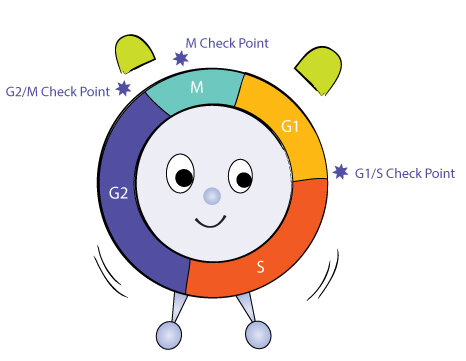
The first major hurdle is the G1/S checkpoint, also known as the restriction point. This is the ultimate point of no return. Once a cell passes this checkpoint, it is committed to dividing. The primary question asked here is: is the DNA intact and ready for replication? The cell checks for any damage to its genome from things like UV radiation or chemical mutagens. If damage is found, the cycle is arrested to allow for repairs.
A key guardian of this checkpoint is the (Rb). In a resting cell, Rb acts as a brake by binding to and inactivating a group of proteins called E2F transcription factors. E2F proteins are responsible for turning on the genes needed for DNA replication. When the cell is ready to divide, G1 cyclin-CDK complexes phosphorylate Rb. This changes Rb's shape, causing it to release E2F. The newly freed E2F can then activate the necessary genes, and the cell moves into the S phase.
After DNA synthesis in S phase, the cell enters G2 and prepares for mitosis. Before it can divide, it must pass the G2/M checkpoint. Here, the cell asks: is all DNA replicated, and is it undamaged? This checkpoint prevents the cell from entering mitosis with incomplete or faulty genetic information. The key molecular player here is a complex called Maturation-Promoting Factor (MPF), which consists of Cyclin B and its partner CDK1. When activated, MPF triggers a cascade of protein phosphorylations that initiate the events of mitosis, like chromosome condensation and the breakdown of the nuclear envelope.
The Spindle Checkpoint
The final major checkpoint occurs during mitosis itself. The Spindle Assembly Checkpoint (SAC), or M checkpoint, is active during metaphase. Its job is to ensure that every single chromosome is properly attached to the mitotic spindle before the sister chromatids are pulled apart. Each pair of sister chromatids must be attached to spindle fibers from opposite poles of the cell. This bipolar attachment creates tension, which signals to the checkpoint that everything is aligned correctly.
Specialized protein structures on the chromosomes called are the connection points for spindle fibers. If even one kinetochore is unattached or improperly attached, it sends out a "wait" signal. This signal blocks the activation of an enzyme called separase. Once all kinetochores are correctly attached, the wait signal ceases, separase is activated, and it cleaves the cohesin proteins holding the sister chromatids together. This allows anaphase to begin, and the chromatids are pulled to opposite ends of the cell.
Failure of the spindle assembly checkpoint can lead to aneuploidy—cells with an incorrect number of chromosomes—which is a common feature of cancer cells and a cause of genetic disorders.
Time to check your understanding of these critical cellular controls.
What are the two main types of regulatory proteins that control the progression of the cell cycle?
What is the primary function of the Retinoblastoma protein (Rb) in a resting cell?
These checkpoints are the cell's essential safety mechanisms. They maintain the integrity of the genome from one generation of cells to the next, ensuring that growth and repair happen in an orderly and error-free way.