Comparative Anatomy of Monocots and Dicots
Seed Morphology
One Cotyledon or Two?
The first clue to a flowering plant's identity lies hidden inside its seed. Angiosperms, or flowering plants, are broadly split into two major groups: monocotyledons (monocots) and dicotyledonous (dicots). The names come from the number of cotyledons, or embryonic leaves, they possess. Monocots have one, while dicots have two.
Think of a bean seed. It splits easily into two halves. Those halves are the cotyledons, acting as fleshy, nutrient-packed structures that feed the embryo. In contrast, a grain of maize, a monocot, doesn't split this way. It has a single, shield-like cotyledon called a that is not a primary storage organ itself. Instead, its job is to transfer nutrients to the growing embryo from another part of the seed.
This difference in cotyledon structure points to a fundamental split in nutrient storage strategy. It's all about where the plant packs its lunch for the embryo.
Packing a Lunch
Plant seeds can be broadly categorised as endospermic or non-endospermic. This depends on whether the food supply, the , is still present in the mature seed. The endosperm is a nutrient-rich tissue that forms during fertilisation.
In non-endospermic (or exalbuminous) seeds, the developing embryo absorbs all the nutrients from the endosperm and stores them in its own fleshy cotyledons. The bean is a classic example. By the time the seed is mature, the endosperm is completely gone.
In endospermic (or albuminous) seeds, the endosperm remains as the primary food source, surrounding the embryo. Grains like maize and wheat are endospermic. Their single cotyledon, the scutellum, acts as an intermediary, not the pantry itself. This strategy keeps the embryo compact and separate from its food reserves until germination begins.
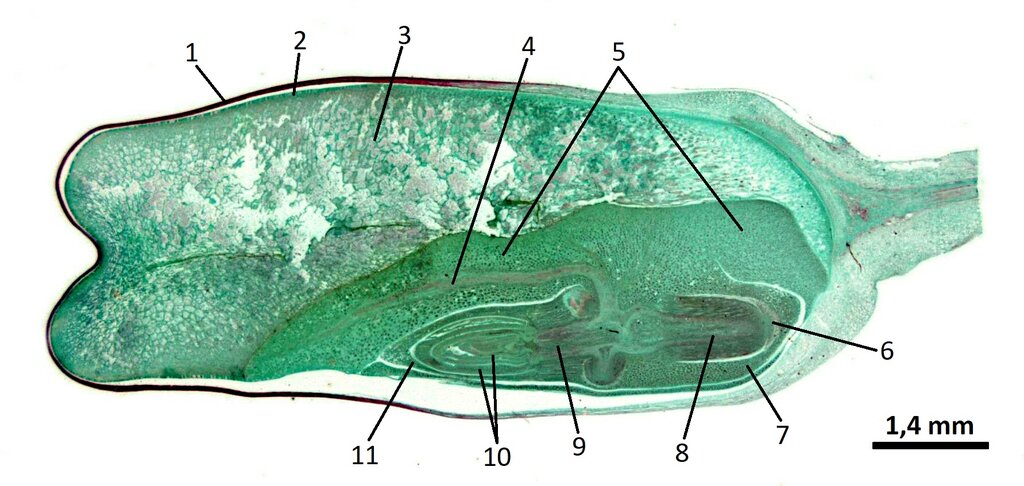
These different storage strategies have trade-offs. Non-endospermic seeds like beans give the seedling a massive, readily available energy boost from their large cotyledons, which often emerge above ground to start photosynthesising. Endospermic seeds like maize provide a more controlled release of energy, keeping the delicate embryo protected and nourished within the grain as it pushes through the soil.
Ready for Takeoff
Every seed contains an embryonic shoot, the plumule, and an embryonic root, the radicle. These are the miniature plant-in-waiting, positioned to grow when conditions are right. Their orientation and protection, however, differ between monocots and dicots.
In a dicot like the bean, the plumule and radicle are tucked securely between the two cotyledons. During germination, the radicle emerges first, followed by a structure called the hypocotyl, which often forms a hook to pull the delicate plumule and cotyledons through the soil.
Monocots offer their embryos extra protection. The plumule is shielded by a pointed sheath called the and the radicle is covered by a similar structure called the coleorhiza. Think of these as protective helmets. The tough, spear-like coleoptile is what you actually see emerging from the soil when a blade of grass or a maize seedling first appears. It pushes through the ground, clearing a path for the fragile first leaves to emerge safely.
So, from the number of embryonic leaves to the location of the food supply and the protective gear on the embryo, the seeds of monocots and dicots are architecturally distinct. These differences set the stage for two very different patterns of growth and development that define the world's flowering plants.
Let's check your understanding of these seed structures.
What is the fundamental difference used to classify flowering plants as either monocots or dicots?
In a non-endospermic seed like a bean, what is the primary role of the two large cotyledons?