Comic Book Scriptwriting Mastery
Script Formats
The Blueprint of a Comic
A comic script is the essential blueprint that translates a writer's vision into a guide for the artist. It's a communication tool, and its clarity directly impacts the final product. While storytelling fundamentals like plot and character are universal, structuring them for a visual medium requires a specific format. The goal is to give the artist everything they need to draw the story, from the setting and action to the specific words spoken by the characters.
There are two dominant formats in the industry: the Full Script and the Plot-First method, famously known as the Marvel Method . Each offers a different level of control and collaboration between the writer and the artist. Choosing the right one depends on the project's needs and the working relationship of the creative team.
The Full Script
The Full Script is the most common format used in modern comics. It provides a detailed, panel-by-panel breakdown of every page. This method gives the writer maximum control over the story's pacing and visual moments. The structure is hierarchical and easy for the entire production team—artist, letterer, and editor—to follow.
The standard is a 12-point Courier font, which mimics a classic typewriter. Margins are typically set to 1.5 inches on the left and 1 inch on the top, bottom, and right. This formatting ensures readability and provides space for notes.
The hierarchy of a full script is straightforward. You start with the page number, then the panel number. This is followed by a description of the action and setting within that panel. Finally, you list the character names and their corresponding dialogue. Sound effects are also explicitly included.
PAGE ONE

PANEL 1

A wide shot of a dusty, sun-scorched canyon. A lone, armored figure, ELARA, stands on a rocky outcrop, her rifle slung over her shoulder. She squints at the horizon.

CAPTION (ELARA)
They said the wastes were empty. They were wrong.

PANEL 2

A close-up on a pair of binoculars Elara is holding. In the reflection of the lenses, we see three rugged vehicles kicking up dust in the distance.

SFX
VRRRRMM

PANEL 3

Elara lowers the binoculars, her expression grim. She taps the side of her helmet.

ELARA
Juno, I've got company. Three bandits, closing fast from the east.
This format leaves little to interpretation. The writer specifies the number of panels on a page, what each contains, and how the dialogue fits. It ensures the pacing and key visual beats are exactly as the writer intends. However, this rigidity can sometimes limit an artist's ability to improvise or contribute their own storytelling ideas to the page layout.
The Marvel Method
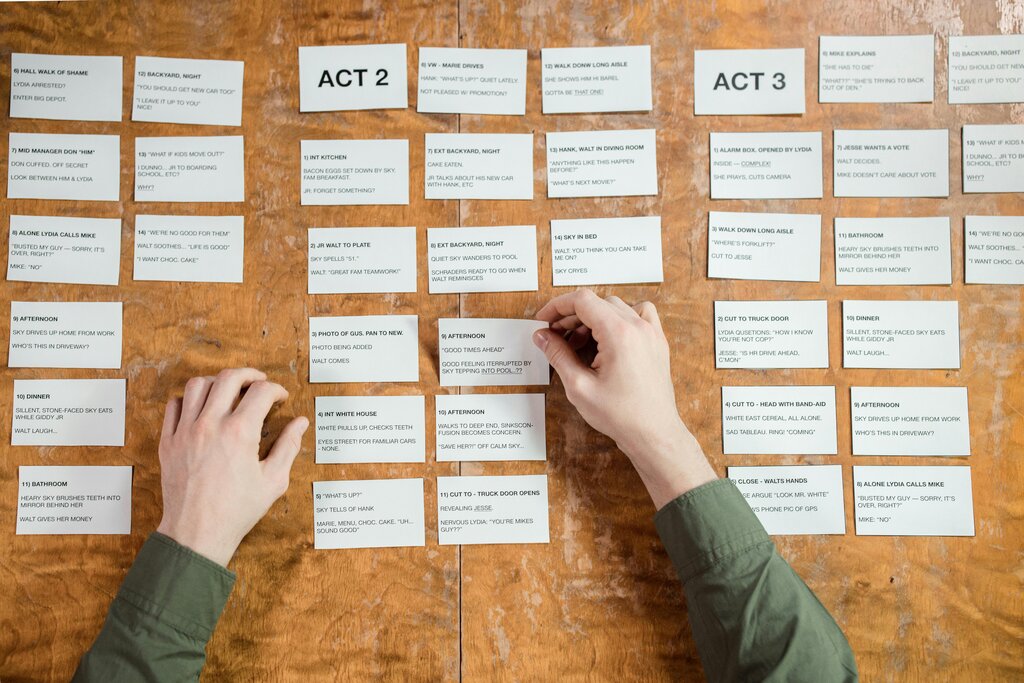
The Plot-First approach, or Marvel Method, works differently. Instead of a rigid panel-by-panel script, the writer provides a synopsis of the story, broken down by pages or scenes. This summary outlines the key actions, character moments, and plot developments. The artist then takes this plot and determines the panel layouts, pacing, and specific camera angles to best tell the story visually.
After the artist draws the pages based on the plot, the script goes back to the writer. The writer then adds the final dialogue, captions, and sound effects to fit the drawn artwork. This method is a more collaborative, back-and-forth process.
For a plot-first script, the writer might describe a full page like this:
Page 1: We open with Elara tracking the bandits through the canyon. She realizes they are heading for a small, hidden settlement. She has to warn them. The page should end with her beginning to run down the rocky path, determined.
The strength of this method is its freedom. It empowers the artist to be a co-storyteller, using their visual expertise to pace scenes and create dynamic layouts. It can lead to more visually innovative comics. The downside is that it gives the writer less precise control over the final pacing, and it requires a great deal of trust and strong communication between the writer and artist.
| Feature | Full Script | Plot-First (Marvel Method) |
|---|---|---|
| Writer Control | High | Medium to Low |
| Artist Freedom | Low | High |
| Process | Linear (Write -> Draw -> Letter) | Cyclical (Plot -> Draw -> Write -> Letter) |
| Best For | Writers who want precise pacing and visual control. | Collaborative teams where the artist is a strong storyteller. |
| Dialogue | Written before the art is drawn. | Written after the art is drawn. |
Regardless of the format, clarity is king. A well-formatted script is a sign of professionalism and the first step in creating a comic that an entire team can build and a reader can enjoy.