Comets Celestial Wanderers
Comet Basics
Cosmic Snowballs
Comets are often called "dirty snowballs," and for good reason. They are cosmic leftovers from the formation of our solar system about 4.6 billion years ago. These icy bodies are a mixture of frozen gases, rock, and dust.
Most comets travel in long, elliptical orbits, spending most of their time in the frigid outer reaches of the solar system. It's only when their path brings them closer to the Sun that they put on the spectacular display we can see from Earth. The Sun's heat causes the comet's ice to vaporize, creating a glowing cloud and a long, streaming tail.
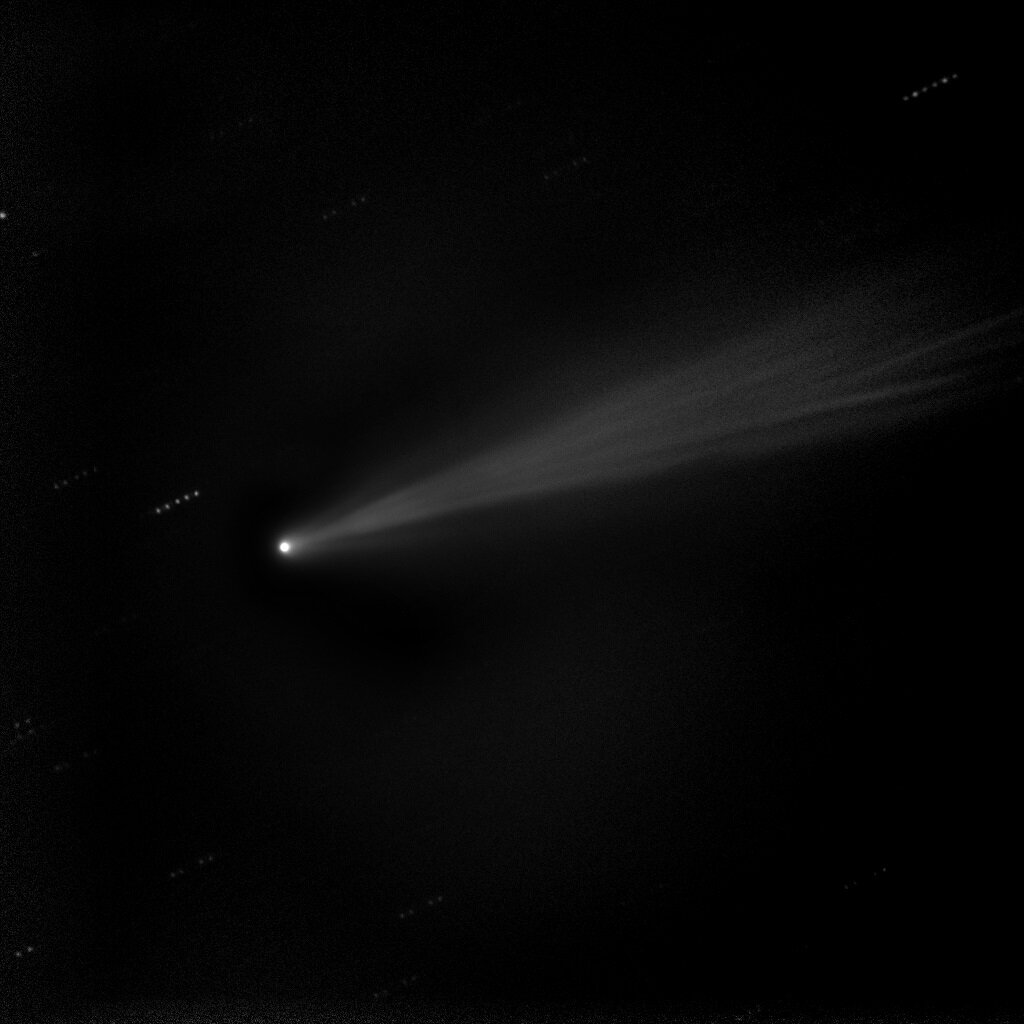
Anatomy of a Comet
A comet has three main parts: the nucleus, the coma, and the tails. Each part plays a role in its appearance and behavior.
The Nucleus: The Solid Core
At the heart of every comet is the nucleus, a solid body typically only a few kilometers across. It's composed of a mix of rock, dust, water ice, and frozen gases like carbon dioxide, methane, and ammonia. The surface is often dark and covered in a dusty crust.
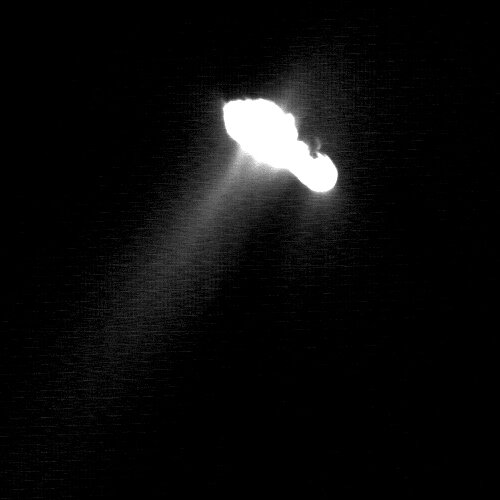
The Coma: A Glowing Atmosphere
As a comet approaches the Sun, the ice on the nucleus's surface doesn't melt—it sublimates. This means it turns directly from a solid into a gas. This process releases gas and dust, forming a vast, fuzzy cloud around the nucleus called the coma. The coma can grow to be enormous, sometimes even larger than the planet Jupiter. Sunlight illuminates this cloud, making the comet visible.
sublimate
verb
To change directly from a solid to a gaseous state without becoming liquid.
The Tails: Dust and Gas
The most striking feature of a comet is its tail, but many comets actually have two. Both tails are formed by material from the coma and always point generally away from the Sun, regardless of the comet's direction of travel.
-
The Dust Tail: This tail is made of tiny solid particles—the "dirt" from the snowball. The pressure of sunlight pushes these particles away from the coma. Because the dust particles are relatively heavy and move slowly, the tail often appears broad, white or yellowish, and curved. It tends to follow along the comet's orbital path.
-
The Ion Tail: This tail is composed of gases that have been ionized, or electrically charged, by the Sun's ultraviolet light. The solar wind, a stream of charged particles flowing from the Sun, then sweeps these ions straight back, away from the Sun. The ion tail is usually fainter, thinner, and has a distinct blue color due to the glow of carbon monoxide ions.
Harbingers and Wonders
For much of human history, comets were mysterious and often feared. Appearing unpredictably in the night sky, they were seen as omens, signaling disasters or the deaths of kings. Without an understanding of what they were, people filled in the gaps with superstition.
This began to change in the 16th century, when Danish astronomer Tycho Brahe observed a bright comet and proved that it was farther away than the Moon. This showed that comets were celestial objects, not phenomena within Earth's atmosphere. Later, in the early 1700s, Edmond Halley used Isaac Newton's new laws of gravity to calculate the orbits of several comets. He noticed that three comets from 1531, 1607, and 1682 had remarkably similar paths and predicted the comet would return again in 1758. When it did, it was named Halley's Comet in his honor, proving that some comets were periodic visitors to our skies.
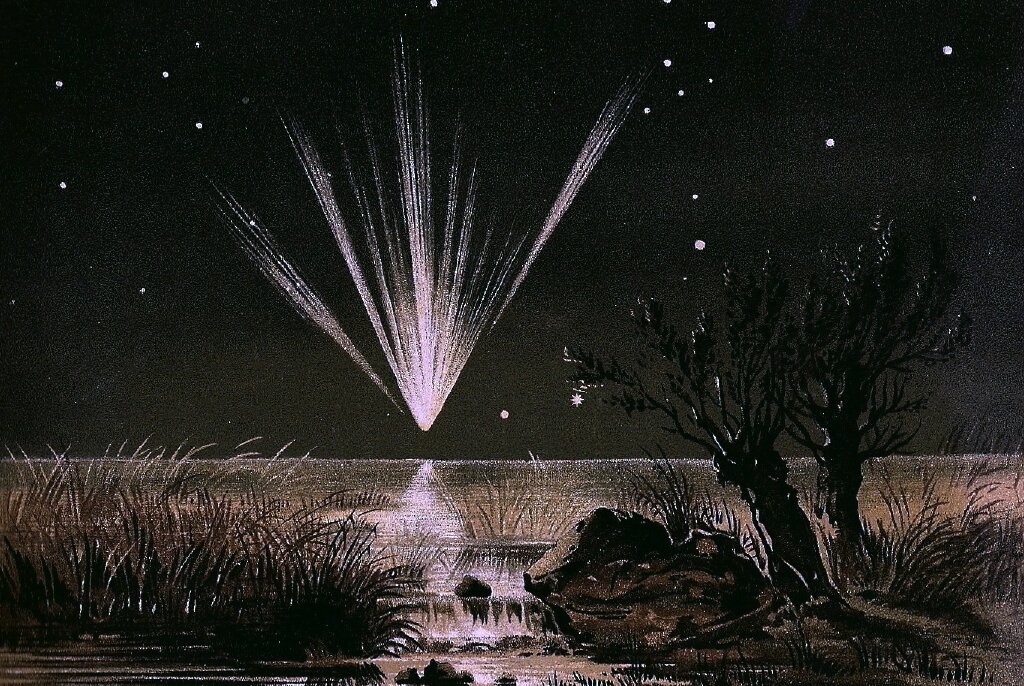
Today, observing comets is an exciting hobby for many amateur astronomers. All you really need is a clear, dark sky, away from city lights. While some comets are bright enough to be seen with the naked eye, a good pair of binoculars or a small telescope can reveal much more detail, including the fuzzy coma and faint tail. Stargazing apps and websites can help you find out which comets are currently visible and where to look for them.
Ready to test your knowledge? This quiz will cover the key parts of a comet and their place in history.
What are the three main parts of a comet?
If a comet is traveling away from the Sun, in which direction do its tails point?
From ancient portents to objects of scientific study, comets continue to capture our imagination as they journey through the solar system.