Comarch ERP XL Fundamentals
Introduction to ERP Systems
What Is an ERP System?
Enterprise Resource Planning, or ERP, is software that acts like a central nervous system for a business. It takes all the core functions of an organization—things like finance, manufacturing, HR, and sales—and integrates them into a single, unified system.
Think about a business without an ERP. The accounting team has its own software, the sales team uses a different tool to track customers, and the warehouse manages inventory on spreadsheets. Information gets trapped in these separate systems, creating data silos. Getting a complete picture of the business requires manually pulling reports from each system and trying to piece them together. It's slow, inefficient, and often leads to errors.
An ERP system breaks down these silos. It creates a single source of truth where everyone in the company can access and share the same, up-to-date information.
The Building Blocks of ERP
ERP systems are typically modular. This means a company can choose the specific components, or modules, that fit its needs. While the exact modules vary between providers, most ERPs are built around a few key areas.
| Module | Core Function |
|---|---|
| Finance & Accounting | Manages the general ledger, accounts payable/receivable, and financial reporting. |
| Human Resources (HR) | Handles payroll, employee records, recruiting, and performance management. |
| Supply Chain Management (SCM) | Tracks goods from manufacturing to distribution, including inventory and order fulfillment. |
| Customer Relationship Management (CRM) | Manages interactions with current and potential customers, from sales leads to support. |
| Manufacturing | Oversees the production process, including planning, scheduling, and quality control. |
A small retail business might start with just the Finance, SCM, and CRM modules. A large manufacturing firm, on the other hand, would likely need all of them to manage its complex operations. The modular design allows an ERP to scale with the business.
Why Bother with an ERP?
Implementing an ERP is a major undertaking, but the benefits can be transformative. By centralizing data and automating processes, these systems help businesses operate more efficiently and make smarter decisions.
By bringing all critical operations into a single system, ERP helps organizations eliminate data silos, reduce redundancies, and enhance decision-making through accurate and up-to-date information.
With a unified system, leaders get a real-time, bird's-eye view of the entire organization. Instead of waiting for weekly reports, they can pull up live dashboards to see how sales are tracking, check inventory levels, and monitor expenses. This immediate access to information allows them to spot trends and address problems before they escalate.
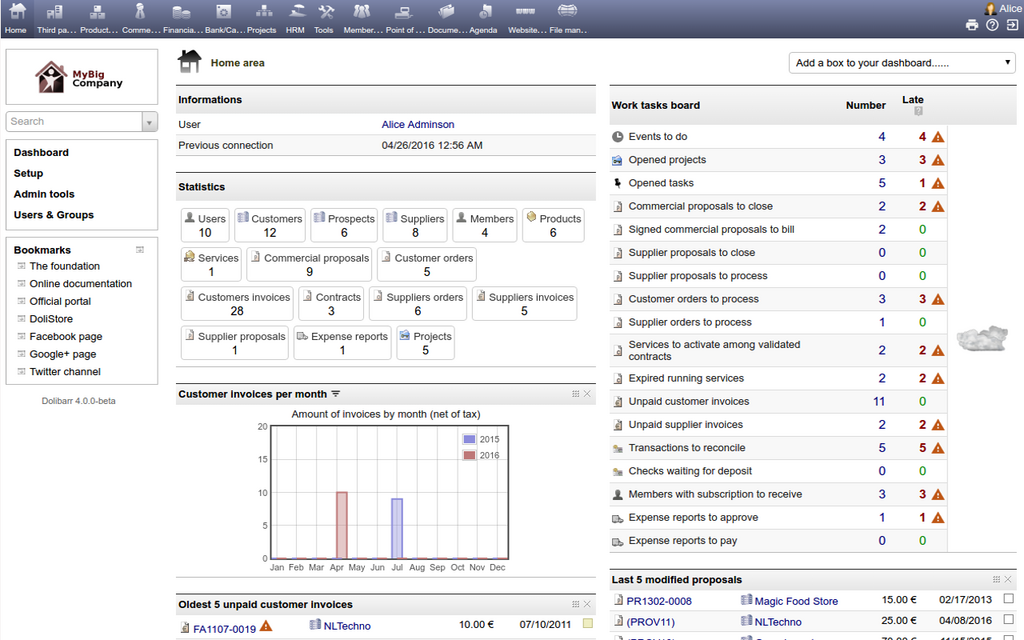
This integration also streamlines workflows between departments. For example, when a salesperson closes a deal in the CRM module, it can automatically trigger an invoice in the finance module and an order fulfillment request in the supply chain module. This automation reduces manual data entry, minimizes errors, and frees up employees to focus on more strategic tasks.
The Hurdles of Adoption
Despite their benefits, ERP projects are notoriously challenging. The two biggest hurdles are usually cost and complexity. The software itself is expensive, and the implementation process—which involves customizing the system, migrating data, and training employees—can be a massive, time-consuming project.
But the biggest challenge is often the human element. An ERP system changes how people do their jobs. It requires new workflows and a willingness to abandon old habits. Without strong leadership and clear communication, employees may resist the change, undermining the entire project.
For successful ERP implementation, it is essential that the business stakeholders are involved throughout, and the ownership of the project is built around these Business Process owners.
Choosing the right system is the first critical step. A company must carefully evaluate its own needs, workflows, and long-term goals. Key criteria for selecting an ERP include its scalability, industry-specific features, and the quality of the vendor's support. A mismatch between the business and the software is a common reason for failure.