Colloids and Surface Phenomena Demystified
Colloidal Systems
The World in Between
Many substances we encounter are mixtures. Sometimes, it's easy to see the different parts, like sand in water. Other times, the mix looks perfectly uniform, like salt dissolved in water. Colloids live in a fascinating middle ground between these two extremes.
Colloid
noun
A mixture where one substance of microscopically dispersed insoluble particles is suspended throughout another substance.
A colloid consists of two parts: the dispersed phase (the particles) and the dispersion medium (the substance they are suspended in). The key feature that defines a colloid is the size of the dispersed particles. They are larger than individual molecules but small enough that they don't settle out due to gravity. Their diameter typically ranges from 1 to 1000 nanometres.
Solution, Suspension, or Colloid?
It can be tricky to tell these three types of mixtures apart just by looking. A true solution, like saltwater, is a homogeneous mixture where the solute particles are individual molecules or ions. A suspension, like muddy water, is a heterogeneous mixture with large particles that will eventually settle down. Colloids are also heterogeneous, but their particles are small enough to remain suspended indefinitely.
| Feature | True Solution | Colloid | Suspension |
|---|---|---|---|
| Particle Size | < 1 nm | 1 - 1000 nm | > 1000 nm |
| Appearance | Transparent | Translucent or Opaque | Opaque |
| Settling | Does not settle | Does not settle | Settles on standing |
| Filtration | Particles pass through filter paper | Particles pass through filter paper | Particles are stopped by filter paper |
Seeing the Unseen
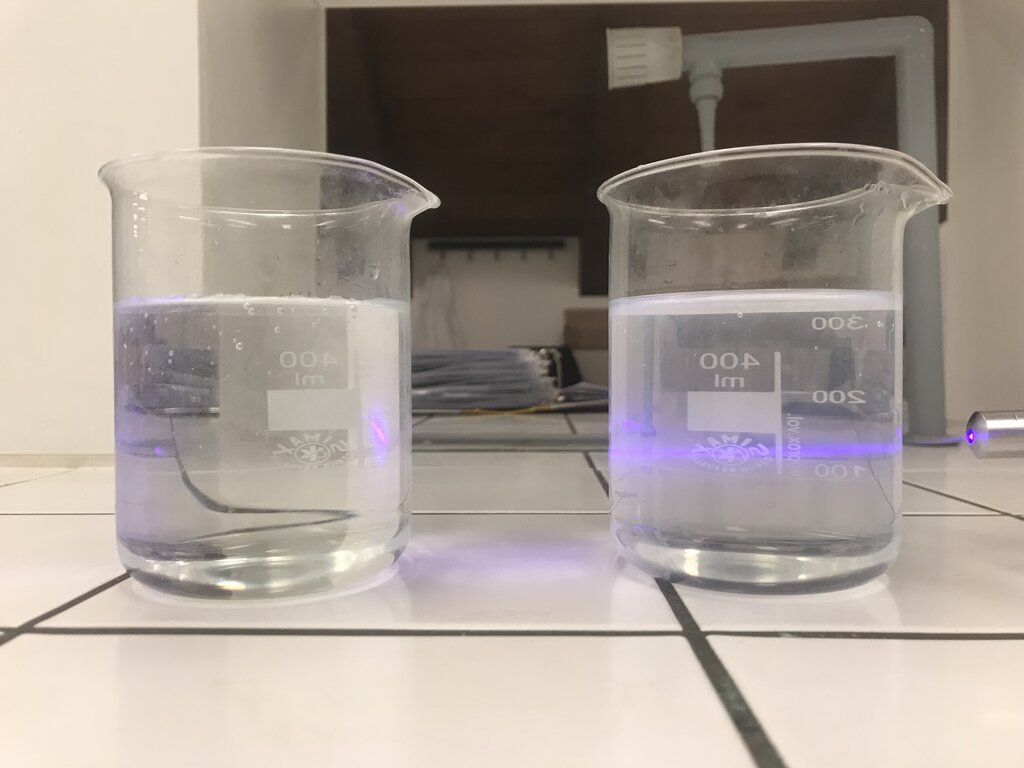
Because of their unique particle size, colloids have some interesting properties that help us identify them. One of the most famous is the Tyndall effect.
The Tyndall effect is the scattering of a beam of light by the particles in a colloid. This makes the light beam visible.
You've seen this phenomenon in action. When sunlight streams through a dusty room, you can see the beam because the dust particles (a colloid of solid in gas) scatter the light. A true solution, however, does not scatter light, so a beam passing through it remains invisible.
Another key property is Brownian motion. If you could look at colloidal particles under a microscope, you would see them moving around randomly in a zigzag pattern. This isn't because the particles themselves are alive. This chaotic dance is caused by the smaller, faster-moving molecules of the dispersion medium constantly colliding with the larger colloidal particles, pushing them around.
A Colloid for Every Occasion
Colloids are all around us and are classified based on the physical state (solid, liquid, or gas) of the dispersed phase and the dispersion medium. This gives rise to several types.
| Dispersed Phase | Dispersion Medium | Type | Example(s) |
|---|---|---|---|
| Solid | Gas | Solid Aerosol | Smoke, Dust |
| Liquid | Gas | Liquid Aerosol | Fog, Mist, Hairspray |
| Gas | Liquid | Foam | Whipped Cream, Soap Lather |
| Liquid | Liquid | Emulsion | Milk, Mayonnaise |
| Solid | Liquid | Sol | Paint, Starch solution |
| Gas | Solid | Solid Foam | Pumice stone, Styrofoam |
| Liquid | Solid | Gel | Gelatin, Butter, Cheese |
| Solid | Solid | Solid Sol | Coloured gemstones, some alloys |
An emulsion is a special type of colloid where small droplets of one liquid are dispersed in another liquid they normally wouldn't mix with, like oil and water. Milk is a natural emulsion of fat globules in water, and mayonnaise is an emulsion of oil in a water-based liquid (vinegar), stabilized by egg yolk.
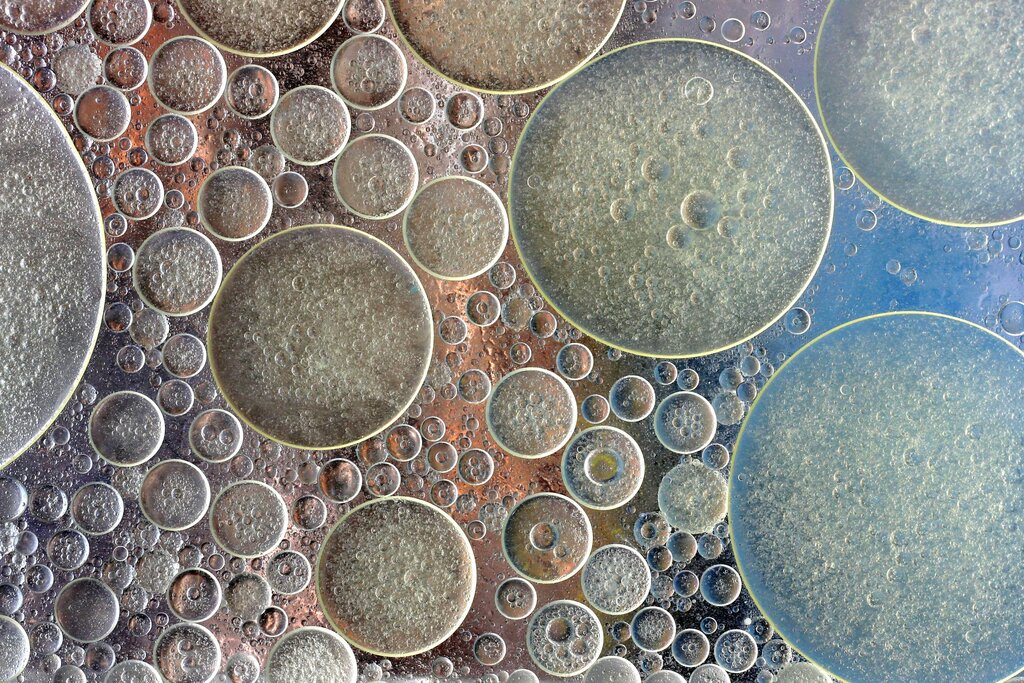
A sol consists of fine solid particles in a continuous liquid medium. Paints are sols where solid pigments are dispersed in a liquid base. A gel is the opposite, where a liquid is trapped within a solid network, giving it a jelly-like structure, like in gelatine desserts.
From the food we eat to the air we breathe, colloidal systems are an essential and often unnoticed part of our world. Understanding them helps us see the complex structures hidden within seemingly simple mixtures.
Ready to test your knowledge?
What is the primary characteristic that distinguishes a colloid from a true solution and a suspension?
The random, zigzag movement of colloidal particles caused by collisions with molecules of the dispersion medium is known as...