Collision Theory Explained
Introduction to Collision Theory
How Reactions Happen
For a chemical reaction to occur, the particles involved—whether they are atoms, ions, or molecules—must first come into contact. It sounds simple, but a lot has to go right. Just bumping into each other isn't enough to start a reaction. This is the central idea behind collision theory.
Collision theory states that for a chemical reaction to happen, reactant particles must collide with each other under very specific conditions.
Think of it like trying to unlock a door with a key. It's not enough to just poke the key near the lock. You have to insert the key correctly (that's orientation) and turn it with enough force (that's energy). If you fail at either of these, the door won't open. Chemical reactions work in a remarkably similar way.
The Rules of a Successful Collision
There are two main conditions that must be met for a collision to result in a chemical reaction. If even one isn't satisfied, the particles will simply bounce off each other unchanged.
- The particles must collide with enough energy.
- The particles must have the correct orientation.
Let's break these down.
Energy and the Activation Barrier
Colliding particles need to hit each other with a certain amount of force. Why? Because chemical reactions involve breaking old chemical bonds and forming new ones. Breaking bonds requires energy. If the colliding particles don't have enough kinetic energy, they won't be able to overcome the repulsion between their electron clouds and start the bond-breaking process.
This minimum amount of energy needed to start a reaction is called the activation energy, often symbolized as .
Activation Energy
noun
The minimum amount of energy required for reactants to transform into products during a chemical reaction.
Imagine trying to push a boulder over a hill. The activation energy is like the energy you need to push the boulder up to the very top. Once it's there, it can roll down the other side on its own. If you don't push it hard enough to reach the peak, it just rolls back down to where it started. No reaction.
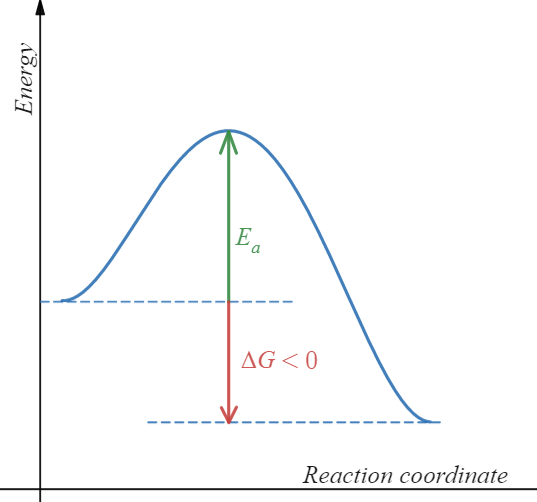
In a reaction, the peak of this energy hill is called the transition state. This is a very unstable, high-energy arrangement of atoms that is neither reactant nor product but something in between. It's the moment when old bonds are breaking and new ones are starting to form.
Proper Orientation
Even with all the energy in the world, a collision won't be effective if the particles aren't lined up correctly. The specific atoms that are going to form a new bond must make direct contact. This is the orientation requirement.
Let's consider a simple reaction where a molecule of nitrogen dioxide () collides with another molecule of nitrogen dioxide to form dinitrogen tetroxide (). For a new nitrogen-nitrogen bond to form, the two molecules must collide in a way that brings the nitrogen atoms close together.
If they collide oxygen-to-oxygen, or oxygen-to-nitrogen, they will just bounce apart. Only a nitrogen-to-nitrogen collision with sufficient energy will lead to the formation of a new bond and a new molecule.
In summary, a reaction only happens when particles collide with energy equal to or greater than the activation energy, and with the correct molecular orientation.
These two simple rules form the foundation for understanding why different reactions proceed at different speeds.