Collagen and Pectin
Introduction to Collagen and Pectin
The Animal Kingdom's Scaffolding
Every complex structure, from a skyscraper to a suspension bridge, needs a framework to hold it together. In the animal kingdom, that framework is often built from a remarkable protein called collagen. It’s the most abundant protein in your body, making up about a third of your total protein content.
collagen
noun
A fibrous protein that serves as a primary structural component of connective tissues in animals.
Structurally, collagen is a marvel of biological engineering. It starts with three long chains of amino acids, which are the basic building blocks of all proteins. These chains, called polypeptide chains, twist around each other to form a tight, sturdy triple helix. This ropelike shape is what gives collagen its incredible tensile strength, allowing it to withstand stretching forces.
These triple helices then assemble into larger structures called fibrils, and fibrils bundle together to form even thicker collagen fibers. It’s this hierarchical structure that allows collagen to perform its vital function in the body. It forms the main component of the extracellular matrix, or ECM.
The extracellular matrix is a network of molecules, including proteins and carbohydrates, found in the spaces between animal cells. It provides structural support and helps cells communicate with each other.
In the ECM, collagen fibers act like reinforcing bars in concrete. They give tissues like skin, tendons, ligaments, and bones their strength and resilience. Without collagen, our bodies would lack structure and integrity.
Collagen is derived from the Greek word kólla, meaning glue, and makes up around three quarters of the skin.
The Plant World's Cement
Plants also need structural support, but they don't have collagen. Instead, their cells are supported by rigid cell walls. One of the key ingredients that helps hold these cell walls together is a complex carbohydrate called pectin.
pectin
noun
A structural polysaccharide found in the primary cell walls of terrestrial plants.
Unlike the highly ordered, repeating structure of collagen, pectin is a more complex and varied molecule. It's a polysaccharide, which means it's made up of long chains of sugar units. The main backbone of pectin is primarily composed of a sugar acid called D-galacturonic acid. However, this backbone is often branched with other types of sugars, creating a diverse family of molecules.
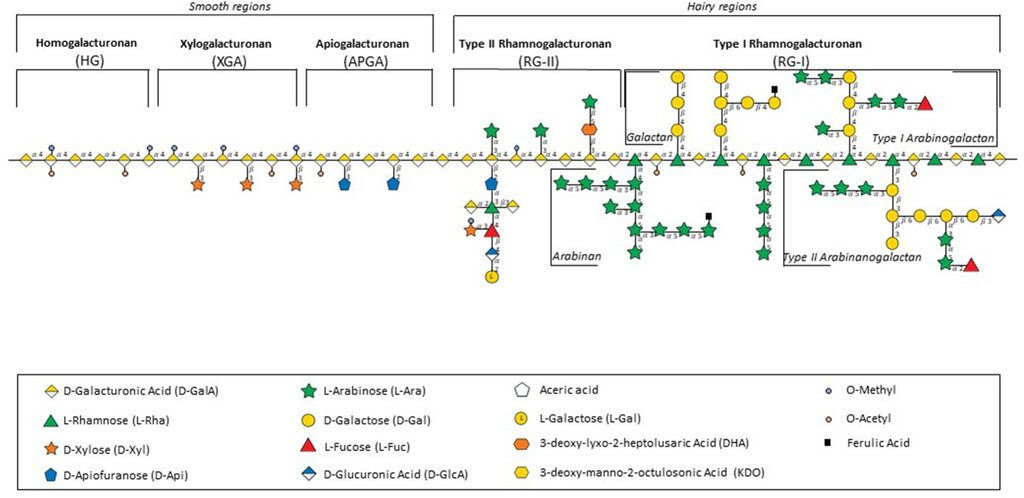
In the plant cell wall, pectin performs a role that’s a bit like mortar between bricks. It's concentrated in a layer called the middle lamella, which is the very first layer formed when a plant cell divides. This pectin-rich layer glues adjacent cells together, helping to form cohesive tissues. Pectin also forms a gel-like matrix within the cell wall itself, embedding other structural components like cellulose fibers. This hydrated gel provides flexibility and allows the cell wall to expand as the plant grows.
While collagen provides tensile strength in animals, pectin provides adhesion and compressive resistance in plants.
Different Kingdoms Different Solutions
Collagen and pectin are perfect examples of convergent evolution, where different organisms independently develop solutions to similar problems. Animals, which need to move, evolved a flexible, strong protein matrix based on collagen to support their tissues. Plants, which are stationary, evolved a rigid carbohydrate-based cell wall where pectin acts as a crucial adhesive and filler.
Both are essential structural molecules, but they are built from different fundamental blocks: collagen from amino acids, and pectin from sugars. This fundamental difference highlights the distinct evolutionary paths taken by the animal and plant kingdoms to achieve structural stability.
| Feature | Collagen | Pectin |
|---|---|---|
| Kingdom | Animalia | Plantae |
| Molecule Type | Protein | Polysaccharide (Carbohydrate) |
| Building Block | Amino Acids | Sugars (Galacturonic Acid) |
| Primary Role | Tensile Strength | Adhesion & Compression Resistance |
| Location | Extracellular Matrix | Cell Wall (Middle Lamella) |
Understanding these two molecules provides a fascinating glimpse into the different strategies life has adopted to build strong, functional organisms.
Ready to check your understanding? Let's see what you've learned about these fundamental biomolecules.
What are the fundamental building blocks of collagen?
The text uses the analogy of "mortar between bricks" to describe the function of which molecule?
By understanding the distinct roles of collagen in animals and pectin in plants, we can better appreciate the diverse molecular toolkits that evolution has produced to solve the universal challenge of structural support.