Coding Essentials for Vibe Coders
Introduction to Programming
What Is Programming?
At its core, programming is the process of giving a computer a set of instructions to perform a specific task. Think of it like writing a recipe. A recipe lists ingredients and step-by-step directions to create a dish. In the same way, a program lists commands for a computer to follow to achieve a goal, like calculating a sum, displaying a webpage, or running a game.
Computers are very literal. They do exactly what you tell them to, which means the instructions need to be precise and clear.
The purpose of programming is to solve problems. We use it to automate repetitive tasks, analyze huge amounts of data, and create the software and applications we use every day, from the social media app on your phone to the operating system on your laptop.
Speaking the Computer's Language
We can't give computers instructions in English or Spanish. Computers operate on a fundamental level using machine code, which is just a series of ones and zeros. This is incredibly difficult for humans to write or understand directly.
This is where programming languages come in. They act as a bridge between human language and machine code. A programming language provides a set of rules and commands that are readable to humans but can also be translated into machine code for the computer to execute. There are hundreds of different languages, like Python, Java, and C++, each designed with different strengths and purposes, much like a carpenter has different tools for different jobs.
A special program called a compiler or an interpreter does this translation work. You write the code, and the compiler turns it into an executable file that the computer can run.
Writing a Simple Program
A long-standing tradition in programming is to make your first program display the message "Hello, World!". It's a simple way to confirm that everything is set up correctly and to see your code do something tangible. While the exact code differs between languages, the basic idea is the same.
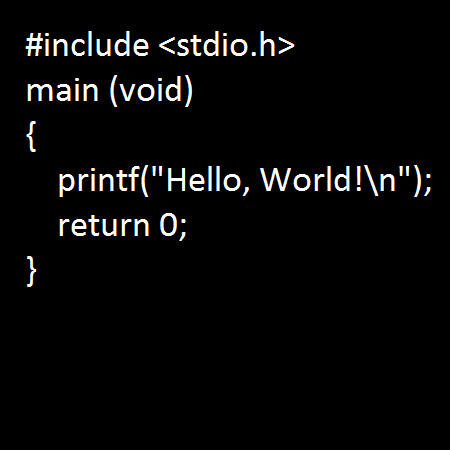
This simple program illustrates two key concepts: syntax and semantics.
syntax
noun
The set of rules that defines the combinations of symbols that are considered to be correctly structured programs in a specific language. It's the 'grammar' of the language.
Syntax includes things like spelling commands correctly (e.g., printf not print), using parentheses () where required, and ending statements with a semicolon ; in some languages. If the syntax is wrong, the program won't run at all.
semantics
noun
The meaning of the expressions, statements, and program units in a language. It's the logic or what the code is supposed to do.
Semantics is about the meaning behind the code. For example, if you wrote a program to print "Hello, World!" but accidentally typed printf("Goodbye, World!");, the syntax is perfect. The program will run without any errors, but it doesn't do what you intended. It has a semantic error.
Correct syntax gets your program to run. Correct semantics makes your program run correctly.
And that's the essence of programming: learning the syntax of a language and using it to write instructions with the right semantics to solve a problem. It all starts with that first "Hello, World!".
What is the primary purpose of programming?
Why are programming languages necessary?