CNC Height Setter Setup for UCCNC
Understanding CNC Height Setters
Finding the Perfect Height
When you're running a CNC job, you often need to switch between different tools. One moment you might be using a long, pointed end mill, and the next, a short, flat one. Each tool has a unique length, and the CNC machine needs to know exactly how long each one is to cut at the correct depth. If it misjudges the length, it could cut too deep and ruin your workpiece, or not cut deep enough, wasting a pass. A height setter, also known as a tool length sensor, solves this problem. It's a device that precisely measures the length of each tool you use.
Think of it like this: your machine's spindle moves up and down along the Z-axis. The machine's "home" position is a fixed point, but the tip of the cutting tool changes with every tool swap. The height setter acts as a consistent reference point. By touching the tool tip to the sensor, the machine can calculate the exact length of the tool and store it as a 'tool length offset.' This offset tells the control software precisely how far to move the Z-axis to make a perfect cut.
Accuracy is everything in CNC machining. A tiny error in the tool height measurement can have a big impact. If the measurement is off, you might find that engraving is too shallow, pockets aren't deep enough, or worse, the tool crashes into your workpiece or clamps. Using a height setter automates this measurement, removing the potential for human error that comes with manual methods, like using a piece of paper. This automation not only improves precision but also speeds up your workflow significantly, especially on jobs that require multiple tool changes.
Precise tool height ensures every cut is made at the intended depth, leading to consistent, high-quality results and preventing costly mistakes.
Types of Height Setters
Height setters come in a few different forms, but they all achieve the same goal. The most common types are touch probes and dedicated tool length sensors.
Tool Length Sensors are typically small, puck-like devices mounted to a fixed position on the machine's bed. To measure a tool, the machine moves the spindle over the sensor and slowly lowers the tool until it makes contact with the sensor's surface. When the tool touches the surface, it completes an electrical circuit, sending a signal to the controller. The controller instantly records the Z-axis position at that exact moment. Since the location of the sensor is known, the machine can accurately calculate the tool length offset. Some sensors use a physical switch instead of an electrical circuit, but the principle is the same.
The tool setter is used to measure the length of the bit, relative to the tool setter.
Touch Probes are more versatile. A touch probe can be mounted in the spindle just like a cutting tool. It has a stylus that, when it makes contact with a surface, sends a signal to the controller. While they are often used to find the edges and corners of a workpiece (setting the X and Y zero points), they can also be used to set tool heights. You would touch the probe to the top of the workpiece to establish the Z zero, then touch each cutting tool to a fixed sensor on the machine bed. The machine then uses the difference between these measurements to know exactly where the tool tip is in relation to the top of the material.
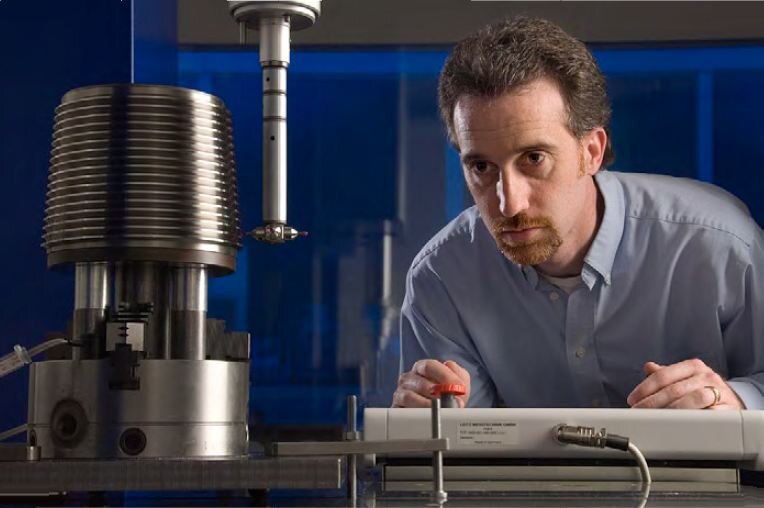
Both types of setters dramatically improve the reliability and efficiency of the CNC process. By automating the critical task of tool measurement, they allow operators to produce accurate parts consistently, with fewer errors and faster setup times.
What is the primary purpose of a CNC height setter (or tool length sensor)?
When a tool makes contact with a typical puck-style tool length sensor, how does it signal the controller to record the Z-axis position?