Clinical Pathophysiology of Anemia
Iron Metabolism Kinetics
The Iron Gatekeeper
Your body performs a constant balancing act with iron. You need it for oxygen transport and energy production, but too much free iron is toxic. To manage this, the body doesn't have an active way to excrete excess iron. Instead, it tightly controls how much iron gets into the bloodstream from the intestines and from recycled red blood cells.
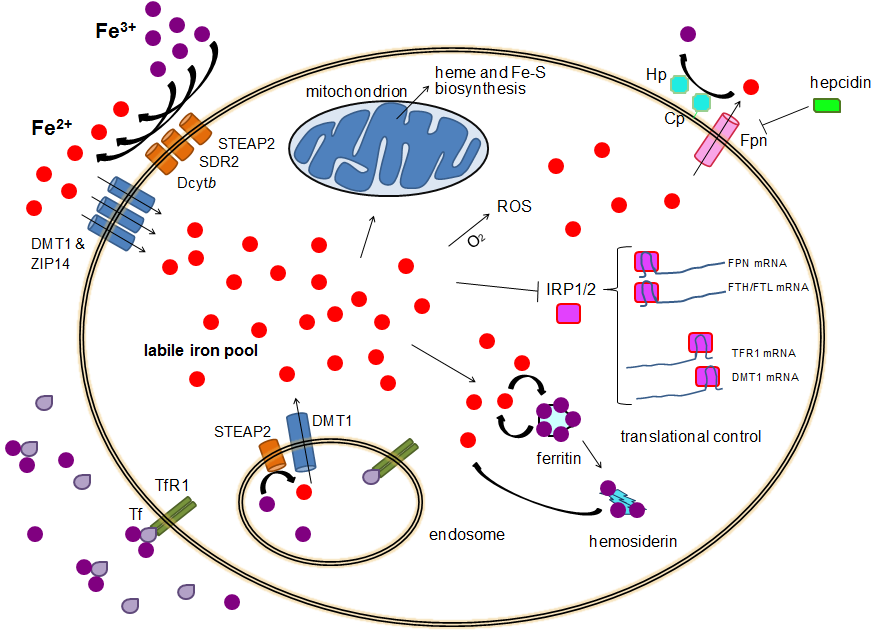
The master regulator of this process is a hormone called , produced by the liver. Think of Hepcidin as the chief gatekeeper for iron. When your iron stores are high, the liver releases more Hepcidin. This hormone travels through the blood and finds its target: a protein called Ferroportin.
Ferroportin acts as the only known cellular gate for iron to exit a cell and enter the bloodstream. It's found on the surface of intestinal cells (enterocytes) and macrophages. When Hepcidin binds to Ferroportin, it causes the gate to be internalized and destroyed. This traps iron inside the cells, preventing it from entering circulation and lowering your blood iron levels.
Getting Iron On Board
Before Hepcidin can regulate iron's exit, the iron has to get into the intestinal cells in the first place. This absorption process happens primarily in the duodenum, the first part of the small intestine.
Most dietary iron comes in the ferric () state, which our bodies can't easily absorb. On the surface of duodenal cells, an enzyme called Duodenal cytochrome B (Dcytb) reduces ferric iron to its more soluble ferrous () form. Immediately after this conversion, a protein called Divalent Metal Transporter 1 (DMT1) grabs the ferrous iron and transports it into the cell.
Once inside the enterocyte, the iron has two potential fates: it can be stored in a protein called Ferritin or it can be transported out into the bloodstream via Ferroportin, ready for use by the body.
The Transport System
Free iron is reactive and can cause cellular damage, so it can't just float around in the blood. As soon as iron exits a cell through Ferroportin, it's immediately picked up by a transport protein called
Each Transferrin molecule can bind two iron ions. In a healthy person, only about one-third of the available Transferrin is actually carrying iron at any given time. This provides a significant buffer, allowing the body to handle sudden influxes of iron without danger.
Clinically, we measure this using two key metrics. Total Iron Binding Capacity (TIBC) is an indirect measure of the total amount of Transferrin in the blood. Transferrin Saturation (TSAT) is a percentage calculated from the serum iron level and the TIBC, telling us exactly what proportion of Transferrin is currently occupied by iron.
In classic iron-deficiency anemia, iron stores are low, so serum iron is low. The body responds by producing more Transferrin to try and capture any available iron, causing the TIBC to go up. The result is a very low Transferrin Saturation, often below 15%.
Storage and Recycling
The body is incredibly efficient at recycling iron. Red blood cells have a lifespan of about 120 days. When they get old or damaged, they are engulfed by specialized macrophages, primarily in the spleen. These macrophages break down the hemoglobin and liberate the iron.
This recycled iron is then either stored within the macrophage inside Ferritin or released back into the bloodstream via Ferroportin, where it binds to Transferrin to be reused.
is the body's main iron storage protein, found in virtually all cells, but especially in the liver, spleen, and bone marrow. While most Ferritin is inside cells, a small amount circulates in the blood, and its level is directly proportional to the amount of stored iron in the body. This makes serum Ferritin a crucial marker for assessing a person's total iron stores.
The interplay between Hepcidin, Ferroportin, Transferrin, and Ferritin creates a tightly controlled system. In anemia of chronic disease, high inflammation leads to high Hepcidin. This blocks Ferroportin, trapping iron in macrophages and raising Ferritin levels, even while Transferrin Saturation drops because no iron is getting into the blood for transport.
Ready to test your knowledge on iron's journey through the body?
What is the primary function of the hormone Hepcidin in iron regulation?
The body has a highly efficient active excretion system to get rid of excess iron.
Understanding these kinetic pathways is key to diagnosing and managing different types of anemia and iron overload conditions.