Clinical Mastery of Upper Limb Anatomy
Shoulder Girdle Mechanics
A Symphony of Movement
The shoulder's incredible range of motion isn't the work of a single joint. It's the result of a finely tuned partnership between the clavicle, scapula, and humerus, coordinated across three distinct articulations: the sternoclavicular (SC) joint, the acromioclavicular (AC) joint, and the functional scapulothoracic joint. This system allows for sweeping arm movements while providing a stable base for powerful actions.
The clavicle acts as a strut, holding the shoulder out and away from the body. This seemingly simple bone is the only bony connection between the entire upper limb and the axial skeleton. It pivots at the SC joint and allows the scapula to glide and rotate along the ribcage, a movement essential for positioning the arm in space.
The 2:1 Rhythm
When you lift your arm out to the side (abduction), the humerus and scapula move in a specific, coordinated pattern known as scapulohumeral rhythm. For the full 180 degrees of abduction, there's a consistent 2:1 ratio of movement. About 120 degrees of the motion comes from the glenohumeral joint (the ball-and-socket), while the remaining 60 degrees comes from the upward rotation of the scapula on the thorax.
This rhythm isn't just an anatomical curiosity; it's a biomechanical necessity. It ensures the glenoid fossa remains aligned under the humeral head, enhancing joint stability at extreme ranges. It also maintains the optimal length-tension relationship for the deltoid muscle, allowing it to generate effective force throughout the entire range of motion.
Muscles in Harmony
Smooth scapular rotation depends on force couples—muscles pulling in different directions to produce a unified rotational movement, much like two hands turning a steering wheel. For upward rotation of the scapula, the upper trapezius, lower trapezius, and serratus anterior muscles form a critical force couple.
The upper trapezius pulls upward, the lower trapezius pulls downward, and the serratus anterior pulls forward and outward around the ribcage. The combination of these linear forces results in the smooth, efficient upward rotation of the scapula that is essential for lifting the arm overhead.
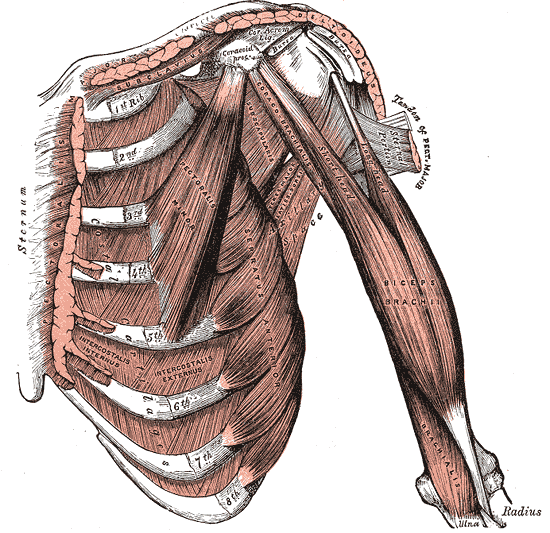
This synchronized action prevents impingement of the rotator cuff tendons under the acromion and ensures the shoulder complex moves as an integrated unit. When one part of this couple is weak or inhibited, the entire rhythm can be thrown off.
Stability and Injury
While muscles provide dynamic stability, ligaments provide static stability. The SC and AC joints, though small, are reinforced by strong ligaments that permit movement while preventing dislocation. The AC joint is stabilized by the acromioclavicular and coracoclavicular ligaments. A hard fall onto the shoulder can tear these ligaments, causing an AC joint separation, where the clavicle springs upward.
When the delicate balance of muscular control is disrupted, it can lead to —abnormal movement of the scapula. This isn't a diagnosis itself, but a sign that the underlying mechanics are faulty. It can manifest as
Scapular winging, where the shoulder blade protrudes from the back. This is often a sign of muscular imbalance or nerve injury affecting the force couples.
Treating shoulder pain often involves more than just focusing on the glenohumeral joint. Restoring proper scapular motion by strengthening the key muscles of the force couple is crucial for long-term function and preventing re-injury.
Progressive, criteria-based loading and scapular control are therapeutic cornerstones.
Understanding these integrated mechanics is key to appreciating both the shoulder's remarkable capabilities and its vulnerability to injury.
What is the primary role of the clavicle in the shoulder complex?
During the full 180 degrees of arm abduction (lifting the arm out to the side), what is the approximate ratio of movement between the glenohumeral joint and the scapulothoracic joint?