Clinical Mastery of Spinal Disc Bulging
Pathophysiology and Disc Dynamics
The Disc's Inner World
The intervertebral disc is a feat of biological engineering, composed of two distinct parts working in concert. At its heart is the nucleus pulposus (NP), a gel-like core rich in water. Its structure is a loose network of Type II collagen fibres suspended in a matrix of water-binding molecules called . Think of it as a pressurised, shock-absorbing cushion. This high water content gives the disc its ability to resist compressive forces, much like a water balloon.
Encasing this core is the annulus fibrosus (AF), a tough outer ring. It's made of 15 to 25 concentric layers, or lamellae, of dense Type I collagen. The fibres in each layer are oriented at an angle to the fibres in the layers above and below, forming a crisscross pattern. This design makes the annulus incredibly strong, allowing it to withstand twisting and bending forces, much like the steel belts in a radial tyre.
The Continuum of Failure
Disc degeneration isn't an event; it's a process. It begins with biochemical changes long before any structural failure occurs. The concentration of proteoglycans in the nucleus pulposus declines, causing it to lose water and become dehydrated. The once-pressurised cushion starts to lose its height and ability to absorb shock effectively.
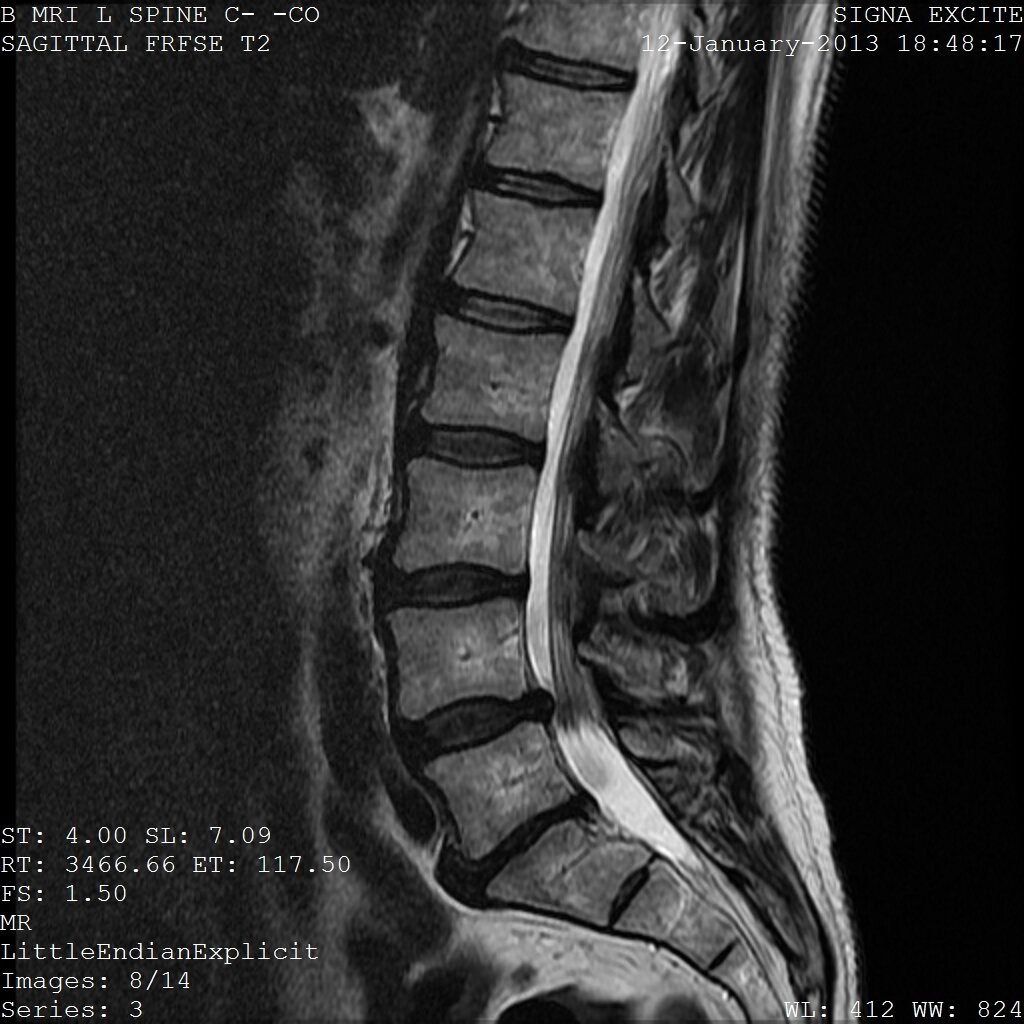
This leads to the first stage of structural change: a 'bulge'. The dehydrated disc sags and expands outwards around its entire circumference. The annulus fibrosus remains intact, but the overall structure is weakened.
A 'herniation' is different. This is a focal displacement of disc material, not a general sagging. Herniations are often classified by their severity. A 'protrusion' occurs when the nucleus pushes into the annulus, but the outer layers of the annulus are still intact. An 'extrusion' is more severe; the nucleus has breached the annulus completely and leaked into the space outside the disc.
Pain's Two Triggers
A herniated disc can cause pain in two main ways: mechanically and chemically.
Mechanical irritation is straightforward. If the extruded nucleus pulposus material physically presses on a nerve root, it can cause pain, numbness, or weakness in the area that nerve supplies. The larger the herniation, the more severe the compression can be.
Chemical irritation is more subtle but equally potent. The material of the nucleus pulposus is recognised by the body's immune system as 'foreign' when it's outside the confines of the annulus fibrosus. This triggers an inflammatory response. The immune system releases a flood of inflammatory mediators, including , into the area. This chemical soup can severely irritate the nerve root, causing intense pain even if the mechanical pressure from the disc is minimal.
This explains why two herniations of the exact same size on an MRI can produce wildly different symptoms. One person might be asymptomatic, while another is in agony, depending on the level of chemical inflammation.
Finally, not all back pain from a disc issue involves a nerve root. The outer third of the annulus fibrosus is innervated by a small nerve called the . A tear or irritation in these outer fibres can directly stimulate this nerve, causing localised 'discogenic' pain without any leg symptoms. It’s a direct pain signal from the damaged disc itself.
Let's check your understanding of these critical distinctions.
What is the primary role of the high water content within the nucleus pulposus?
The initial biochemical change that begins the process of disc degeneration is a decline in what substance?
Understanding the interplay between the disc's biochemistry and its structural integrity is the key to grasping why and how disc-related pain occurs.