Clinical Mastery of JAK Inhibitors in Dermatology
JAK-STAT Signaling Pathways
The Cell's Relay Race
Imagine your cells need to respond to an external signal, like a message warning of inflammation. They can't just open the door and let the message in. Instead, they rely on a sophisticated relay system to carry the message from the outside of the cell to the DNA inside its nucleus. The JAK-STAT pathway is one of these critical messaging systems.
The key players are Janus kinases (JAKs) and Signal Transducers and Activators of Transcription (STATs). Think of JAKs as the first runners in the relay. They are enzymes that wait just inside the cell membrane, attached to cytokine receptors. STATs are the second runners, floating in the cytoplasm, waiting for the handoff.
The race begins when a —a signaling protein like interleukin-4 (IL-4) or interferon-gamma (IFN-gamma)—binds to its specific receptor on the cell's surface. This binding is like the starting gun. It pulls two receptors, and their attached JAKs, close together. This proximity allows the JAKs to activate each other through a process called phosphorylation, essentially tagging each other with a phosphate group to pass the baton.
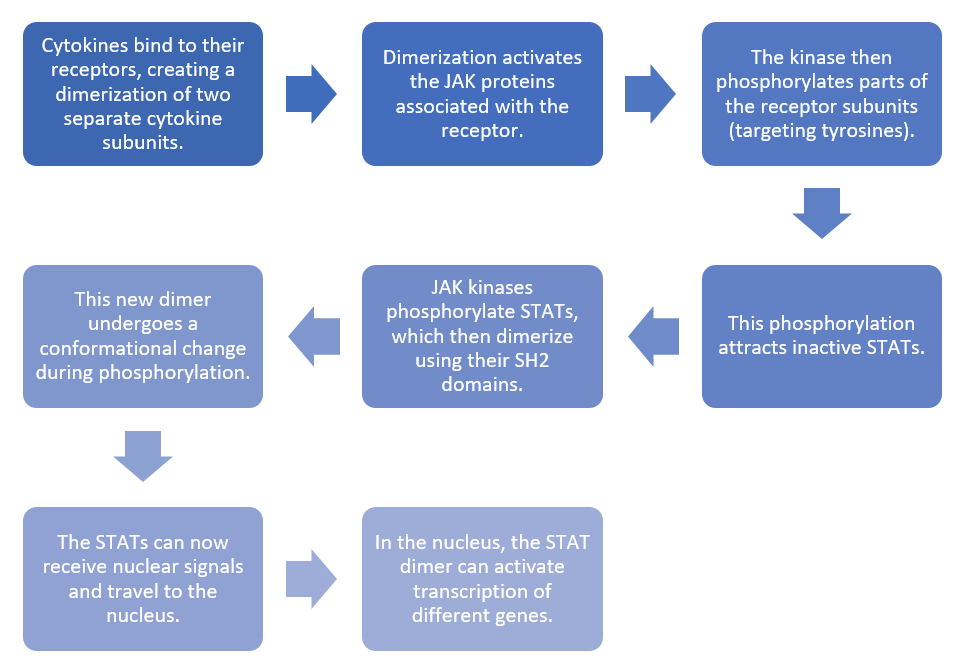
Once activated, the JAKs don't just stop. They immediately phosphorylate the receptor itself, creating a docking site for STAT proteins. When a STAT protein binds to this site, the JAK phosphorylates it too. This energized STAT then detaches, finds another phosphorylated STAT, and they pair up, forming a dimer—two proteins bound together. This STAT dimer is the final runner. It has the clearance it needs to enter the cell's nucleus, where it binds to specific DNA sequences and initiates the transcription of genes that fuel inflammation.
A Team of Specialists
The system's specificity comes from the fact that there isn't just one type of JAK or STAT. Humans have four JAK enzymes: JAK1, JAK2, JAK3, and TYK2. Different cytokine receptors are pre-wired to partner with specific JAKs. When a cytokine binds its receptor, it activates a particular combination of JAKs, which in turn recruits and activates a specific subset of STATs.
This combinatorial system allows the cell to produce a tailored response to hundreds of different signals using a relatively small number of components. For dermatological conditions, understanding which cytokines use which JAKs is the key to targeted therapy.
| Cytokine(s) | Associated JAK Pair(s) | Relevance to Skin |
|---|---|---|
| IL-4, IL-13 | JAK1, JAK3 | Key drivers of atopic dermatitis (eczema) |
| IL-12, IL-23 | JAK2, TYK2 | Heavily involved in psoriasis |
| IFN-gamma | JAK1, JAK2 | Broad pro-inflammatory signal in many skin diseases |
| IL-6 | JAK1, JAK2, TYK2 | Contributes to systemic inflammation and skin conditions |
By knowing that the signals for eczema are primarily transmitted through JAK1 and JAK3, we can use drugs that specifically inhibit those enzymes. This blocks the relay race at a crucial step, preventing the STAT dimers from ever reaching the nucleus to turn on the inflammatory genes. The result is a highly targeted interruption of the intracellular signal that drives the disease.
What is the initial event that triggers the activation of the JAK-STAT signaling pathway?
The process by which JAKs and STATs are activated is called __________.