Clinical Lipidology and Management Strategies
Lipoprotein Pathophysiology
Two Highways for Lipid Transport
Lipids are essential, but they don't dissolve in blood. To travel through the circulation, they're packaged into particles called lipoproteins. Think of these as tiny delivery trucks, each with a specific origin and destination. There are two distinct transport systems: one for fats from your diet (exogenous) and another for fats made by your liver (endogenous).
The Exogenous Pathway
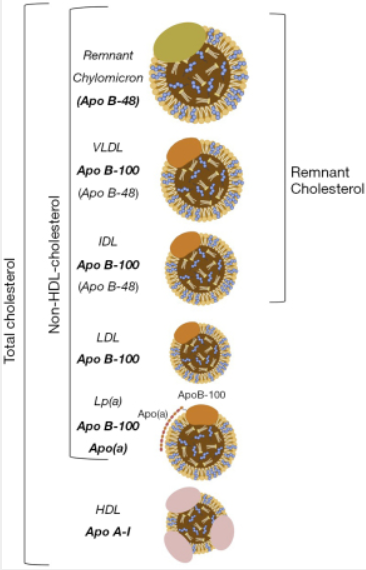
This route begins after a meal. Dietary triglycerides and cholesterol are absorbed by intestinal cells and assembled into the largest, most triglyceride-rich lipoproteins: chylomicrons. Each chylomicron is built around a structural protein called Apolipoprotein B-48 (ApoB-48), which is exclusive to this particle.
Once released into the lymphatic system and then the bloodstream, chylomicrons are not yet fully functional. They mature by acquiring two key apolipoproteins from high-density lipoproteins (HDL): ApoC-II and ApoE.
's job is crucial. As chylomicrons circulate, ApoC-II acts as a key, activating an enzyme called (LPL) located on the walls of capillaries in muscle and fat tissue. LPL rapidly breaks down the triglycerides inside the chylomicron, releasing free fatty acids that nearby cells can absorb for energy or store for later. As it sheds its triglyceride cargo, the chylomicron shrinks, becoming a chylomicron remnant. This remnant, now relatively enriched in cholesterol, travels to the liver, where its ApoE protein is recognized by hepatic receptors, leading to its swift removal from circulation.
The Endogenous Pathway
While the exogenous pathway handles dietary fats, the endogenous pathway manages lipids produced internally by the liver. The liver packages its own triglycerides and cholesterol into Very Low-Density Lipoproteins (VLDL). A key distinction is that VLDL particles use a full-length version of ApoB, called ApoB-100, as their structural protein. This single protein will stay with the particle throughout its entire lifecycle.
Once secreted into the blood, VLDL particles follow a similar path to chylomicrons. They acquire ApoC-II and ApoE from HDL. The newly acquired ApoC-II activates LPL on capillary walls, which cleaves VLDL's triglycerides, releasing fatty acids to peripheral tissues. As VLDL loses triglycerides, it transforms into a smaller, denser particle known as Intermediate-Density Lipoprotein (IDL), or a remnant lipoprotein.
Remnant lipoproteins like IDL are considered highly atherogenic. They are small enough to penetrate the endothelial lining of arteries but still large enough to be engulfed by macrophages, contributing to foam cell formation and plaque development.
LDL Formation and Clearance
The fate of IDL is a critical branch point. About half of the IDL particles are cleared directly by the liver via their ApoE protein. The remaining IDL particles undergo further modification in the circulation. An enzyme called hepatic lipase removes more triglycerides, and the particle sheds most of its apolipoproteins, except for the single, defining ApoB-100. This final transformation creates the Low-Density Lipoprotein (LDL).
LDL is a small, dense, cholesterol-rich particle. Its primary role is to deliver cholesterol to peripheral tissues. This delivery and its clearance from the blood depend entirely on the LDL receptor, which specifically recognizes ApoB-100.
The number of LDL receptors on the surface of liver cells is tightly regulated. When a hepatocyte has enough cholesterol, it reduces the synthesis of LDL receptors, causing plasma LDL levels to rise. Conversely, when the cell needs cholesterol (for example, when statins block its internal production), it upregulates LDL receptors, pulling more LDL particles out of the blood. This homeostatic mechanism is central to lipid management. Dysregulation, whether through genetics or lifestyle, leads to elevated LDL levels and accelerates because more ApoB-100-containing particles are available to enter the arterial wall.
Understanding these two pathways provides the foundation for interpreting a patient's lipid panel and managing their cardiovascular risk. Pathophysiology in either system—be it hepatic overproduction of VLDL or impaired clearance of LDL remnants—drives the development of atherosclerosis.
Which lipoprotein is primarily responsible for transporting triglycerides from a meal you've just eaten?
The apolipoprotein ApoC-II plays a crucial role by activating which enzyme?