Clinical Applications and Mechanisms of rTMS
Synaptic Plasticity Mechanisms
Modulating Synapses with Frequency
Repetitive Transcranial Magnetic Stimulation (rTMS) doesn't just pass electricity through the brain; it fine-tunes the communication between neurons. The key is frequency. By adjusting the rate of the magnetic pulses, we can either strengthen or weaken the connections, or synapses, between brain cells.
Think of it like training a muscle. High-frequency rTMS, typically at 5 Hz or higher, is like a rapid workout. It bombards the neurons with quick, successive pulses, causing them to fire repeatedly. This intense activity strengthens their connections, a process known as Long-Term Potentiation (LTP). The synapse becomes more efficient, making it easier for the presynaptic neuron to excite the postsynaptic neuron in the future.
Conversely, low-frequency rTMS, at 1 Hz or less, acts more like a slow, controlled stretch. The steady, infrequent pulses gently stimulate the neurons without causing a frenzy of activity. This leads to a weakening of synaptic connections, a phenomenon called Long-Term Depression (LTD). The synapse becomes less responsive, dampening communication along that pathway.
High-frequency transcranial magnetic stimulation (HF-rTMS, ≥ 5 Hz) enhances local neural excitability, whereas low-frequency transcranial magnetic stimulation (LF-rTMS, ≤ 1 Hz) produces inhibitory effects on neural activity.
These opposing effects are the foundation of rTMS therapy. For conditions like depression, often linked to underactivity in certain brain regions, high-frequency rTMS can be used to boost neuronal communication. For conditions characterized by hyperactivity, like some anxiety disorders, low-frequency rTMS can help calm things down.
The Molecular Gatekeeper
These changes in synaptic strength are driven by a crucial molecular player: the N-methyl-D-aspartate (NMDA) receptor. The NMDA receptor is a special type of channel on the surface of a neuron that allows ions to pass through, but only when certain conditions are met. Think of it as a gate with two locks.
The first lock is the neurotransmitter glutamate, which must bind to the receptor. The second lock is the neuron's own electrical state. At rest, the channel is blocked by a magnesium ion (). For the gate to fully open, the neuron must already be partially excited (depolarized) to push the magnesium ion out of the way. This dual-requirement makes the NMDA receptor a coincidence detector—it only opens when the sending neuron releases glutamate and the receiving neuron is already active.
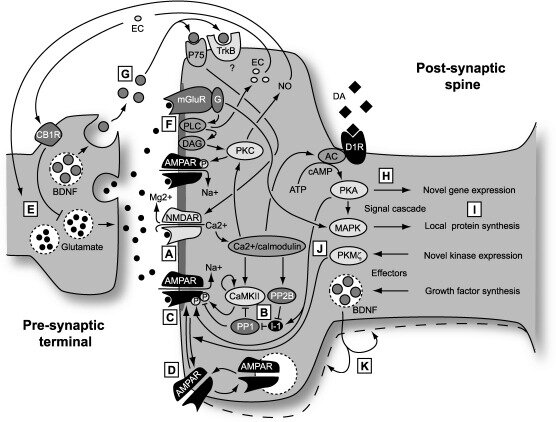
During high-frequency rTMS, the rapid firing causes a strong, sustained depolarization of the postsynaptic neuron. This effectively ejects the magnesium plug from the NMDA receptors. With the gate now open, calcium ions () flood into the cell. This large influx of calcium triggers a cascade of chemical reactions that strengthens the synapse, primarily by adding more AMPA receptors (another type of glutamate receptor) to the surface. More receptors mean a stronger response to future glutamate release—the essence of LTP.
Low-frequency stimulation tells a different story. It causes a smaller, more gradual increase in intracellular calcium. This modest influx activates a different set of enzymes, specifically protein phosphatases. These enzymes do the opposite of the LTP cascade: they remove AMPA receptors from the synapse, making it less responsive and inducing LTD.
The Brain's Internal Thermostat
The brain isn't a passive recipient of rTMS. Its response depends on its state before stimulation begins. This concept is known as metaplasticity—plasticity of plasticity. The brain has homeostatic mechanisms to prevent neural activity from spiralling out of control, ensuring that synapses don't become maximally strong or completely silent.
One of the most influential frameworks for this is the Bienenstock-Cooper-Munro (BCM) model. The BCM model proposes that there's a sliding threshold for inducing LTP versus LTD. This threshold isn't fixed; it changes based on the recent history of activity at that synapse.
If a synapse has been highly active, the threshold for inducing LTP shifts higher, making it harder to strengthen it further and easier to induce LTD. This prevents runaway excitation. Conversely, if a synapse has been quiet, the threshold shifts lower, making it more receptive to potentiation. This homeostatic metaplasticity means that the effect of an rTMS session can depend on the patient's brain activity just before and during the treatment, a critical factor in achieving consistent therapeutic outcomes.
The ultimate goal of rTMS is to produce lasting changes in cortical excitability that outlive the stimulation session itself. By repeatedly applying these patterned pulses over days or weeks, the induced LTP- or LTD-like effects can stabilize, leading to a meaningful and persistent reorganization of neural circuits.
What is the primary effect of applying high-frequency rTMS (≥ 5 Hz) to a neural pathway?
A patient is being treated for a disorder linked to hyperactivity in the dorsolateral prefrontal cortex. Which rTMS protocol would be most appropriate to calm this region?
By understanding these fundamental mechanisms, clinicians can better tailor rTMS protocols to modulate specific neural circuits, nudging them toward a healthier state of balance and function.