Clinical Anatomy of the Gluteal Region
Gluteal Topography and Osteology
The Gluteal Framework
The gluteal region, or buttocks, is more than just a collection of muscles; it's a complex anatomical area built upon a solid bony framework. This framework is formed by the pelvic girdle and the proximal end of the femur. The pelvic girdle itself is composed of the two hip bones, known as the os coxae, which connect posteriorly with the sacrum.
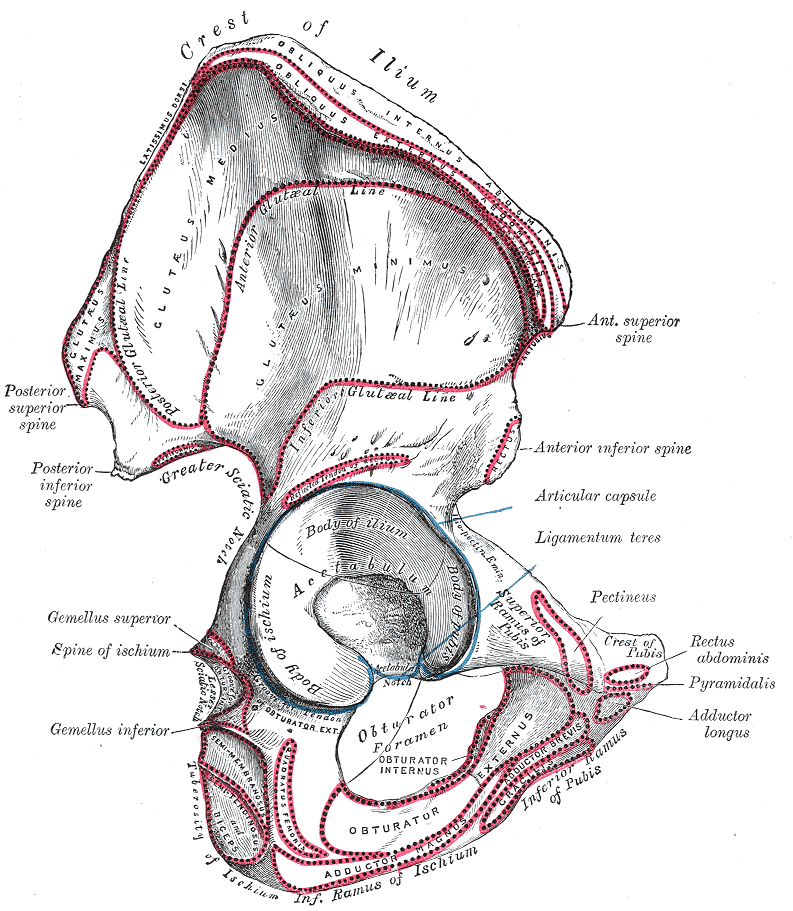
Three specific bony landmarks are essential for understanding the structure and function of this region. These are points you can often feel, or palpate, through the skin.
First is the iliac crest, the curved superior border of the ilium, which is the largest bone of the pelvis. You can feel this as the ridge at the top of your hip. Second is the greater trochanter, a prominent projection on the proximal and lateral part of the femur. It serves as a major attachment site for several gluteal muscles. Finally, the ischial tuberosity is the rounded bone at the lower part of the ischium, sometimes called the "sit bone" because it bears the body's weight when sitting.
Defining the Boundaries
Topographically, the gluteal region has clear boundaries. Superiorly, it is defined by the iliac crest. Inferiorly, the boundary is the gluteal fold, the horizontal crease formed by the skin and underlying fat at the junction of the buttock and the thigh.
The vertical boundary separating the two buttocks is the intergluteal cleft. These surface landmarks directly correspond to the underlying skeletal structures and are crucial for clinical examinations and understanding muscle actions.
Superior Boundary: Iliac Crest Inferior Boundary: Gluteal Fold Medial Boundary: Intergluteal Cleft
Gateways of the Pelvis
The posterior aspect of the os coxae features two large indentations: the greater and lesser sciatic notches. On their own, they are simply open curves in the bone. However, two strong ligaments transform these notches into critical passageways, or foramina.
The sacrotuberous ligament is a large, flat band that runs from the sacrum to the ischial tuberosity. The smaller sacrospinous ligament runs from the sacrum to the ischial spine, a pointed projection that separates the greater and lesser sciatic notches.
By closing off the posterior aspect of these notches, the ligaments create the greater sciatic foramen and the lesser sciatic foramen. These openings are the primary gateways for nearly all nerves and blood vessels that pass from the pelvic cavity into the gluteal region and the back of the thigh. Understanding their location and boundaries is the key to understanding the organization of the entire region's neurovasculature, which we will explore next.
Now, check your understanding of the gluteal region's bony framework.
What bony landmark is commonly known as the 'sit bone' because it bears the body's weight when sitting?
Which structures are primarily responsible for transforming the greater and lesser sciatic notches into foramina (openings)?
This skeletal and ligamentous structure provides the foundation upon which the powerful gluteal muscles act.