Claude vs Cursor for AI Coding
Introduction to AI-Assisted Coding
Your New Coding Partner
Writing code used to be a solo activity, a conversation between a developer and a machine. Now, there's a third party in the room: artificial intelligence. AI-assisted coding is the practice of using AI tools to help write, debug, and manage software. Think of it as a pair programmer that’s available 24/7, never gets tired, and has processed nearly all the public code in the world.
These AI tools integrate directly into your coding environment. They can suggest the next line of code before you type it, find subtle bugs that might take hours to track down, or even write an entire function based on a simple comment you wrote in plain English. The goal isn't to replace the developer, but to augment their skills.
As artificial intelligence increasingly handles routine coding tasks, developers are shifting their focus towards higher-level skills such as problem definition, system design, critical thinking, and communication.
By offloading repetitive and time-consuming tasks to an AI, you can focus more on the creative aspects of software development: architecting the system, designing a great user experience, and solving the core problem your software is meant to address. This leads to faster development cycles and often, higher-quality code.
The AI Toolkit
AI assistance in programming isn't a single feature but a collection of different tools, each designed to help at various stages of development. Some are small conveniences, while others can fundamentally change how you approach a project.
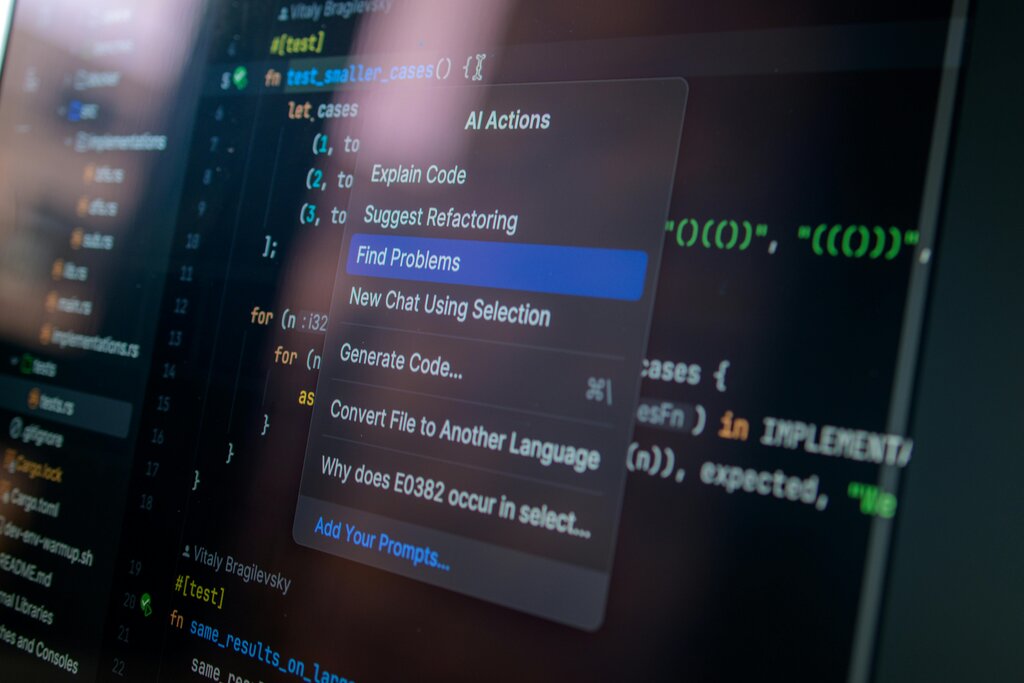
These tools come in many forms. Some are built into code editors, while others are standalone applications or web-based chatbots. Here’s a breakdown of the common types.
| Tool Type | What It Does |
|---|---|
| Code Completion | Suggests single lines or entire blocks of code as you type. |
| Debugging & Analysis | Scans your code to find potential bugs, security flaws, or inefficiencies. |
| Code Generation | Creates code from natural language descriptions (e.g., "write a function to sort a list"). |
| Refactoring | Helps restructure existing code to make it cleaner and more efficient without changing its behavior. |
| Documentation | Automatically generates comments and documentation for your functions and classes. |
The impact of these tools is significant. They lower the barrier to entry for new programmers, making it easier to get started and learn best practices. For experienced developers, they act as a force multiplier, boosting productivity and helping to manage the complexity of large projects.
The key is to treat the AI as a collaborator. You provide the direction and critical thinking, while the AI handles the repetitive syntax and boilerplate code.
In the following sections, we'll dive into specific examples of these tools, like Cursor and Claude Code, to see how they work in practice. For now, let's check your understanding of the basics.
What is the primary goal of AI-assisted coding tools, according to the provided text?
AI-assisted coding is best described as having a conversation between a developer, a machine, and a third party: artificial intelligence.