Classical vs Quantum Computing Explained
Introduction to Computing
What is a computer?
At its heart, a computer is a machine that processes information. It takes input, manipulates it according to a set of instructions, and produces an output. Think of a simple calculator. You input numbers (like 2 + 2), it follows the instruction to add them, and it outputs the result (4).
Modern computers do this on a massive scale, but the core idea is the same. Whether you're editing a photo, writing an email, or watching a video, the computer is just following a long list of simple instructions to manipulate data. But to do this, all that complex information has to be translated into a language the machine can understand.
The language of computers
Computers don't understand words, images, or sounds directly. Instead, they see everything in terms of on or off, yes or no, true or false. This two-state system is called binary, and it's the fundamental language of all classical computers.
Each of these individual pieces of information, a 0 or a 1, is called a bit.
Bit
noun
The basic unit of information in computing. A bit can have only one of two values, most commonly represented as 0 or 1.
You can think of a bit like a light switch. It can either be on (1) or off (0). By itself, a single switch can't convey much information. But when you combine millions or billions of them, you can represent almost anything.
For example, to represent numbers, we use the binary number system. Here's how it compares to the decimal system we use every day:
| Decimal Number | Binary Representation |
|---|---|
| 0 | 0 |
| 1 | 1 |
| 2 | 10 |
| 3 | 11 |
| 4 | 100 |
| 5 | 101 |
By stringing bits together into groups, like a byte (8 bits), computers can represent letters, colors in a picture, and notes in a song. Every piece of data on your computer is just a very long sequence of these 0s and 1s.
The physical switch
So how does a computer physically store and manipulate these 0s and 1s? It uses billions of microscopic electronic switches called transistors.
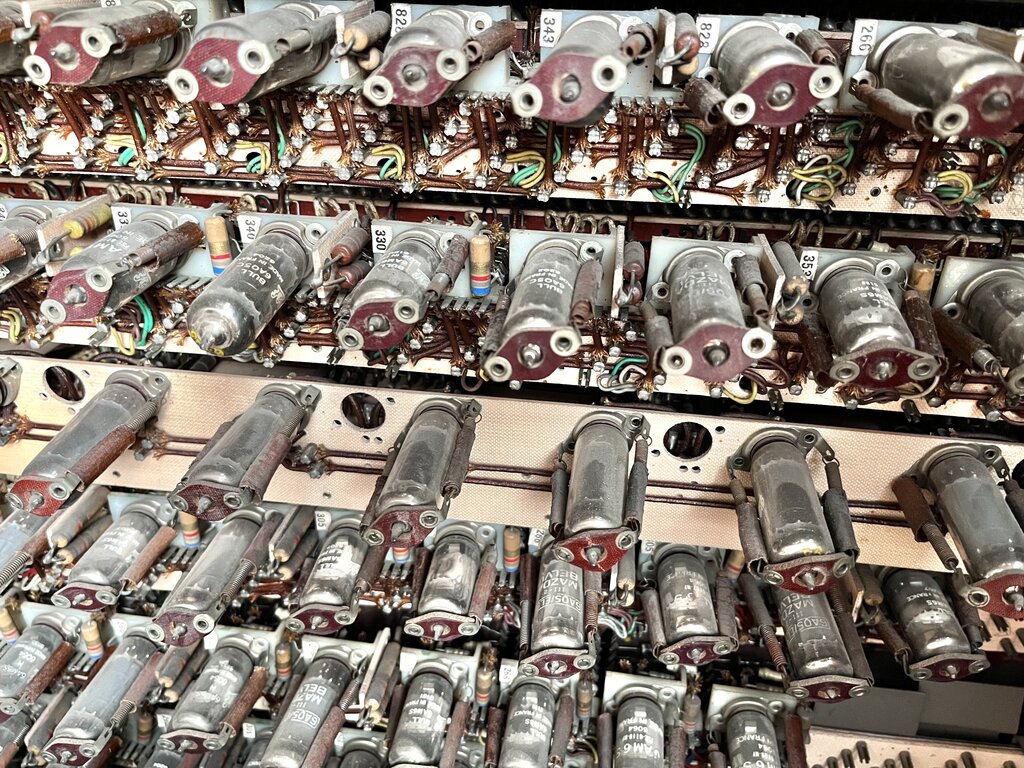
A transistor is a semiconductor device that can either block an electric current or let it pass through. When a current is blocked, it represents a 0 (off). When the current passes, it represents a 1 (on). This allows the computer to physically represent binary information.
These tiny transistors are the fundamental building blocks of modern electronics. They are combined to create something called logic gates, which are the real brains of the operation. Logic gates take one or more binary inputs and produce a single binary output based on a simple rule.
The three most basic logic gates are AND, OR, and NOT. Every task a computer performs is built from combinations of these simple logical operations.
Here's what they do:
- An AND gate outputs 1 only if both of its inputs are 1.
- An OR gate outputs 1 if at least one of its inputs is 1.
- A NOT gate has only one input and simply inverts it. A 1 becomes a 0, and a 0 becomes a 1.
From simple logic to complex tasks
By combining these simple logic gates in clever ways, engineers can build circuits that perform more complex operations, such as addition. For example, a circuit called a "half adder" can add two bits together. It's made from just one AND gate and one XOR gate (a special type of gate built from the basic ones).
When you chain these circuits together, you can add larger and larger numbers. And from addition, you can build circuits for subtraction, multiplication, and division. These arithmetic and logic circuits form the core of a computer's Central Processing Unit (CPU).
All the amazing things a computer does, from rendering a 3D world in a video game to predicting the weather, boil down to executing billions of these incredibly simple logical operations every single second. It's the speed and scale of these operations that create the powerful machines we use every day.
Now that we have a grasp of how classical computers work, let's test your knowledge.