Classical Machine Learning for Data Analysts
Introduction to Machine Learning
What Is Machine Learning?
Instead of writing a long list of rules for a computer to follow, what if you could just show it examples and have it figure out the rules on its own? That's the core idea behind machine learning. It's a way of teaching computers to learn from data, identify patterns, and make decisions with minimal human intervention.
Machine Learning
noun
A field of artificial intelligence (AI) that gives computers the ability to learn from data without being explicitly programmed.
Why is this so significant? Humans are great at spotting patterns, but we have our limits. We can't sift through millions of medical records to find subtle links between lifestyle and disease, or analyze terabytes of financial data to detect fraud in real-time. Machines can. Machine learning automates the process of discovery, allowing us to find valuable insights in massive datasets that would otherwise be impossible to explore.
Types of Machine Learning
Machine learning isn't a single technique; it's a collection of methods. The approach you use depends on the problem you're trying to solve and, most importantly, the type of data you have. The four main categories are supervised, unsupervised, semi-supervised, and reinforcement learning.
Think of it like this: the type of learning is defined by the kind of feedback the computer gets.
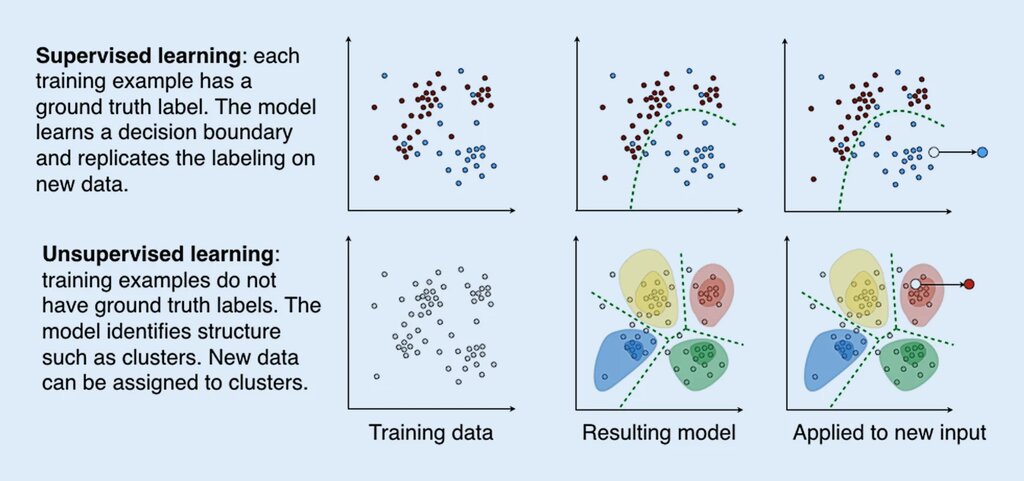
With supervised learning, the machine learns from data that is already labeled. It's like studying with flashcards where the question is on one side and the answer is on the other. The algorithm is given a set of inputs (the questions) and their corresponding correct outputs (the answers). Its job is to learn the mapping function between the two.
A classic example is a spam filter. It's trained on thousands of emails that have already been labeled as 'spam' or 'not spam.' By analyzing these examples, it learns the patterns and words that signal a junk message, so it can classify new, incoming emails correctly.
Unsupervised learning is the opposite. The algorithm is given data without any labels or correct answers. Its task is to find the hidden structure or patterns on its own. It’s like being handed a huge pile of unsorted Lego bricks and asked to group them by color and shape without being told what the categories are.
Businesses often use this for customer segmentation. An algorithm might analyze purchasing data and group customers into distinct clusters, like 'frequent bargain hunters' or 'high-value weekend shoppers,' without any predefined labels. This helps companies tailor their marketing efforts.
Semi-supervised learning is a practical middle ground. It uses a small amount of labeled data alongside a large amount of unlabeled data. This is useful because getting labeled data can be expensive and time-consuming. The model uses the few labeled examples to get a head start on understanding the unlabeled data.
For instance, a photo app might ask you to identify a person in a few pictures. Once it learns who that is, it can then scan the rest of your unlabeled photos to find other images of the same person.
Finally, there's reinforcement learning. This type of learning is all about trial and error. An 'agent' (the algorithm) learns to make decisions by performing actions in an environment to achieve a goal. It receives rewards for good actions and penalties for bad ones.
Think of training a dog. You reward it with a treat for sitting (a good action) but not for barking (a bad action). Over time, the dog learns to sit to maximize its treats. Reinforcement learning is the powerhouse behind game-playing AI, which can learn to master complex games, and it's also used in robotics and self-driving cars to navigate dynamic environments.
| Learning Type | Data Used | Core Idea | Common Application |
|---|---|---|---|
| Supervised | Labeled | Learn from examples with known answers | Spam detection |
| Unsupervised | Unlabeled | Discover hidden patterns | Customer segmentation |
| Semi-supervised | Mostly unlabeled, some labeled | Use a little labeled data to understand lots of unlabeled data | Photo tagging |
| Reinforcement | No predefined data | Learn through rewards and penalties | Game-playing AI |
Machine Learning in Data Analysis
In data analysis, these learning methods unlock powerful capabilities. Supervised learning is used for prediction, such as forecasting sales for the next quarter or identifying patients at high risk for a certain disease.
Unsupervised learning is a key tool for exploration. It helps analysts discover previously unknown customer groups, detect unusual activity that could signal fraud, or organize vast document libraries by topic.
Essentially, machine learning allows us to move beyond simply describing what happened in the past to predicting what will happen in the future and discovering patterns we never knew existed.
Now, let's test your understanding of these fundamental concepts.
What is the core idea behind machine learning?
You are training a model to identify spam emails. You provide it with a large dataset of emails, each one already labeled as 'spam' or 'not spam'. What type of machine learning is this?