Class 9 Computer System Essentials
Computer System Architecture
The Computer's Blueprint
Every modern computer, from a massive supercomputer to the smartphone in your pocket, follows a fundamental design. This design is called the Von Neumann architecture, and it's a simple yet powerful idea: both the instructions a computer follows and the data it works on are stored in the same memory. This means the computer can treat its own instructions as data, a concept that makes computing incredibly flexible.
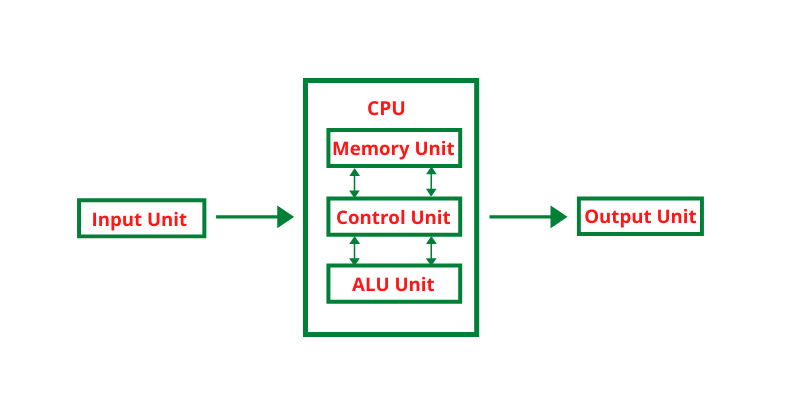
This architecture lays out a logical map for how a computer works. It's not about the physical parts you can touch, but about how information flows and gets transformed. It breaks the computer down into a few key functional units that work together seamlessly.
From Raw Data to Meaningful Information
At its heart, a computer performs a simple, three-step dance called the Input-Process-Output (IPO) cycle. This cycle is how a computer turns raw, meaningless facts into something useful.
Input: You provide raw data to the computer. This could be typing letters on a keyboard, clicking a mouse, or speaking into a microphone.
Process: The Central Processing Unit (CPU) takes this data and performs operations on it based on a set of instructions.
Output: The computer presents the result of the processing as useful information, like displaying text on a screen or playing a sound.
Think of it like baking a cake. Your ingredients—flour, sugar, eggs—are the data. They are just raw items on their own. The act of mixing and baking according to a recipe is the processing. The final, delicious cake is the information—the organised, useful result. A computer does the same thing, but with electronic pulses instead of flour and sugar.
The Functional Units
The IPO cycle is carried out by several key functional units working in concert. The CPU, or Central Processing Unit, is the brain of the operation. It's where the actual "thinking" happens. But the CPU itself is split into two main parts.
The first is the Arithmetic Logic Unit (ALU). This is the calculator of the CPU. It handles all mathematical calculations (addition, subtraction) and logical comparisons (like checking if one number is greater than another). The ALU is built from millions of tiny electronic switches called logic gates, which are the fundamental building blocks of all digital computation.
The second part is the Control Unit (CU). If the ALU is the calculator, the CU is the traffic cop. It doesn't do any calculations itself. Instead, it directs the flow of data between the CPU, memory, and input/output devices. It fetches instructions from memory, decodes them, and tells the other parts of the computer what to do and when to do it.
Together, these units give modern computers their key characteristics: incredible speed, near-perfect accuracy, and the versatility to do everything from editing video to browsing the web. They can perform billions of operations per second without getting tired or making mistakes, all by following the simple, elegant blueprint of the system's architecture.
Ready to check your understanding of how these pieces fit together?
What is the key principle of the Von Neumann architecture?
In the context of the Input-Process-Output (IPO) cycle, raw, unorganised facts are called __________, while the processed, useful result is called __________.
Understanding this architecture is the first step to seeing a computer not as a magic box, but as a logical system designed to turn simple data into powerful information.