Class 9 Computer System Essentials
Computer Architecture Foundations
The Computer's Blueprint
At its heart, every computer follows a clever design plan. This plan, or architecture, determines how all the physical parts work together to run software. The most common blueprint used in everything from your phone to massive supercomputers is the von Neumann architectures.
The core idea is simple but revolutionary: instructions (the program) and data (the information the program works with) are stored in the same memory. Think of it like a cookbook where the recipe (instructions) and the list of ingredients (data) are written on the same page. This allows the computer to treat its own instructions as data, a powerful concept that makes computing flexible.
Von Neumann Architecture is a digital computer architecture whose design is based on the concept of stored program computers where program data and instruction data are stored in the same memory.
The Main Components
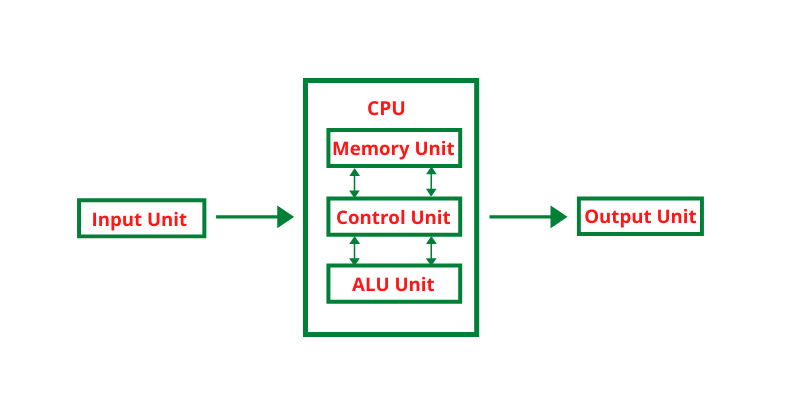
This architecture breaks a computer down into three fundamental sections, which communicate with each other to get work done. This is often shown as a functional block diagram.
-
Input Unit: This is the gateway into the computer. It takes raw data and instructions from the outside world and converts them into a digital format the machine can understand. This includes more than just keyboards and mice; it can be data from a hard drive, a network connection, or a sensor.
-
Central Processing Unit (CPU): Often called the brain of the computer, the CPU is where all the thinking happens. It fetches instructions from memory and executes them. The CPU itself has three main parts:
- Arithmetic Logic Unit (ALU): This is the calculator. It performs all mathematical calculations (addition, subtraction) and logical operations (like AND, OR, and NOT).
- Control Unit (CU): This is the traffic director. The Control Units doesn't perform any calculations itself. Instead, it directs the flow of data between the CPU and other devices, managing and coordinating all the computer's operations.
- Memory Unit: This consists of very fast, small storage locations called registers. They hold data and instructions temporarily that the CPU is currently working on, allowing for rapid access.
-
Output Unit: This is the reverse of the input unit. It takes the processed data from the CPU and converts it into a form humans can understand, such as text on a screen, sound from speakers, or a printed document.
How It All Connects
These components don't work in isolation. They are connected by a set of electrical pathways called a bus. The bus acts like the computer's highway system, allowing data and control signals to travel between the CPU, memory, and the input/output devices.
When you run a program, a constant, cyclical process begins. The CPU fetches an instruction from memory, decodes it to understand the command, executes the command, and then stores the result. This entire process is known as the Fetch-Decode-Execute cycle.
This cycle is the fundamental rhythm of a computer, repeated millions or even billions of times per second. Every single action, from moving your mouse cursor to playing a video, is the result of the CPU executing a long series of these simple instructions.
Let's review what we've learned about the fundamental structure of a computer.
Now, test your understanding of these core concepts.
What is the key principle of the von Neumann architecture?
Which part of the CPU performs mathematical operations like addition and logical operations like AND/OR?
Understanding this architecture is the first step to seeing how a machine made of simple switches and circuits can perform the amazing tasks we see every day.