Class 7 Science Exam Excellence
Photosynthesis and Plant Nutrition
The Leaf's Inner Factory
From the outside, a leaf looks simple. But inside, it's a bustling factory designed for one primary purpose: making food. The leaf's outer layer, the epidermis, is like the factory walls. It's usually coated in a waxy layer called the cuticle, which prevents the leaf from losing too much water.
Beneath the upper epidermis lies the palisade mesophyll, a tightly packed layer of cells filled with chloroplasts. This is the main assembly line for photosynthesis. Below that is the spongy mesophyll, where cells are spread out with large air spaces between them. This structure allows gases like carbon dioxide and oxygen to circulate freely.
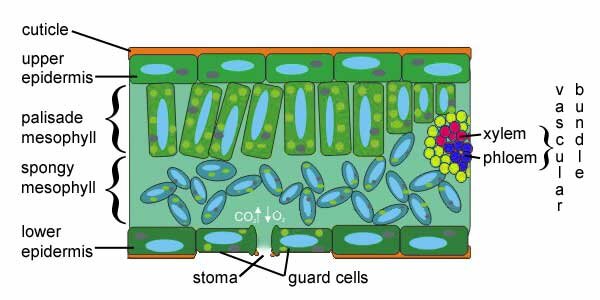
Dotted across the epidermis, especially on the underside of the leaf, are thousands of tiny pores called stomata. Each stoma is flanked by two specialised guard cells. These cells control the opening and closing of the pore, regulating the exchange of gases with the atmosphere. Carbon dioxide enters through the stomata, and oxygen, a waste product of photosynthesis, exits.
The Recipe for Sunlight
Photosynthesis is the chemical process plants use to convert light energy into chemical energy. The recipe has three main ingredients: carbon dioxide () from the air, water () absorbed by the roots, and sunlight. The magic ingredient that captures the sunlight is a green pigment called , found inside chloroplasts.
Using the energy from sunlight, the plant rearranges the atoms of carbon dioxide and water to produce two things: glucose (a type of sugar) and oxygen (). The glucose is the plant's food, providing energy for growth and other life processes. The oxygen is released into the atmosphere.
Alternative Lifestyles
While most plants are autotrophs, meaning they make their own food, some have evolved different strategies. These plants are called heterotrophs.
Parasitic plants, like the dodder, don't have much chlorophyll and can't perform photosynthesis effectively. Instead, they grow on other plants and use specialised structures called haustoria to steal water and nutrients directly from their host.
Insectivorous plants, such as the Pitcher Plant, often grow in soils that are poor in essential nutrients like nitrogen. While they still photosynthesise to make sugars, they supplement their diet by trapping and digesting insects. The pitcher plant has modified leaves that form a pitfall trap containing digestive fluid. Insects are lured in by nectar, slip down the waxy inner walls, and are broken down, providing the plant with the nitrogen it needs.
Other organisms form partnerships. , for example, are a composite organism arising from a symbiotic relationship between algae (or cyanobacteria) and fungi. The algae provide food through photosynthesis, while the fungus provides a protective structure and absorbs water and minerals from the environment. This teamwork allows lichens to thrive in harsh environments where neither organism could survive alone.
The Starch Test
How can we prove that photosynthesis has actually happened? Plants store the glucose they produce as starch. We can test for the presence of starch using an iodine solution. When iodine comes into contact with starch, it turns a blue-black colour.
This is especially interesting to observe in a variegated leaf, which has both green and white patches. The green parts contain chlorophyll and can photosynthesise, while the white parts lack chlorophyll.
If you perform the starch test on a variegated leaf that's been in the light, only the green areas will turn blue-black. This demonstrates that chlorophyll and light are both necessary for photosynthesis to produce starch.
The starch test procedure involves first boiling the leaf in water to break down cell walls, then in alcohol to remove the chlorophyll, and finally adding iodine solution to test for starch.
Ready to check your understanding of how plants create and get their food? Let's see what you've learned.
What is the primary function of the stomata on a leaf's surface?
Which of the following are the three essential ingredients required for photosynthesis to occur?
From the microscopic stomata regulating gas exchange to the complex chemistry of photosynthesis, the life of a plant is a marvel of biological engineering. Understanding these processes reveals just how fundamental plants are to life on Earth.