Class 12 Physics UP Board Chapter 1 Mastery
Electric Charge
The Heart of Electricity
At the core of all electrical phenomena is electric charge. It's a fundamental property of matter, just like mass. While mass determines how an object responds to gravity, charge determines how it responds to electric and magnetic forces.
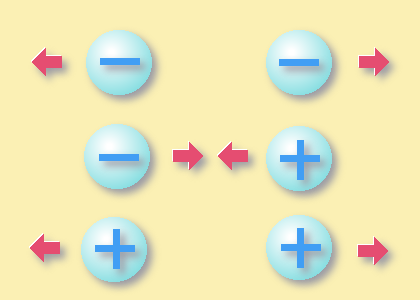
There are two kinds of electric charge: positive and negative. These aren't just arbitrary labels; they describe a fundamental duality. The rule is simple: like charges repel each other, and opposite charges attract. Two positive charges will push each other away, as will two negative charges. But a positive charge and a negative charge will pull toward each other.
This behavior comes from the particles that make up atoms. Protons, found in the atom's nucleus, carry a positive charge. Electrons, which orbit the nucleus, carry a negative charge. An object is electrically neutral when it has an equal number of protons and electrons, as their charges cancel each other out. When this balance is disturbed, the object becomes charged.
The Rules of Charge
Electric charge follows a few simple, unbreakable rules. These properties are universal, applying everywhere from a static shock on a doorknob to the processes inside a star.
Quantization of Charge
Charge isn't continuous; it comes in discrete packets. The smallest unit of free charge ever observed is the charge of a single proton or electron. This is called the elementary charge, denoted by the symbol .
Any observable charge, , in an object is always an integer multiple of this elementary charge. You can have a charge of or , but you can never have a charge of . Think of it like money: you can have 1 cent or 2 cents, but you can't have half a cent. The elementary charge is the "cent" of electricity.
Additivity
noun
The property that the total electric charge of a system is the algebraic sum of all the individual charges contained within it.
Finally, charge is conserved. The law of conservation of charge states that the net charge of an isolated system remains constant. You can't create charge out of thin air, nor can you destroy it. You can only move it from one place to another.
How to Charge an Object
Since charge can't be created, how do objects become charged? It's all about transferring electrons. There are three main ways to do this.
1. Charging by Friction
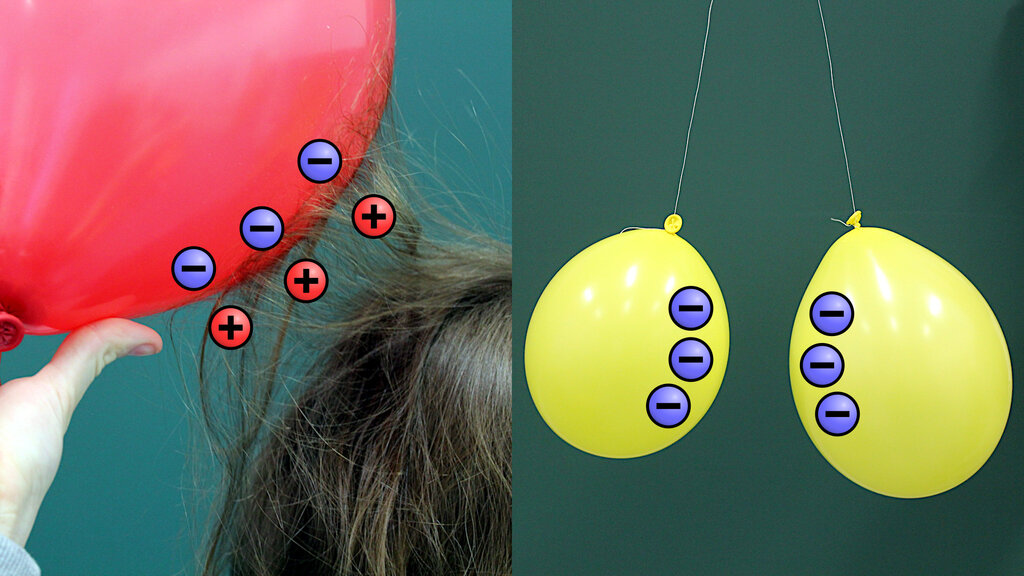
This happens when you rub two different materials together. Electrons can be literally rubbed off one object and transferred to the other. The object that gains electrons becomes negatively charged, and the one that loses them becomes positively charged. Rubbing a balloon on your hair is a classic example: electrons move from your hair to the balloon.
2. Charging by Conduction
Conduction is charging by direct contact. If you touch a charged object to a neutral one, some of the excess charge will transfer. For example, if a negatively charged rod touches a neutral metal sphere, some of the rod's excess electrons will flow onto the sphere, giving it a net negative charge.
3. Charging by Induction
Induction is a clever way to charge an object without actually touching it. If you bring a negatively charged rod near a neutral metal sphere, the electrons in the sphere will be repelled and move to the far side. This leaves the side of the sphere closer to the rod with a net positive charge.
If you then connect the far side of the sphere to the ground (a process called grounding), the repelled electrons will flow away from the sphere into the Earth. Removing the ground connection traps the net positive charge on the sphere. When the rod is moved away, the sphere is left with a uniform positive charge.
Understanding these methods of charging is the first step toward understanding how static electricity works, from lightning in the sky to the cling of a plastic wrap.
Ready to check your understanding?
What is the fundamental rule of interaction between electric charges?
An object has a net positive charge. What does this imply about its atomic composition?
These core ideas—what charge is, its rules, and how it moves—form the foundation for everything else in the study of electricity and magnetism.