Class 10 Comprehensive Curriculum
Numbers and Equations
Numbers and Their Building Blocks
Every composite number can be broken down into a unique product of prime numbers. This simple but powerful idea is called the Fundamental Theorem of Arithmetic and it's the bedrock of number theory. Think of prime numbers as the basic bricks, and composite numbers as the structures you build with them. No matter how you arrange the construction process, the set of bricks for any given structure is always the same.
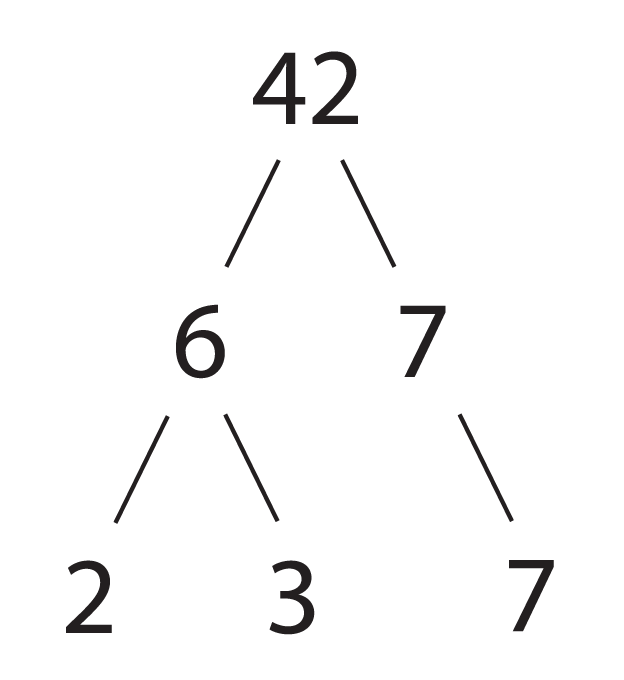
For example, let's factorise the number 140. We can start by dividing it by the smallest prime, 2.
Finding Common Ground
This method of prime factorisation is incredibly useful for finding the Highest Common Factor (HCF) and Lowest Common Multiple (LCM) of two or more numbers. You might remember finding these using listing methods, but prime factorisation is more systematic, especially for larger numbers.
To find the HCF, you take the product of the smallest power of each common prime factor.
To find the LCM, you take the product of the greatest power of each prime factor involved.
Let's find the HCF and LCM of 90 and 144. First, we find their prime factorisations: 90 = 2 × 3 × 3 × 5 = 2¹ × 3² × 5¹ 144 = 2 × 2 × 2 × 2 × 3 × 3 = 2⁴ × 3²
The Nature of Numbers
We can classify real numbers into two groups: rational and irrational. Rational numbers can be expressed as a fraction , where and are integers and . Irrational numbers cannot. Proving a number is irrational often requires a special technique called proof by contradiction..
Let's prove that is irrational. We start by assuming the opposite: that is rational. This means we can write it as a fraction in its simplest form.
- Assume is rational. So, , where a and b are integers with no common factors other than 1 (co-prime), and b ≠ 0.
- Squaring both sides gives , which means .
- This tells us that is an even number. If a square is even, the number itself must be even. So, is even.
- We can write for some integer .
- Substituting this into our equation from step 2: . Dividing by 2 gives .
- This means is also even, so must be even.
- Here is the contradiction. We stated that and have no common factors, but we have just shown they are both even, meaning they share a common factor of 2. Our initial assumption must be false. Therefore, is irrational.
This same logic can be used to prove that , , and other similar roots are irrational.
The World of Polynomials
Moving from numbers to algebra, let's revisit polynomials. A quadratic polynomial has the general form , where . The 'zeros' of a polynomial are the values of for which the polynomial equals zero. For a quadratic polynomial, there's a direct relationship between its zeros and its coefficients.
If the zeros of the polynomial are and , then:
Sum of the zeros: Product of the zeros:
These relationships are powerful. They let us find the sum and product of zeros without actually solving for them.
For the polynomial , we have , , and . Sum of zeros = . Product of zeros = .
Let's check. The zeros of this polynomial are 1 and 3. Sum = . Product = . It works!
Solving Equations Together
Many real-world problems involve multiple conditions, which can be modelled as a pair of linear equations with two variables. For example:
The solution is the pair of values that satisfies both equations simultaneously. We can find this solution graphically or algebraically.
Graphically, the solution is the point where the lines representing the two equations intersect. Algebraically, we can use methods like substitution or elimination.
Substitution Method
- Solve one equation for one variable. From , we get .
- Substitute this expression into the other equation: .
- Solve for : .
- Substitute the value of back into the rearranged equation: . The solution is .
Elimination Method
- Line up the equations. Notice that the coefficients of are and . We can eliminate by adding the two equations together.
| Equation 1 | |
|---|---|
| Equation 2 | |
| Sum |
- Solve for the remaining variable: .
- Substitute this value back into either original equation. Using the first one: . The solution is again . Both algebraic methods give the same result as the graphical approach.
Let's test what you've learned about these core concepts.
What does the Fundamental Theorem of Arithmetic state?
If the prime factorisation of two numbers are and , what is their Highest Common Factor (HCF)?
These topics form the bridge from foundational maths to the more advanced problems you'll face. Mastering them is key.