Clarity and Peace Through Self-Knowledge
Introduction to Humanistic Psychology
A Holistic View of Humanity
Humanistic psychology emerged as a powerful alternative to the dominant schools of thought in the mid-20th century: psychoanalysis and behaviorism. While psychoanalysis focused on unconscious conflicts and behaviorism on learned responses, humanistic psychology took a different path. It championed the idea that people are inherently good and have an innate drive to make themselves and the world better.
Humanistic psychology is a holistic approach in psychology that focuses on the whole person.
This perspective doesn't break a person down into their past traumas or conditioned behaviors. Instead, it looks at the entire individual, emphasizing their creativity, free will, and potential for growth. Two of the most influential figures in this movement were Abraham Maslow and Carl Rogers, who provided frameworks for understanding how we can achieve our full potential.
Maslow's Hierarchy of Needs
Abraham Maslow proposed that human actions are motivated by a series of needs, which he arranged in a hierarchy. Think of it as a pyramid. To reach the top, you must first secure the foundation. You can't worry about your life's purpose if you don't know where your next meal is coming from.
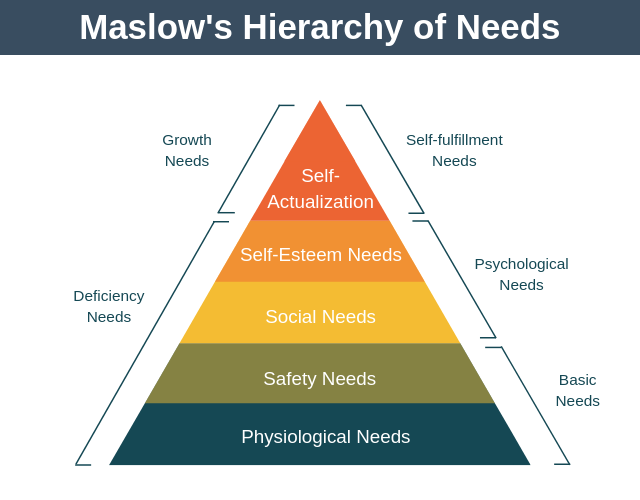
The pyramid starts with our most basic physiological needs like food, water, and shelter. Once those are met, we seek safety, which includes personal security, employment, and health. The next level is love and belonging, the need for friendships, intimacy, and family.
After that comes esteem, which involves self-respect, confidence, and the desire to be valued by others. Only when these foundational needs are reasonably satisfied can we turn our attention to the peak of the pyramid: self-actualization.
self-actualization
noun
The realization or fulfillment of one's talents and potentialities, considered as a drive or need present in everyone.
Self-actualization isn't about achieving perfection. It's about becoming the most complete version of yourself, fulfilling your unique potential, and experiencing moments of profound happiness and harmony. It's a continuous process of growth, not a final destination.
The Fully Functioning Person
While Maslow focused on needs, his contemporary Carl Rogers explored the conditions that allow for personal growth. He described the ideal state as being a "fully functioning person." This is someone who is in touch with their deepest feelings and desires, understands their emotions, and trusts their own instincts.
Rogers believed three core conditions were necessary to achieve this state. The first is self-concept, or how you see yourself. The second is congruence, which is the alignment between your self-concept and your actual experiences. When your view of yourself is realistic and flexible, you experience congruence. When there's a mismatch, you feel incongruent, leading to anxiety.
The final, crucial ingredient is unconditional positive regard.
Unconditional positive regard is the experience of being accepted, valued, and loved for who you are, without any strings attached. It's the feeling that even if you make mistakes, you are still fundamentally worthy.
Rogers argued that receiving this kind of acceptance from others, especially in childhood, helps us develop a healthy self-concept. It allows us the freedom to be our true selves, explore our potential, and move toward becoming a fully functioning person. This principle became a cornerstone of his therapeutic approach, emphasizing empathy and acceptance to help clients achieve personal growth.
| Thinker | Core Concept | Key Idea |
|---|---|---|
| Abraham Maslow | Hierarchy of Needs | We are motivated by a progression of needs, from basic survival to self-actualization. |
| Carl Rogers | Fully Functioning Person | Growth requires congruence between our self-concept and reality, fostered by unconditional positive regard. |
Let's review these key ideas before we test your knowledge.
Now, let's check your understanding of these foundational principles.
Humanistic psychology arose as a "third force" in psychology, offering a different perspective from which two dominant schools of thought?
According to Abraham Maslow's hierarchy of needs, what is the correct order of progression, starting from the most basic?
Understanding these humanistic principles offers a framework for personal development. By focusing on our innate potential and the conditions that help us thrive, we can move toward greater self-awareness and fulfillment.