CISSP Certification Fundamentals
Security and Risk Management
The Core of Information Security
At the heart of keeping information safe are three fundamental principles, often called the CIA triad. These aren't just technical terms; they're the goals behind every security measure, from a simple password to a complex corporate firewall. Think of them as the three legs of a stool. If any one of them is weak, the entire system can topple.
Confidentiality, integrity, and availability—the CIA triad—are the three pillars of information security.
Confidentiality is about privacy and secrecy. It ensures that data is accessible only to authorized users. Think of it like a sealed envelope. The contents are meant only for the recipient, and security measures—the envelope's seal—prevent others from peeking inside.
Integrity means keeping data accurate and trustworthy. It ensures that information has not been altered or tampered with by unauthorized people. If you send a message that says "Pay $100," integrity guarantees it doesn't arrive reading "Pay $1,000."
Availability ensures that authorized users can access the information when they need it. Data is useless if you can't get to it. Imagine a bank's website being down on payday. The information is confidential and its integrity is intact, but because it's not available, it's failing a key security goal.
Steering the Ship
Knowing the goals of security is one thing; achieving them is another. This is where security governance comes in. Governance is the framework of policies, rules, and processes that an organization uses to manage its security efforts. It’s the high-level strategy that ensures security decisions align with business objectives and that someone is accountable.
A central part of governance is risk management. You can't protect against every single threat, so you have to make smart choices about what to prioritize. Risk management is the process of identifying, assessing, and responding to potential threats.
Risk
noun
The potential for loss or damage when a threat exploits a vulnerability.
The process generally follows a few key steps: identify what could go wrong, analyze how likely it is to happen and what the impact would be, and then decide how to handle it.
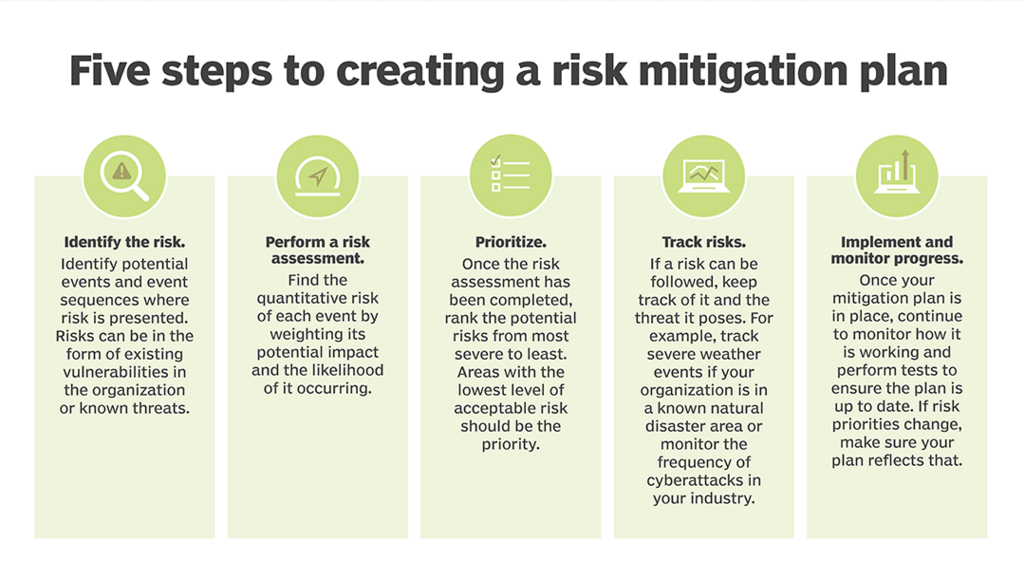
When a risk is identified, there are four main ways to treat it:
- Mitigate: Reduce the risk by implementing a control. If you're worried about theft, you might install a security camera.
- Transfer: Shift the risk to another party. Buying insurance is a classic example of transferring financial risk.
- Avoid: Eliminate the risk by not engaging in an activity. If an online service is too risky to use, you might forbid employees from accessing it.
- Accept: Acknowledge the risk and do nothing. This is usually for risks where the cost of mitigation outweighs the potential loss.
The Rules of the Road
To implement governance and manage risk effectively, organizations create documentation that outlines their security expectations. This documentation forms a hierarchy, moving from broad principles to specific instructions.
| Type | Purpose | Example |
|---|---|---|
| Policy | High-level statement of intent from management. | "All sensitive employee data must be protected from unauthorized access." |
| Standard | A mandatory rule that supports a policy. | "All company laptops must be encrypted using AES-256." |
| Procedure | A step-by-step guide for carrying out a task. | A document titled "How to Encrypt Your Laptop Hard Drive." |
| Guideline | A recommended, non-mandatory best practice. | "Create passwords that are at least 12 characters long." |
These internal rules don't exist in a vacuum. They're often shaped by external forces like laws and regulations. Governments and industry bodies impose rules to protect consumers and ensure fair practices. Examples include the General Data Protection Regulation (GDPR) in Europe, which governs data privacy, and the Health Insurance Portability and Accountability Act (HIPAA) in the U.S., which protects patient health information.
Beyond laws, security professionals are also guided by a code of professional ethics. This involves acting honorably, honestly, and legally to protect society and the infrastructure we all rely on.
Preparing for the Worst
Sometimes, despite the best planning, things go wrong. A natural disaster could flood a data center, or a cyberattack could take systems offline. This is where business continuity and disaster recovery planning become critical.
Business Continuity Planning (BCP) is a proactive process focused on keeping essential business functions running during and after a disaster. It asks, "How do we continue to operate in a crisis?" This could involve shifting work to an alternate site or having employees work from home.
Disaster Recovery Planning (DRP) is a subset of BCP. It's more reactive and focuses on the technical side of things, specifically how to restore IT systems and data after a disruption. A DRP would include steps for restoring data from backups and bringing servers back online.
Together, these plans ensure an organization can withstand a major disruption and get back to normal as quickly as possible, protecting both its assets and its reputation.
Let's review the key concepts we've covered.
A bank's website being down during a major holiday, preventing customers from accessing their accounts, is a failure of which security principle?
An organization decides to purchase cybersecurity insurance to cover potential financial losses from a data breach. Which risk treatment strategy are they using?