Circulatory System for Medical Representatives
Hemodynamic Principles
The Physics of Blood Flow
To understand how cardiovascular drugs work, it helps to think like an engineer. The circulatory system isn't just a network of biological tubes; it's a hydraulic circuit. Blood moves for the same reason water flows in a pipe or electricity moves through a wire: it follows a pressure gradient.
In relating Ohm's Law to fluid flow, the voltage difference is the pressure difference (ΔP; sometimes called driving pressure, perfusion pressure, or pressure gradient), the resistance is the resistance to flow (R) offered by the blood vessel and its interactions with the flowing blood, and the current is the blood flow (F).
This relationship gives us a fundamental equation for hemodynamics. Here, flow (Q) is directly proportional to the change in pressure (ΔP) and inversely proportional to resistance (R).
In the systemic circulation, the pressure gradient is the difference between the pressure in the aorta and the pressure in the right atrium. Resistance is the sum of all forces impeding that flow. This simple equation is the key to understanding how the body, and the drugs we use, can manipulate blood pressure and organ perfusion.
The Engine's Power
The heart's job is to generate flow. The total amount of blood the left ventricle pumps into the aorta each minute is called Cardiac Output (CO). It’s the primary measure of the heart's work. Think of it as the total volume of fluid moving through the system over time.
Cardiac Output is the product of two key variables: how much blood is ejected with each beat (Stroke Volume, or SV) and how many times the heart beats per minute (Heart Rate, or HR).
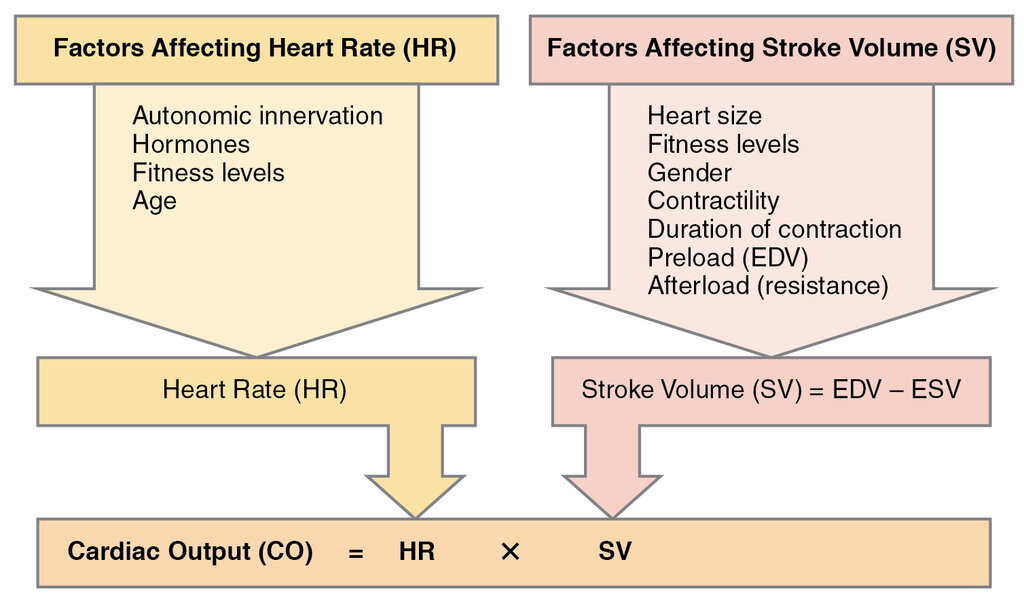
Stroke volume itself is determined by three things: preload (the stretch on the ventricle before it contracts), contractility (the intrinsic strength of the heart muscle), and (the pressure the ventricle must overcome to eject blood). Heart rate is mainly regulated by the autonomic nervous system and hormones like epinephrine. A change in any of these factors will alter the heart's output.
Resistance and Regulation
If Cardiac Output is the flow, Systemic Vascular Resistance (SVR) is the primary force opposing it. SVR represents the cumulative resistance of all the blood vessels in the systemic circulation. While every vessel contributes, the main site of regulation is the arterioles—the small, muscular arteries that lead into capillary beds.
The tone of the smooth muscle in the walls of arterioles determines their diameter. Small changes in diameter cause large changes in resistance.
This is governed by Poiseuille's Law, where resistance is inversely proportional to the radius to the fourth power (). This means that halving the radius of an arteriole increases its resistance 16-fold. Vasoconstriction (narrowing) increases SVR, while vasodilation (widening) decreases it. This powerful mechanism allows the body to precisely control blood flow to different organs.
Changes in resistance are the primary means by which blood flow is regulated within organs because control mechanisms in the body maintain arterial and venous blood pressures within a narrow range.
Now we can tie these concepts together. The average pressure in the arteries over one cardiac cycle is the Mean Arterial Pressure (MAP). It's a crucial indicator of organ perfusion. If MAP is too low, organs don't get enough blood. MAP is determined by the balance between the blood being pumped in (CO) and the resistance it meets (SVR).
Vascular Compliance
There's one more piece to the puzzle: vascular compliance. This is the ability of a blood vessel to stretch and expand in response to pressure. Think of it as the elasticity of the pipes. Healthy arteries, especially the aorta, are highly compliant. When the left ventricle ejects blood during systole, these arteries expand to accommodate the stroke volume, which stores energy and smooths out the pressure pulse.
With aging and diseases like atherosclerosis, arteries lose their elasticity and become stiff. This is a reduction in . A stiff artery doesn't expand as easily, causing two problems. First, systolic pressure spikes much higher for the same stroke volume, which increases the afterload on the heart. Second, the pressure drops more rapidly during diastole because the 'rebound' effect is lost. This results in a widened pulse pressure (systolic minus diastolic pressure) and is a hallmark of arterial stiffness.
Understanding these hemodynamic relationships is fundamental. When discussing a vasodilator, you're talking about a drug that reduces SVR. When talking about a beta-blocker, you're referencing a drug that reduces HR and contractility, thus lowering CO. Each intervention targets a specific variable in the equations that govern our circulation.
Which equation best represents the fundamental relationship between blood flow (Q), pressure gradient (ΔP), and resistance (R) in the circulatory system?
The total amount of blood the left ventricle pumps into the aorta each minute is known as __________.