Circuit Dynamics and Practical Electricity
Complex Resistance Analysis
Beyond Simple Chains
You've seen how resistors behave when strung together in a simple series line or stacked in parallel rows. Most real circuits, however, are a mix of both. These combination circuits might look complicated, but the strategy for analyzing them is straightforward: simplify them piece by piece.
The goal is to find the circuit's equivalent resistance (), which is the single resistance value that could replace the entire complex network without changing the total current or voltage. To do this, we work from the inside out, collapsing sets of resistors into single equivalents.
Identify any groups of resistors that are purely in series or purely in parallel. Calculate their equivalent resistance, and then redraw the circuit with that single equivalent resistor in its place. Repeat until only one resistor remains.
For the parallel section, you use the reciprocal formula: . For the final series calculation, it's a simple sum: . By repeatedly applying these two basic rules, any series-parallel network can be tamed.
Reading the Rainbow
In a diagram, resistors are labeled with their values. On a real circuit board, they tell you their resistance using a series of colored bands. Learning this code is a fundamental skill for anyone working with electronics.
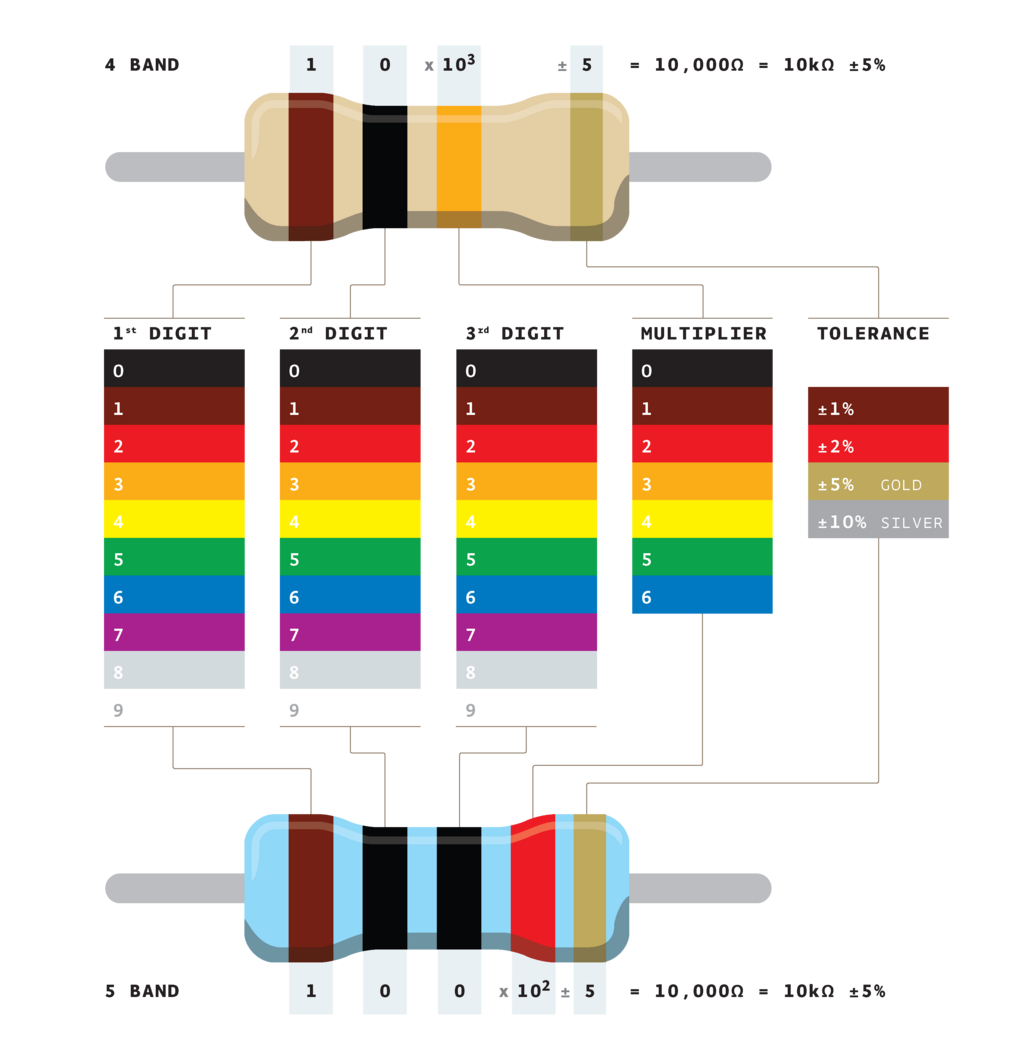
For a typical 4-band resistor, the first two bands represent the first two significant digits of the resistance value. The third band is the multiplier (the power of 10), and the fourth band indicates the tolerance. Tolerance tells you how much the actual resistance might vary from its stated value. A gold band means ±5%, while silver means ±10%. No component is perfect, and this manufacturing variance can be important in sensitive circuits.
| Color | Digit | Multiplier | Tolerance |
|---|---|---|---|
| Black | 0 | 10^0 | - |
| Brown | 1 | 10^1 | ±1% |
| Red | 2 | 10^2 | ±2% |
| Orange | 3 | 10^3 | - |
| Yellow | 4 | 10^4 | - |
| Green | 5 | 10^5 | ±0.5% |
| Blue | 6 | 10^6 | ±0.25% |
| Violet | 7 | 10^7 | ±0.1% |
| Gray | 8 | 10^8 | ±0.05% |
| White | 9 | 10^9 | - |
| Gold | - | 10^-1 | ±5% |
| Silver | - | 10^-2 | ±10% |
Besides resistance and tolerance, every resistor has a power rating, measured in watts (W). This rating specifies the maximum amount of power the resistor can safely dissipate as heat before it gets damaged. A resistor with a higher power rating is physically larger. If you replace a bulky 1W resistor with a tiny 1/4W resistor, even with the same resistance, it will likely overheat and burn out. This is a crucial trade-off: higher power handling requires more physical space.
When Reduction Fails
Sometimes you'll encounter a circuit that can't be simplified using the series-parallel reduction method. The classic example is a bridge circuit, where resistors are interlinked in a way that none are strictly in series or parallel with each other.
To solve these, we need a more advanced tool: the Delta-Wye (or Δ-Y) transformation. This technique allows us to convert a three-terminal "delta" (Δ) configuration of resistors into an equivalent "wye" (Y) configuration, or vice versa. This change can break the deadlock, turning an unsolvable network into one that can be simplified with standard series-parallel methods.
The delta configuration looks like a triangle (or the Greek letter Δ). The wye configuration looks like the letter Y.
Here are the formulas for converting a delta network (with resistors ) into an equivalent wye network (with resistors ):
Once you've performed the transformation, the new wye resistors will be in series with other parts of the circuit, allowing you to resume the normal reduction process. It's a powerful trick for untangling the most stubborn resistor networks.
What is the primary goal when analyzing a combination series-parallel resistor circuit?
A circuit contains a 100Ω resistor () in series with a parallel combination of two 100Ω resistors ( and ). What is the total equivalent resistance of this circuit?
With these techniques, you can find the equivalent resistance of almost any resistor network you're likely to encounter.