Chronicles of the Cosmic Timeline
Cosmic Genesis
From Point to Cosmos
The standard model of cosmology traces the universe back to an incredibly hot, dense state. This wasn't an explosion in space, but rather an expansion of space itself from a single point. Every location in our current universe was once part of that initial state. The laws of physics as we know them break down at this absolute beginning, often called the —a point of infinite density and temperature.
But the simple Big Bang model had puzzles. For example, why is the universe so uniform on large scales? Distant regions that could never have been in contact seem to share the same temperature. To solve this, the theory of was developed. It proposes that in the first fraction of a second—from around $10^{-36}$ to $10^{-32}$ seconds—the universe underwent a period of exponential expansion, growing faster than the speed of light.
The First Elements
As the universe expanded, it cooled. For the first few minutes, it was a hot, dense soup of fundamental particles. When the temperature dropped to about a billion Kelvin, protons and neutrons could finally fuse together without being immediately blasted apart by high-energy photons. This process is called Big Bang Nucleosynthesis (BBN).
In this brief window, lasting only about 20 minutes, the first atomic nuclei were forged. The universe's composition was set to roughly 75% hydrogen nuclei (single protons) and 25% helium-4 nuclei by mass, along with trace amounts of deuterium, helium-3, and lithium. The precise ratios of these light elements predicted by BBN theory match observational data with remarkable accuracy, providing strong evidence for the Big Bang model.
| Element | Predicted Abundance (by mass) | Observed Abundance (by mass) |
|---|---|---|
| Hydrogen-1 | ~75% | ~75% |
| Helium-4 | ~25% | ~25% |
| Deuterium (H-2) | ~0.0025% | ~0.0026% |
| Lithium-7 | ~0.00000001% | ~0.000000003% |
The slight discrepancy in lithium-7 abundance is an ongoing area of research known as the "cosmological lithium problem."
An Opaque Universe Becomes Clear
For the next 380,000 years, the universe was still too hot for stable atoms to form. It was a plasma of nuclei and free electrons, and this plasma was opaque. Photons of light couldn't travel far before scattering off a free electron, like light in a thick fog. This was the radiation-dominated era, where the energy density of the universe was primarily in the form of photons.
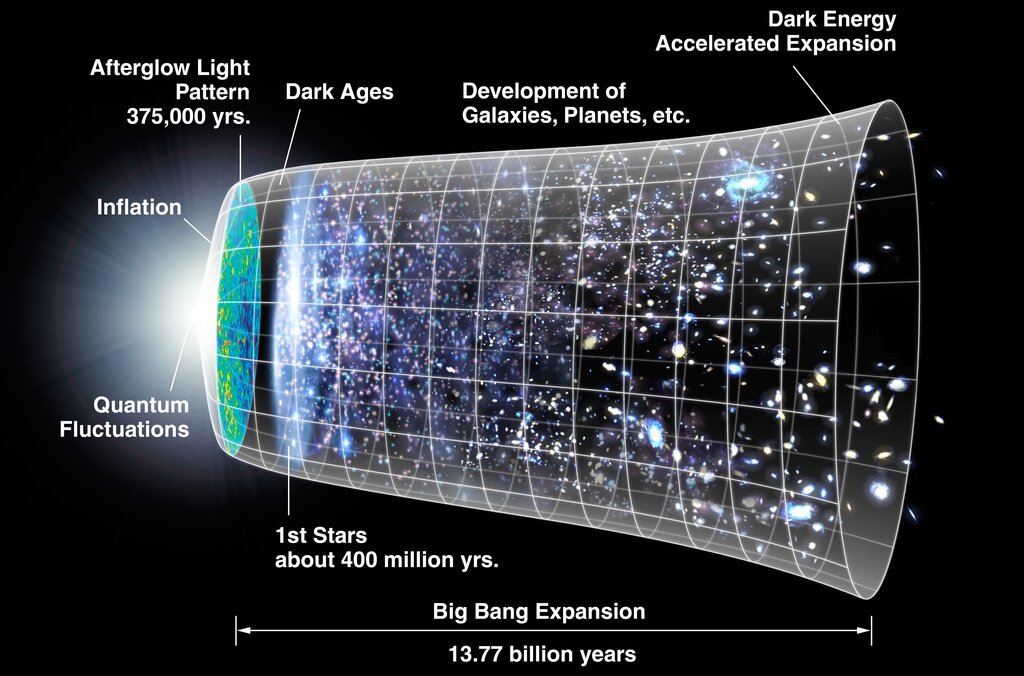
As expansion continued, the universe cooled enough for electrons to be captured by nuclei, forming the first neutral atoms. This event is known as Recombination (a bit of a misnomer, as it was the first time they combined). With the free electrons now bound into atoms, the universe suddenly became transparent. The photons that had been scattering around were now free to travel unimpeded through space.
This transition marked the shift from a radiation-dominated to a matter-dominated universe. Gravity, acting on matter, began to pull the slight density variations left over from cosmic inflation into larger and larger clumps. These were the seeds from which the first stars and galaxies would eventually grow.
The light released during Recombination is still detectable today. It has been stretched by the expansion of the universe into the microwave part of the spectrum.
We call this relic light the (CMB). It is a faint, uniform glow of radiation filling the entire sky, a direct snapshot of the universe when it was just 380,000 years old. Tiny temperature fluctuations in the CMB map directly to the initial density variations that seeded all cosmic structure. Studying it is like cosmic archaeology.
The initial conditions set by inflation and confirmed by the CMB laid the groundwork for everything that followed. Without that brief, explosive expansion, our universe would look very different—if it could exist at all.
Let's review the key phases of the universe's birth.
What best describes the Big Bang according to the standard model of cosmology?
The theory of cosmic inflation was introduced to solve which major puzzle of the simple Big Bang model?
From the initial singularity to the first light, these early moments defined the cosmos we inhabit today.