Cholinergic Pharmacology: Agonists and Antagonists
Muscarinic Receptor Subtypes
A Family of Receptors
The autonomic nervous system uses acetylcholine as a key messenger, but its effects vary dramatically depending on where it binds. This is because there isn't just one type of muscarinic receptor; there are five distinct subtypes, labeled M1 through M5. While they all respond to acetylcholine, they are wired differently on the inside, leading to very different outcomes in the cell.
Think of them as two separate teams. The M1, M3, and M5 receptors form one team, triggering an excitatory cascade inside the cell. The M2 and M4 receptors form the other team, which has an inhibitory effect. This fundamental split comes down to the type of G-protein each receptor is coupled with.
The Excitatory Trio: M1, M3, and M5
The M1, M3, and M5 receptors are coupled to a G-protein known as Gq (pronounced G-q). When acetylcholine binds to one of these receptors, the Gq protein activates an enzyme called phospholipase C (PLC).
PLC's job is to split a specific lipid in the cell membrane, PIP₂, into two smaller molecules: inositol trisphosphate (IP₃) and diacylglycerol (DAG). These are known as second messengers because they carry the signal onward from the receptor. IP₃ diffuses into the cytoplasm and opens channels on the endoplasmic reticulum, releasing a flood of stored calcium ions (Ca²⁺) into the cell. This surge in intracellular calcium is a powerful 'go' signal that activates various enzymes and cellular processes.
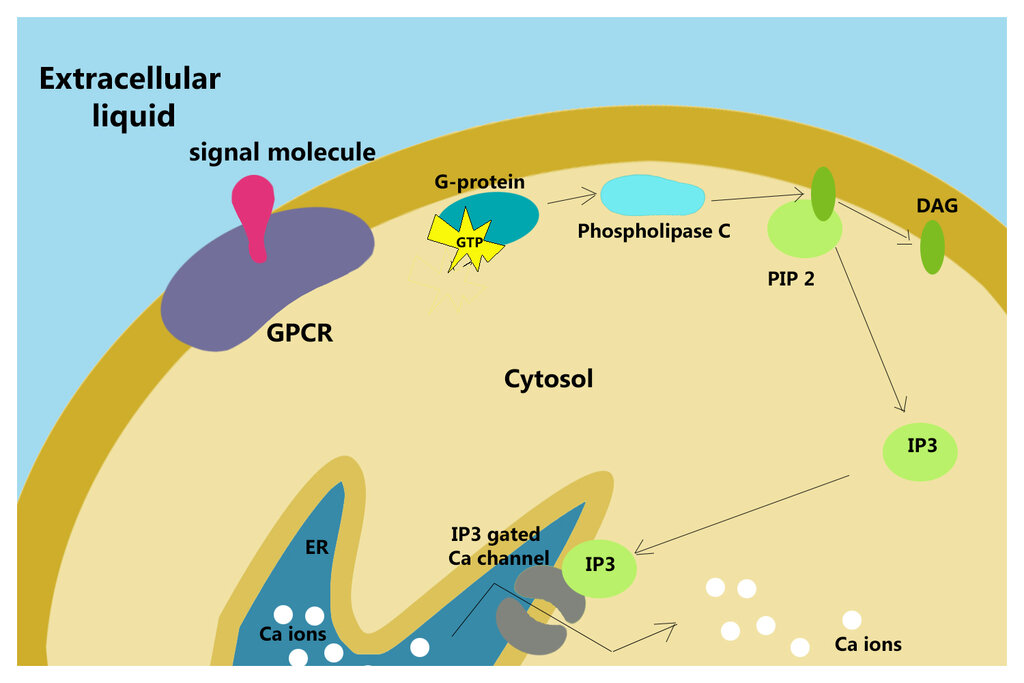
Let's look at where this happens:
- M1 Receptors: Found mainly in the central nervous system and on gastric parietal cells. Their activation in the stomach is a key step in promoting gastric acid secretion.
- M3 Receptors: These are widespread, located on smooth muscle throughout the body (like in the airways, bladder, and gut), as well as on glands. Activation here causes smooth muscle contraction—leading to bronchoconstriction and bladder emptying—and stimulates glandular secretions, like saliva.
- M5 Receptors: Primarily located in the brain, particularly in the substantia nigra, their function is less understood but is linked to dopamine release and vasodilation.
The Inhibitory Pair: M2 and M4
The M2 and M4 receptors work differently. They are coupled to Gi/o (G-inhibitory) proteins. When activated, these proteins do the opposite of the Gq pathway: they inhibit an enzyme called adenylyl cyclase.
Adenylyl cyclase is responsible for producing the second messenger cyclic AMP (cAMP). By inhibiting this enzyme, M2 and M4 receptors cause intracellular cAMP levels to fall. A drop in cAMP has an inhibitory effect on many cellular functions. Additionally, the Gi protein can directly open certain potassium channels, allowing potassium ions to flow out of the cell. This makes the cell membrane more negative (hyperpolarized) and less likely to fire an action potential.
Metabotropic receptors activate a G-protein that in turn activates a secondary messenger, that in turn will activate something else.
Here's where this inhibitory action matters:
- M2 Receptors: These are the primary muscarinic receptors in the heart. Their activation by acetylcholine from the vagus nerve is what slows heart rate. They decrease the rate of depolarization in the sinoatrial node, the heart's natural pacemaker.
- M4 Receptors: Found mostly in the central nervous system, they act as autoreceptors on cholinergic neurons, creating a negative feedback loop that reduces further acetylcholine release.
| Receptor | G-Protein | Second Messenger System | Primary Effect |
|---|---|---|---|
| M1 | Gq | ↑ IP₃, DAG, Ca²⁺ | CNS excitation, gastric acid secretion |
| M2 | Gi/o | ↓ cAMP, ↑ K⁺ efflux | ↓ Heart rate and contractility |
| M3 | Gq | ↑ IP₃, DAG, Ca²⁺ | Smooth muscle contraction, gland secretion |
| M4 | Gi/o | ↓ cAMP | ↓ Neurotransmitter release |
| M5 | Gq | ↑ IP₃, DAG, Ca²⁺ | Vasodilation, dopamine release |
Understanding this division is crucial for pharmacology. A non-selective muscarinic agonist will activate all five subtypes, leading to a messy combination of effects: a slow heart rate (M2), but also sweating, salivation, and blurred vision (M3). This is why developing drugs that selectively target just one subtype is a major goal, as it could provide a therapeutic benefit without the widespread side effects.
Time to check your understanding.
Which group of muscarinic receptors is coupled to the Gq protein and triggers an excitatory cellular response?
A patient is given a drug that selectively activates M3 receptors. Which of the following effects is most likely to occur?