Chinese High School Trigonometry Essentials
Angles and Their Measurement
What Is an Angle?
An angle measures the amount of turn between two lines, or rays, that meet at a common point. Think of the hands on a clock. As a hand moves from the 12 to the 3, it creates an angle. The point where the rays meet is called the vertex, and the rays themselves are the sides of the angle.
We measure angles to describe rotation. In geometry and many real-world applications, the most common unit of measurement for angles is the degree.
Measuring in Degrees
Imagine a full circle. If you divide that circle into 360 equal slices, each tiny slice represents one degree. A full rotation is therefore 360 degrees, written as . A half-turn, like a straight line, is . A quarter turn, which forms a right angle, is .
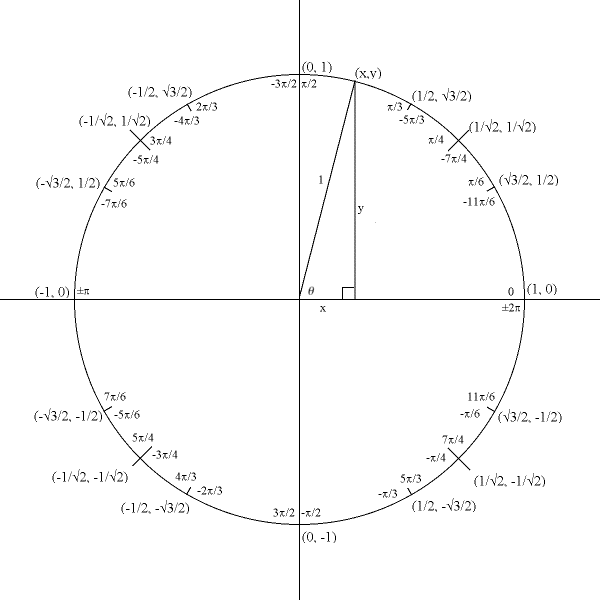
Degrees are useful in many fields, from construction and navigation to art and design. They give us a simple, intuitive way to talk about the steepness of a roof or the direction of a ship.
A full circle is . A straight angle is . A right angle is .
But in higher-level mathematics and physics, there's another way to measure angles that is often more convenient: radians.
Radian Measurement
Radians are a way to measure angles using the radius of a circle itself. Here's the idea: take the radius of a circle and lay it along the edge, or circumference. The angle created by this arc is exactly one radian.
Because the circumference of a circle is times its radius (), a full circle contains radians. This means a full rotation is equal to radians.
radians radians
This direct link between an angle and an arc length makes radians incredibly useful in calculus and physics, especially when dealing with circular motion or wave functions.
Converting Between Units
Since is equal to radians, we can create conversion factors to switch between the two units. This relationship is the key to all conversions.
To convert degrees to radians, multiply by . To convert radians to degrees, multiply by .
Let's convert a angle to radians.
Now let's convert an angle of radians back to degrees.
It's a good idea to memorize some common angle conversions.
| Degrees | Radians |
|---|---|
Becoming comfortable with both systems is essential, as different fields prefer one over the other. Engineers might use degrees for building plans, while physicists use radians to describe the motion of a particle.
Let's test your understanding of angles and their measurements.
What is the common point where the two rays of an angle meet called?
A full rotation, like a complete circle, is equal to how many degrees?
With this foundation, you're ready to explore how angles form the basis of all trigonometric functions.