Chinese for Drama Lovers
Mandarin Pronunciation
The Music of Mandarin
If you take away one thing about speaking Mandarin, let it be this: pitch matters. A lot. Unlike English, where the pitch of your voice adds emotion, in Mandarin, the pitch of a syllable changes its core meaning. This is what makes it a tonal language.
The same sound, like "ma," can mean "mother," "hemp," "horse," or "to scold," depending entirely on the musical tone you use to say it. Getting these tones right is the first and most important step to being understood.
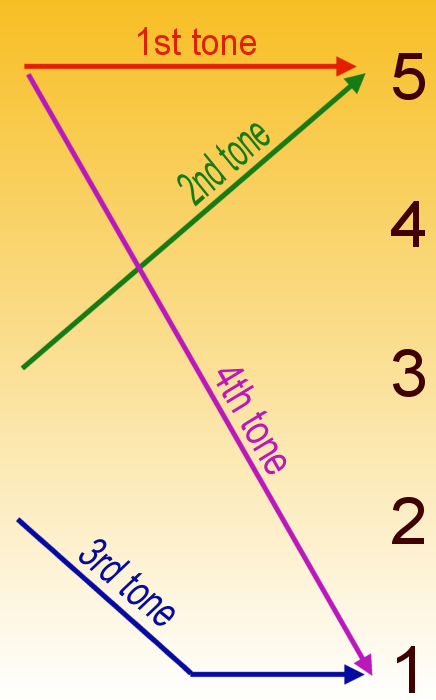
There are four main tones, plus a fifth neutral tone which is short and light. Let's walk through the main four.
-
First Tone (—): High and flat. Imagine a doctor asking you to say "Ahhh." Keep your voice steady and high, without any dips or rises. It's often written with a flat line, like this: mā.
-
Second Tone (ˊ): Rising. This one sounds like you're asking a question, as in, "Huh?" Your voice starts in the middle and rises in pitch. It's marked with a rising accent: má.
-
Third Tone (ˇ): Dipping and rising. This is usually the trickiest for learners. Your voice starts in the middle, dips down, and then rises back up. Think of a drawn-out, surprised "Oh...kay?" It looks like a little checkmark: mǎ.
-
Fourth Tone (ˋ): Falling. This is a sharp, quick drop in pitch. It's like a command, such as "Stop!" Your voice starts high and falls decisively. It's marked with a falling accent: mà.
| Tone | Mark | Pitch | Description |
|---|---|---|---|
| 1st | mā | High-Level | A sustained, high pitch. |
| 2nd | má | Rising | Starts mid-range and goes up. |
| 3rd | mǎ | Dipping | Dips down, then comes back up. |
| 4th | mà | Falling | Starts high and drops sharply. |
So how do we know how to pronounce a word we've never seen? That's where Pinyin comes in.
Pinyin
noun
The official system for writing Mandarin sounds using the Roman alphabet. It's a pronunciation guide, not a direct English translation.
Pinyin breaks every Mandarin syllable into two parts: an Initial and a Final. The Initial is the starting consonant sound, and the Final is the rest of the syllable, mostly vowels. The tone mark is placed over the main vowel in the Final.
For example, the word for "hello," 你好 (nǐ hǎo), is made of two syllables:
nǐ= Initialn+ Finali+ 3rd tonehǎo= Initialh+ Finalao+ 3rd tone
By learning the sounds of each Initial and Final, you can pronounce any word written in Pinyin.
Avoiding Common Pitfalls
As you start, your brain will try to apply English pronunciation rules to Pinyin letters. Resist this urge! Many letters sound quite different than they look to an English speaker.
For instance, the Pinyin q is not like the English 'q'. It's a sound closer to the "ch" in "cheese," but with the tongue pushed forward. Similarly, the Pinyin x is not like an English 'x', but more like the "sh" in "sheep," with a smile.
Another common mistake is with aspirated and unaspirated sounds. In English, we often release a puff of air (aspiration) with sounds like 'p', 't', and 'k'. In Mandarin, this puff of air distinguishes one sound from another.
bin Pinyin sounds like an English 'p' with no puff of air.pin Pinyin sounds like an English 'p' with a strong puff of air.
Hold your hand in front of your mouth. When you say the Pinyin p, you should feel a distinct puff of air. When you say the Pinyin b, you should feel almost nothing.
Your mouth will have to learn new shapes to make these sounds. Be patient and practice mimicking native speakers.
Ready to test your knowledge of these foundational concepts?
In Mandarin, what is the primary function of changing the pitch (or tone) of a syllable?
Which tone in Mandarin is described as being high and flat, like a sustained note?
Mastering tones and Pinyin is a journey, but it's the bedrock of speaking clear, confident Mandarin. Keep listening, keep mimicking, and you'll build a strong foundation.